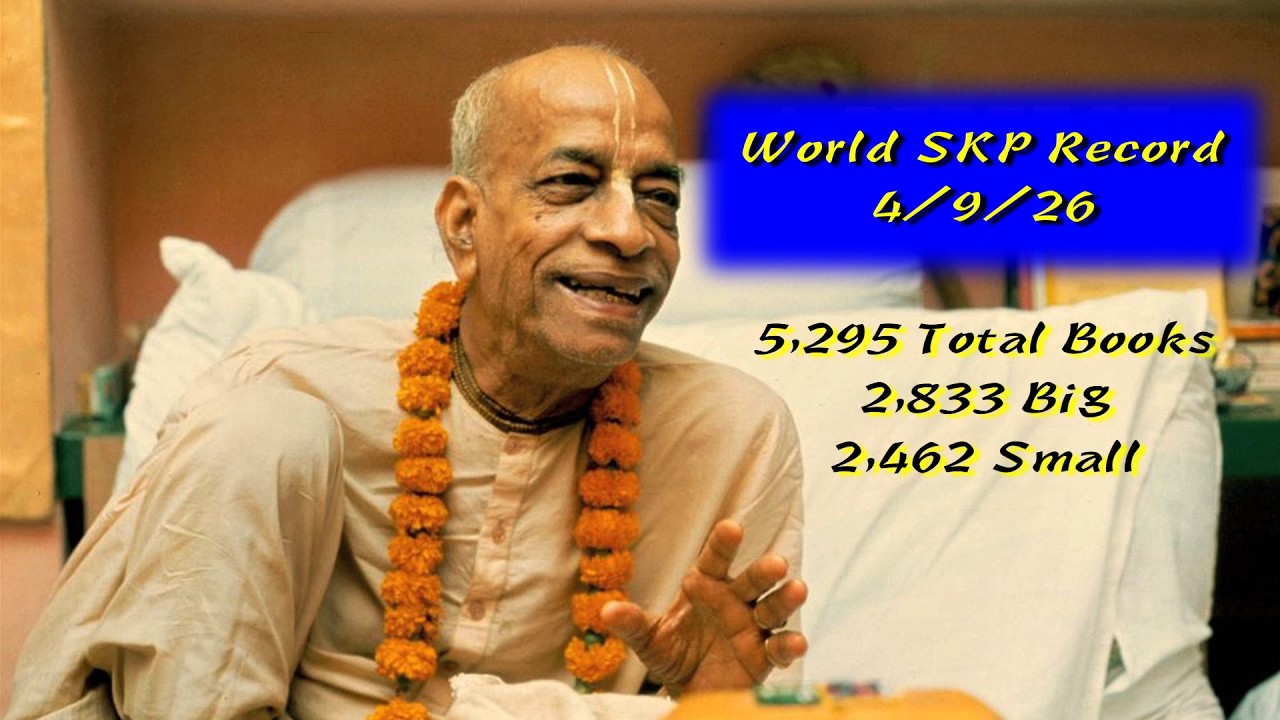
The 2026 World SKP Record attributed to Mahotsaha Das marks a landmark moment in contemporary ISKCON book distribution, with a verified total of 5,294 spiritual texts placed in a single day across diverse readerships. The distribution included 73 Maha books, 2,758 Big books, 207 Medium books, and 2,256 Small books, alongside specialty placements comprising 1 Bhakta Stack, 205 Trayodashi stacks, 2 Caitanya-Caritamrta Sets, and 61 Srimad Bhagavatam Sets (58 of the 44-volume edition and 3 of the 18-volume edition). This synthesis of volume, variety, and strategic curation reflects a mature Sankirtan methodology designed to meet seekers where they are, while upholding ethical outreach and unity across dharmic traditions.
Within ISKCON (International Society For Krishna Consciousness), measurable outreach is often tracked under the umbrella of Sankirtan, frequently abbreviated in community usage as SKP. While styles differ across regions, the underlying principle remains constant: share wisdom texts responsibly, respectfully, and inclusively. In that context, the 2026 performance stands out not merely for its numerical achievement but for its discipline in classification, inventory control, and community engagement rooted in the Bhakti Tradition.
The category mix is revealing. Big books comprised approximately 52 percent of the final tally (2,758 of 5,294), Small books accounted for about 43 percent (2,256), Medium books approximately 4 percent (207), and Maha books close to 1.4 percent (73). Such a distribution profile suggests a balanced strategy: accessibility for first-time readers through concise titles, paired with a strong emphasis on deeper-study volumes for committed practitioners and libraries.
The 61 Srimad Bhagavatam Setsunusually high for any single-day effortare especially noteworthy. The count explicitly records 58 sets of the 44-volume edition and 3 sets of the 18-volume edition, underscoring a focus on comprehensive scripture placement suitable for temples, reading circles, academic libraries, and household study. The 2 Caitanya-Caritamrta Sets complement this emphasis by offering historically and theologically rich narratives of Sri Caitanya, central to Gaudiya Vaishnava theology and practice.
The presence of curated bundles1 Bhakta Stack and 205 Trayodashi stacksindicates targeted reading pathways. Such stacks aggregate thematically linked titles, supporting graduated engagement from introductory to more advanced texts. In practice, these bundles streamline volunteer interactions, reduce decision fatigue for recipients, and enhance the likelihood of sustained reading, satsanga, and discussion.
Operationally, an effort of this scale necessitates rigorous preparation. Standard best practices include pre-sorting inventory by category, staging route plans for urban and campus clusters, and establishing clear handoff protocols between teams. Even distribution logisticssuch as localized replenishment points, time-boxed micro-campaigns, and weather-aware mobilitycan be decisive in converting intention into measurable outcomes while preserving volunteer well-being.
From a quantitative perspective, the cadence is instructive. If the outreach window spanned roughly twelve hours, the average would equate to about 441 books per hour, or a little over seven books per minute, acknowledging that real-world distribution occurs in pulses (with notable surges around community gatherings and quieter intervals during transit and inventory checks). This kind of throughput demands precisely defined roles, scripted yet empathetic conversations, and swift documentation.
Verification protocols are central to credibility in SKP reporting. Typical measures include pre- and post-event inventory reconciliation, dual-signoff tallies at collection points, and post-hoc variance analysis. The explicit line items reported heredown to set formats and curated stacksreflect an auditing mindset intended to reduce double counting and ensure transparency, aligning with the wider dharmic principle of satya (truthfulness) in service and record-keeping.
Team formation and training shape consistency. Volunteers generally benefit from focused briefings on respectful dialogue, informed consent, and the ethical contours of spiritual outreach. Many report that the most meaningful exchanges arise when listening precedes sharingparticularly where recipients articulate personal quests related to mindfulness, ethics, and community, themes that resonate across Hindu Dharma and the broader dharmic family that includes Buddhism, Jainism, and Sikhism.
Accounts from participants emphasize an atmosphere of humility and inclusion rather than pressure or persuasion. Conversations often center on universal dharmic valuesahimsa, seva, inner discipline, gratitude, and contemplative practicethat have natural affinities across traditions. Those receiving texts frequently share reflections on how scripture-based insights can inform family life, workplace ethics, and civic responsibility, thereby connecting timeless wisdom with contemporary concerns.
The text selection itself supports a layered spiritual pedagogy. Srimad Bhagavatam provides a sustained theological and philosophical journey; Caitanya-Caritamrta anchors historical and devotional context; and Big, Medium, and Small titles create multiple points of entry for readers at different stages. This multi-tiered approach aligns with an inclusive vision of spiritual education, where unity in spiritual diversity is strengthened by offering resources that honor differing temperaments and capacities for study.
Ethical outreach remains non-negotiable. The distribution model foregrounds voluntary acceptance, non-coercive gifting, and openness to dialogue. When recipients express interest in related dharmic streamssuch as Buddhist meditation, Jain ahimsa ethics, or Sikh seva practicesvolunteers commonly affirm these paths’ shared moral ground, thereby furthering the objective of harmony among dharmic traditions rather than asserting sectarian primacy.
Impact assessment, while often reduced to counts, benefits from qualitative follow-up. Reading circles, satsanga gatherings, and study cohorts can translate distribution into transformation. Over time, measures such as attendance at study groups, reader feedback on comprehension and practice, and the emergence of local facilitators provide a clearer picture of how book placements mature into living wisdom and community resilience.
Risk management is inherent to large-scale efforts. Fatigue, logistical bottlenecks, and inventory mismatches are perennial hazards. Mitigations include rotation schedules to prevent burnout, reserve stock staged near high-traffic areas, and contingency plans for weather or transport delays. A brief post-event retrospectivewhat went well, what can be refinedensures that learning compounds across future campaigns.
For communities wishing to replicate such outcomes, key principles emerge: define a balanced catalog that encourages progressive study; train volunteers in empathetic listening and ethical conversations; audit inventory with redundancy; map outreach to natural footfall patterns; and cultivate partnerships with temples, libraries, schools, and interfaith forums where dharmic values are welcomed. These steps not only increase distribution efficiency but also deepen the culture of mutual respect that sustains long-term learning.
The 2026 World SKP Record by Mahotsaha Das ultimately stands as a study in disciplined devotionrooted in the Bhakti Tradition, executed with operational clarity, and framed by a consciously inclusive ethos. Numbers tell one story; the wider narrative concerns how knowledge travels, takes root, and inspires households and communities to cultivate inner steadiness, compassion, and shared purpose across the dharmic spectrum.
Inspired by this post on Dandavats.