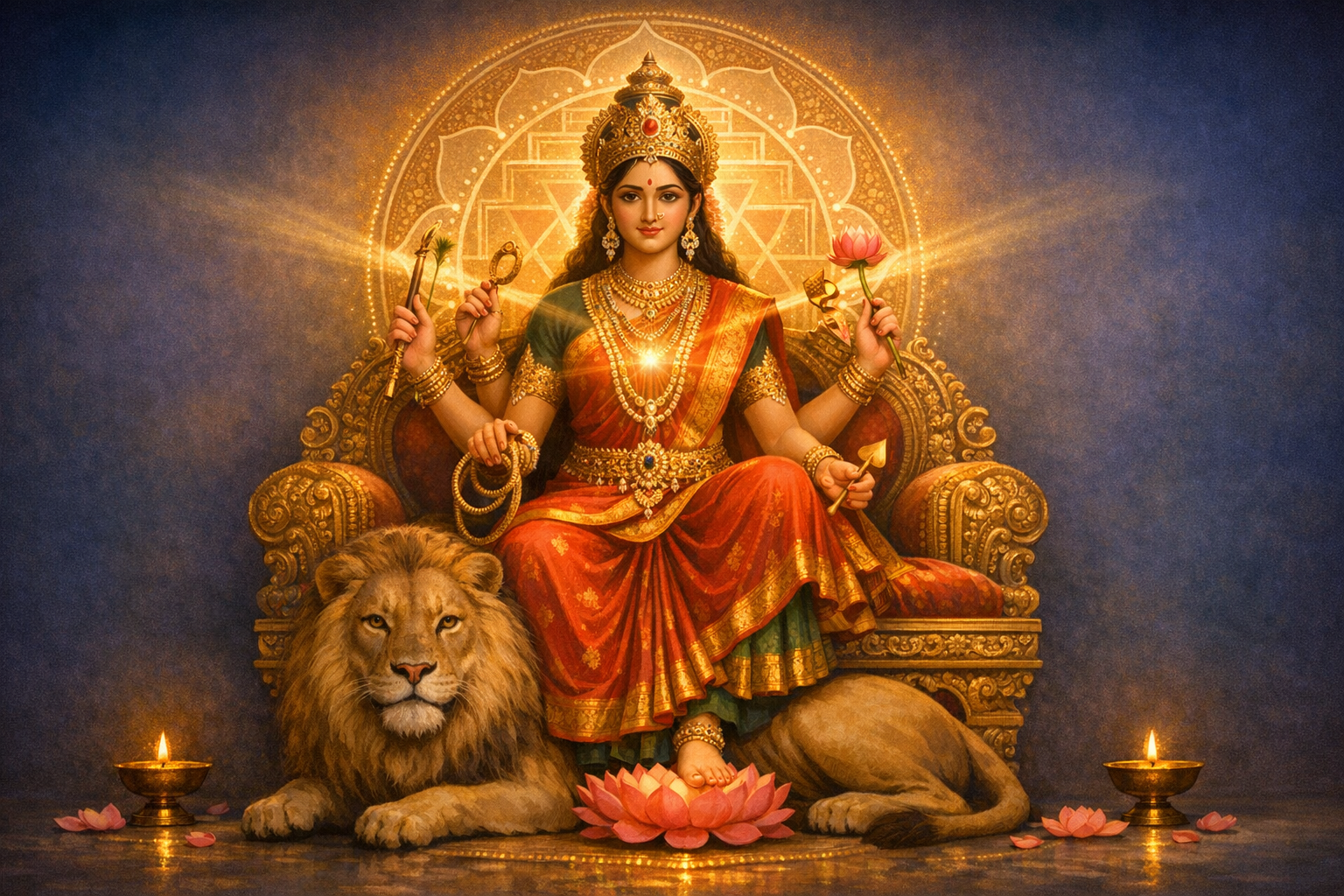
Indra Parameshwari designates the Goddess as the sovereign center of reality, a title that condenses layers of Vedic semantics, Shakta theology, and living ritual practice. The epithet does not identify the deity with the storm-god Indra of early Vedic hymns; rather, indra here functions as a classical Sanskrit honorific for supremacy and lordship, while Parameshwari (Parama + Ishwari) proclaims the Goddess as the Highest Sovereign among all powers. Read as a whole, Indra Parameshwari signals the Devi’s unbounded authority—cosmic, ethical, and soteriological—within Hinduism’s Shakta traditions.
Philologically, the term indra operates in Sanskrit as a marker of preeminence, a sense preserved in compounds such as narendra (lord of men) and gajendra (lord of elephants). In this register, indra is a superlative for mastery rather than a specific deity-name. Parameshwari, the feminine of Parameshwara, fuses Parama (supreme, ultimate) with Ishwari (Lady, Ruler), yielding the precise sense of the “Supreme Lady” who is sovereign over deities, elements, and sentient beings alike. The combined force of the compound conveys theological absoluteness: a Goddess who is at once the ground, measure, and goal of existence.
Shakta theology has long articulated this sovereignty. Early Vedic resonances appear in the celebrated Devi Sukta (Rig Veda 10.125), where the Goddess speaks as the immanent intelligence animating gods and cosmos. Upanishadic narrative further elevates the feminine principle in the Kena Upanishad, where Umā Haimavatī discloses to Indra the true nature of the victory over the asuras, demonstrating that ultimate knowledge belongs to the supreme, ineffable Reality—encountered there in a feminine theophany. Later Purāṇic sources, notably the Devi Mahatmya and the Devi Bhagavata Purana, systematize this vision: the Goddess is Mahadevi, the source and summit of all deities, the matrix from which creation, maintenance, and dissolution flow.
Within this theological horizon, the image of Indra Parameshwari as the lion-seated Queen of the cosmos crystallizes a sophisticated iconography. The lion (simha) in Hindu sacred art functions as an unambiguous emblem of royal authority, fearless protection, and dharmic power (kshatra). In Shakta traditions, the motif of the simhasana (lion-throne) or the simhavahini (lion-mounted) Goddess encodes the message that the Devi is enthroned over, and master of, the energies that drive the universe. Seated upon the lion, she tames the instinctual, channels the heroic, and adjudicates sovereignty with wisdom (jnana) and compassionate power (kriya).
Sri Vidya materials refine this regal symbolism with liturgical precision. Lalita Tripurasundari—exemplar of the Parameshwari ideal—is described as enthroned upon the Simhasana upheld by the Panchabrahmas, presiding over the Sri Chakra whose nine enclosures (avarana) map consciousness from multiplicity back to the bliss of nondual fullness (ananda). Here, the lion-throne signifies stable mastery of the tattvas (principles of manifestation), while the Goddess’s gentle yet sovereign gaze affirms that creation and liberation both flow from Shakti’s freedom (svatantrya-shakti).
Metaphysically, Indra Parameshwari names the unity of consciousness and power. Shakti is not an auxiliary force but the very capacity by which the Absolute knows (jnana-shakti), wills (iccha-shakti), and manifests (kriya-shakti). This triadic articulation, found across Tantra and echoed in Kashmir Shaivism’s expositions, grounds a coherent cosmology: the universe is a pulsation of the Supreme Lady’s freedom, while the path of return (upasana and jnana) is an alignment with her own luminance. Thus, “sovereignty” is not merely political or mythic; it is ontological.
Ritually, this sovereignty is celebrated through forms both public and intimate. In Navaratri and Durga Puja, the lion-seated Goddess appears as Mahishasuramardini, a transparent icon of protective power wedded to moral clarity. In domestic and temple upasana—whether Panchopachara or Shodashopachara puja—devotees install the Devi upon a seat (asana) consciously envisioned as the simhasana of the heart, offering mantras, flowers, and light so that the powers of speech, action, and discernment may be harmonized under her rule. In the Sri Vidya lineage, Navavarana puja moves concentrically through the Sri Chakra, a contemplative reenactment of ascent from periphery to the sovereign center.
Ethically, the lion-seated image instructs with rare economy. The lion stands for disciplined courage rather than brute force; the throne signifies rightful order rather than domination. Together, they articulate kshatra as an inner capacity—self-mastery, accountability, and steadiness in adversity. In this reading, Indra Parameshwari’s throne becomes a measure for conduct: power yoked to wisdom, protection aligned with compassion, decisiveness tempered by humility. Practitioners often attest that contemplation on the simhasana cultivates fearlessness of a distinctly moral kind.
Comparative dharmic perspectives illuminate how widely this lion-throne idiom resonates. In Buddhism, the Buddha’s lion-roar (siṃhanāda) symbolizes the fearless proclamation of truth, and the simhasana serves as a canonical seat of teaching. In Jainism, the lion is closely associated with Tirthankara Mahavira, and thrones signify the poised transcendence of the Jina. Sikh tradition honors the ideal of sovereign courage through the very name Singh (lion), connoting uprightness in defense of dharma. Across Hinduism, Buddhism, Jainism, and Sikhism, the lion becomes a shared emblem of fearlessness, truth-speaking, and ethical guardianship; the simhasana signifies rightful authority grounded in spiritual realization.
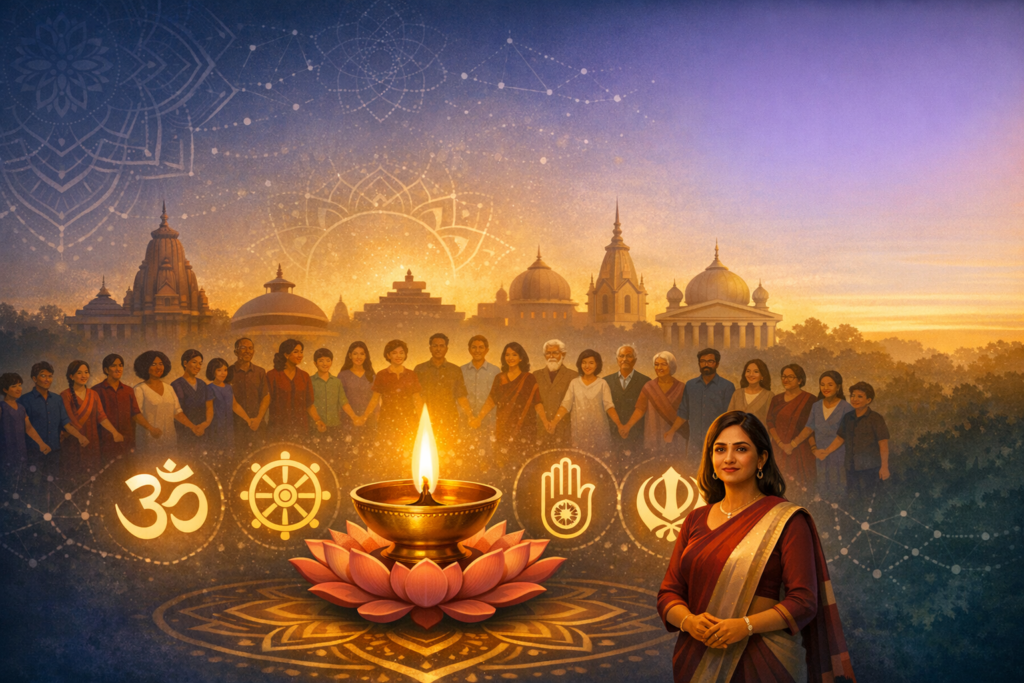
Such convergences underscore a core civilizational insight: unity in spiritual diversity. The idea of Ishta—cherished across Hindu thought and affirmed in many modern expositions—holds that different aspirants are drawn to different forms of the Divine according to temperament and path, without contradiction at the level of the Absolute. In this context, Indra Parameshwari can be honored as an Ishta within Shakta practice while standing in genuine solidarity with the ideals and icons of the broader dharmic family. Shared symbols such as the lion and throne serve as bridges, not barriers.
Historically and artistically, the lion-throne motif traveled with Indian art and statecraft. From classical sculpture in the subcontinent to Southeast Asian temples, the simhasana appears beneath deities and kings alike, encoding a visual grammar of sovereignty, justice, and cosmic order (rita). Within Hindu temple architecture and ritual seating (asana-vidhi), this grammar is renewed whenever a murti is consecrated, a guru is installed for teaching, or a devotee prepares the inward seat of contemplation.
Distinguishing Indra Parameshwari from cognate names clarifies meaning. Indrani (Shachi) is venerated as the consort of the Vedic Indra and praised in texts such as the Rig Veda and later Puranas. Indra Parameshwari, by contrast, employs indra as a semantic intensifier of supremacy rather than a personal name, and Parameshwari as the signature of ultimate divinity. The title thus belongs to the Mahadevi theology in which the Goddess is not a subordinate but the very ground of all deities—including the Vedic Indra—who act through her power.
Scripturally anchored contemplation reinforces practice. The Devi Mahatmya offers archetypal episodes of protection and clarity; the Lalita Sahasranama meditates on the Supreme Lady through a thousand names that weave metaphysics with devotion; the Upanishads point toward a nondual realization in which worship culminates in knowledge. These sources, read together, yield a coherent picture: Indra Parameshwari is both the adorable Mother (Devi) and the unsurpassed Reality (Parama Tattva).
In lived experience, devotees frequently report that the lion-seated icon speaks to times of uncertainty with a language of steadiness. The throne evokes unshakable presence; the lion, right action; the Goddess, a wisdom that neither evades complexity nor capitulates to fear. Many communities find that aligning domestic rhythms—daily puja, vrat, and festival cycles—with this symbolism fosters resilience and compassion in family and civic life.
From a philosophical angle, the title engages classical questions about power and truth. Sovereignty, in this frame, is intelligible only when oriented by reality-as-consciousness; otherwise it decays into mere force. By naming the Goddess Parameshwari, the tradition asserts that the structure of the world—ethical, aesthetic, and ontological—converges in a single source. The devotional corollary is straightforward: to enthrone the Supreme Lady in the heart is to bring speech, will, and action under the governance of truth.
Ritual specialists underscore how this enthronement becomes a daily discipline. Preparatory nyasa places sacred syllables upon the body; asana and dhyana stabilize attention; mantra recitation entrains breath and mind to the Devi’s rhythm. Even brief but consistent practice, undertaken with shraddha (trust) and viveka (discernment), can reshape the emotional baseline from anxiety to courageous serenity—a transformation that devotees often summarize as moving from restlessness to the lion’s calm.
Theologically, the title further safeguards balance. As the Sovereign Mother, Indra Parameshwari integrates protection and nourishment, firmness and tenderness. The lion is not merely a war-emblem; it is also a guardian of thresholds, an image of alert compassion. The throne is not merely a badge of power; it is a seat of judgment, learning, and truth-speaking. Together, they articulate the Devi’s role in aligning cosmic order with personal liberation.
In interfaith and intercultural settings, this iconography opens a constructive conversation. One need not conflate distinct traditions to recognize convergent ethical horizons: courage that serves compassion, authority that serves justice, and devotion that serves truth. Positioned in this way, the figure of Indra Parameshwari becomes not only a focal point for Shakta practice but also a bridge for mutual understanding within the wider dharmic world.
In sum, Indra Parameshwari names the Goddess as the supreme, lion-seated sovereign whose rule extends from metaphysical foundations to practical ethics. The title’s philology clarifies meaning; the scriptures offer doctrinal depth; the iconography instructs at a glance; and the rituals translate insight into habit. Across Hinduism, and in resonance with Buddhist, Jain, and Sikh ideals, the lion-throne continues to signify fearless truth and compassionate authority. To contemplate this form is to remember that ultimate sovereignty belongs to wisdom—and that such wisdom can, and must, be enthroned within the heart.
Inspired by this post on Hindu Blog.