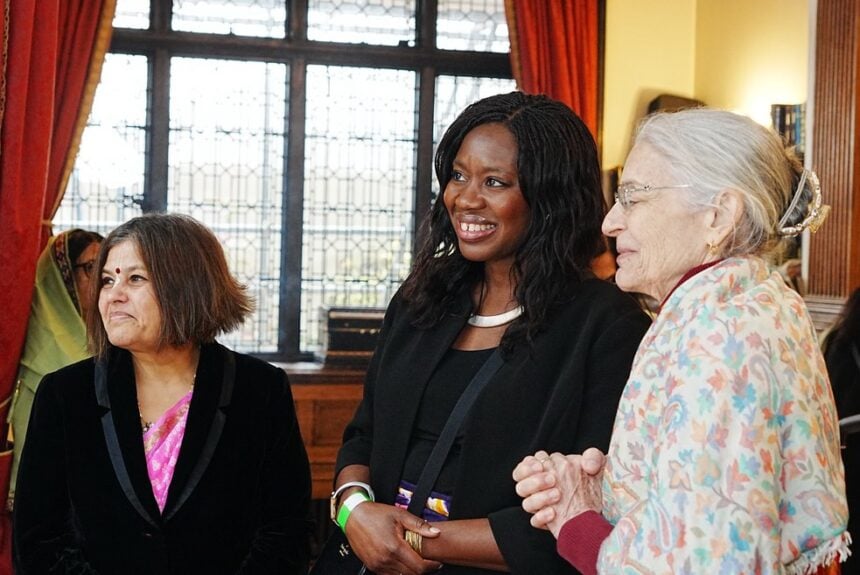
Bhaktivedanta Manor’s public Rama Navami festival offered a compelling demonstration of how devotion and diversity can reinforce one another in contemporary Britain. Welcomed by the Communications team, an array of civic and community dignitaries attended, including three local Mayors and Miatta Fahnbulleh MP, Parliamentary Under-Secretary of State with the brief for Devolution and Faith. Their presence signalled strong institutional recognition of the temple’s contribution to social cohesion, cultural heritage, and interfaith dialogue, while the festival itself foregrounded bhakti as a unifying force that nurtures shared values across communities.
Rama Navami, observed on the ninth tithi of Chaitra Shukla Paksha, commemorates the appearance of Maryada Purushottama, Sri Rama, and is celebrated across India and the global Hindu diaspora as a festival of ethical clarity and compassionate leadership. The dharmic resonance of Rama’s liferooted in satya (truth), daya (compassion), and dharma (righteous duty)extends dialogically into the wider family of Indian traditions. Sikh teachings revere the divine name Ram as a revered epithet for the Supreme; Jain retellings engage with Ramayana motifs to illustrate ahiṃsa and exemplary conduct; Buddhist cultures across Southeast Asia carry living Ramayana performance and literary traditions. This pluriversal presence of Rama narratives underscores a shared ethical grammar that enables unity in diversity without erasing distinct paths.
As an ISKCON Krishna temple, Bhaktivedanta Manor hosts Rama Navami through the lens of the Bhakti Tradition. The devotional current is characteristically expressed through kirtan, readings from Ramayana traditions (including Valmiki Ramayana and Sri Ramacharitmanas), and ceremonial abhishekam for deities of Sri Rama, Sita, Lakshmana, and Hanuman. These practices invite not only theological reflection but also embodied participationsacred music, congregational chanting, and prasadam distribution that transforms the festival into a living pedagogy of seva, gratitude, and fraternity.
The attendance of civic leaders and representatives from a wide spectrum of communities provided more than ceremonial gravitas; it illustrated a public ethic of mutual respect. Such engagement affirms that large diaspora temples can be vital partners in community development, youth engagement, and emergency response initiatives, from food donation drives to mental well-being signposting. By sharing festival greetings and witnessing ritual practices first-hand, leaders model the civic principles that underpin pluralist democracies, thereby normalising the visible presence of dharmic traditions in public life.
From an interfaith perspective, the festival functioned as an inclusive commons. The Communications team’s curationwelcoming dignitaries, orienting visitors, and facilitating respectful participationenabled accessible, meaningful encounters with sacred space. Attendees consistently described a palpable sense of shared humanity as devotional music filled the temple room and families queued patiently for darshan. Social researchers note that such multi-stakeholder gatherings are particularly effective at strengthening bridging social capital: they reduce unfamiliarity, increase empathy, and build interpersonal trust across religious and cultural lines.
The theological core of Rama Navami at the Manor emphasized values with broad civic utility. Rama’s life is often studied as a template for governance anchored in duty and compassiona perspective that resonates with contemporary discourses on ethical leadership, restorative justice, and community stewardship. In this spirit, dignitaries and visitors alike engaged with narratives that translate naturally into public ethics: integrity in leadership, responsibility to family and society, and the disciplined pursuit of the common good.
Programmatically, the festival exemplified best-practice principles increasingly standard at large temple gatherings: clear wayfinding, volunteer stewards trained for hospitality, multilingual communication where appropriate, and thoughtful scheduling that balances ritual precision with public accessibility. Family-friendly zones, considerate queue management for darshan, and well-organised prasadam service supported a welcoming environment for both regular worshippers and first-time guests. These measures do more than enhance visitor experience; they operationalise the dharmic ethic of care.
Participants frequently reported emotionally resonant momentshearing the conch, glimpsing the deities at abhishekam, or joining a familiar bhajan choruswhile children watched, learned, and asked questions about Lord Rama’s ideals. Many guests observed that hearing civic greetings alongside Vedic kirtan reframed the festival as a shared social asset, not only a community-specific celebration. In this way, devotion became a medium through which public belonging was expanded, not narrowed.
Within the wider family of dharmic traditions, the festival’s ethos harmonised with long-standing principles: ahimsa as a civilisational value in Buddhism and Jainism; seva as a cornerstone of Sikh practice; and dana, vrata, and kirtan as expressions of Hindu spirituality. This alignment reflects the philosophical insight articulated by Swami Vivekananda regarding Ishtathe recognition that different seekers approach the Divine through distinct, equally valid forms. By honouring diverse spiritual vocabularies while celebrating a common ethical horizon, the Manor’s Rama Navami embodied Vasudhaiva Kutumbakam, the world-as-one-family ideal.
For community practitioners and cultural organisations, several transferable lessons emerge. First, strategic interfaith invitations and clear orientation protocols help non-Hindu guests participate respectfully. Second, interpretive materialsconcise guides to ritual meaning, ethical themes, and festival historyempower visitors to connect the dots between devotion and civic life. Third, structured feedback from dignitaries and attendees supports continuous improvement, enabling teams to refine accessibility, translation support, and sustainability practices.
In particular, sustainability and accessibility deserve continued emphasis at large religious events. Waste reduction, responsible sourcing for prasadam, and partnerships with local charities for surplus food redistribution align devotional practice with environmental stewardship. Similarly, step-free access, seating for elders, and quiet spaces for neurodiverse visitors express a dharmic ethic of inclusion. These improvements not only elevate visitor experience but also offer a replicable model for community events across Britain and beyond.
From a measurement standpoint, festivals of this scale benefit from lightweight evaluation frameworks that track engagement and community impact over time. Indicative metrics may include estimated footfall, volunteer hours, interfaith representation, school or youth group participation, and qualitative feedback capturing visitor learning and sentiment. When complemented by post-event dialogue with civic partners, such data can inform policy discussions on culture, integration, and local development.
Ultimately, Rama Navami at Bhaktivedanta Manor fused bhakti with broad-based community engagement. The presence of three local Mayors, Miatta Fahnbulleh MP, and representatives from multiple communities reflected a shared commitment to unity in diversity. The festival’s devotional heartcentered on Lord Rama, the Bhakti Tradition, and living Hindu practicewas woven seamlessly with interfaith dialogue, cultural literacy, and civic friendship. In an era that demands both principled conviction and wide-armed inclusion, this celebration offered a luminous template: devotion deepens humanity, and humanity, when honoured in all its variety, guides devotion toward the common good.
Inspired by this post on Dandavats.