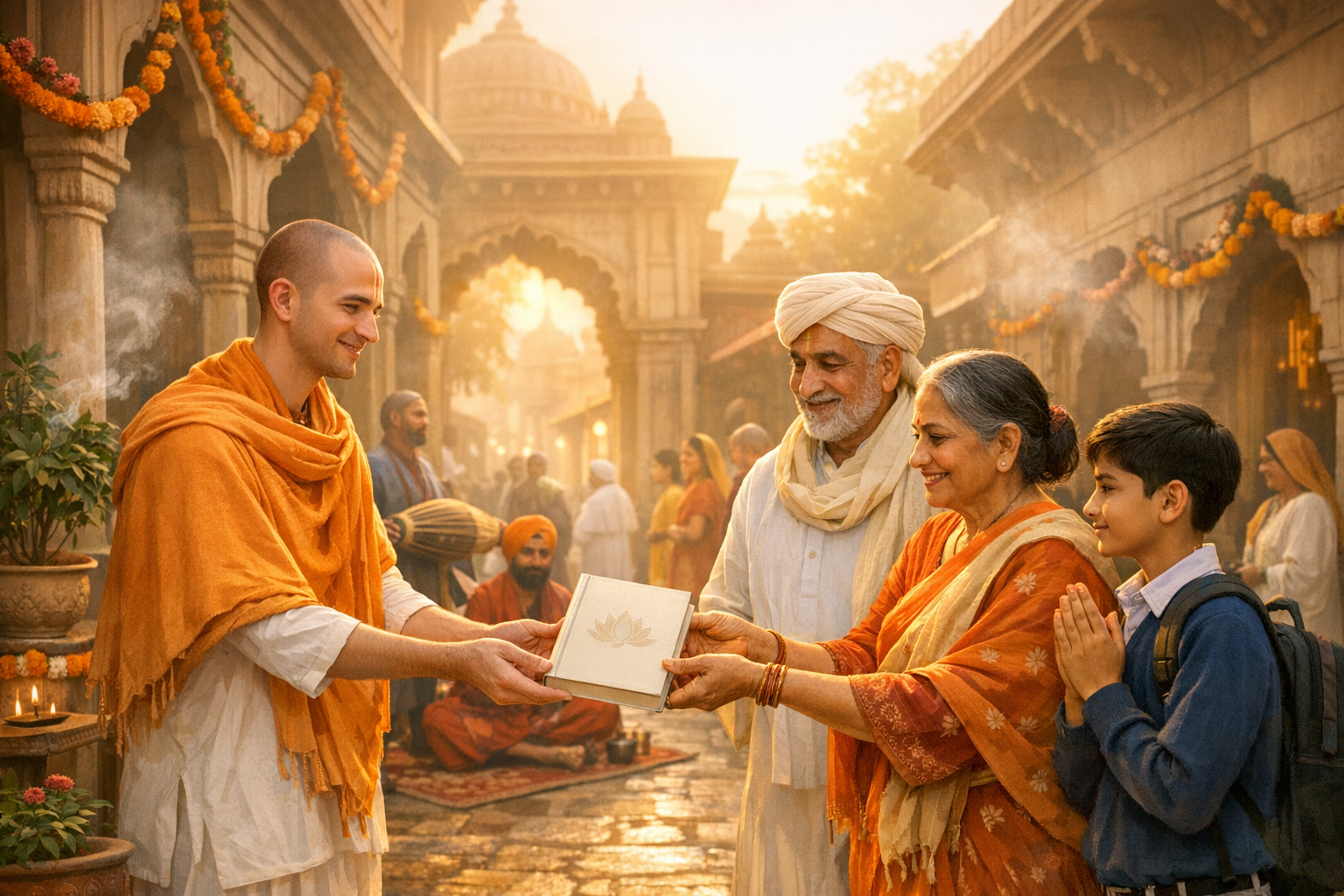
Vrindavan’s narrow lanes, incense-thick dawns, and the steady hum of kirtan form the living backdrop to a story of devotion, stewardship, and literary service. In this milieu, a quiet pledge made by Rasada Prabhuwho foresaw that his days were fewbecame a catalyst for a renewed wave of book distribution dedicated to Srila Prabhupada’s teachings. Parasuram das, reflecting on the “Zonal days” of ISKCON and the arc of a lifetime in service, presents an honest, seasoned conviction: whatever the institutional ebbs and flows, the heart of the mission remains cleardissemination of transcendental literature as a service (seva) to society.
This account unfolds in academic detail yet retains a living immediacy because it emerges from Vrindavan’s everyday realityon pilgrim routes, under the canopies at temple gates, and along the perimeters of Krishna Balaram Mandir. The presence of Parasuram das offers a grounded historical memory: book distribution in ISKCON has persisted through distinct organizational phases, always oriented around the clarity of Srila Prabhupada’s directive to publish, translate, and share wisdom texts such as the Bhagavad-gita and Srimad-Bhagavatam. Rasada Prabhu’s legacy funds underscore a principle central to dharmic life: resources, when offered in the right spirit, become instruments for uplifting collective understanding.
Historically, Vrindavan’s status as a sacred geographyinterlaced with pilgrimage circuits, seasonal festivals, and daily ritualshas made it a natural hub for receiving and sharing sacred texts. The flow of pilgrims during Kartik, Janmashtami, and other utsavas increases opportunities for meaningful, respectful interaction. In this setting, book distribution is less an event than an organic extension of Vrindavan’s culture: a gentle invitation to study, reflect, and apply.
The institutional framework rests upon the Bhaktivedanta Book Trust (BBT), which provides curated, edited, and translated editions of Srila Prabhupada’s works. Over decades, these texts have been made available in numerous Indian languages and international tongues, enabling a geographically and culturally diverse readership. The program in Vrindavan typically features cornerstone titlesBhagavad-gita As It Is, Srimad-Bhagavatam, and Sri Caitanya-caritamritaalongside primers and thematic selections designed for new readers, families, students, and practitioners seeking structured study.
Operationally, effective book distribution in Vrindavan requires careful planning: aligning with local norms, coordinating with temple authorities where necessary, and timing presence to daily and seasonal rhythms. Teams factor in climate sensitivity (heat, rain), footfall densities around ghats and mandirs, and language preferences of visiting groups. In practice, a micro-warehousing modelsmall, secure storage close to high-footfall zonesreduces last-mile friction while maintaining the flexibility to respond to pilgrim surges.
Training remains essential. Distributors study core texts to answer questions responsibly and cultivate etiquette rooted in ahimsa (non-harm), satya (truthfulness), and anukampa (compassion). The approach emphasizes non-coercion: individuals are free to accept or decline, and dialogue is framed by respect. New volunteers shadow experienced distributors, learning how to initiate conversations, listen attentively, and offer suggestions that match a person’s interest and time constraints.
The program’s ethical architecture is equally explicit. Literature is presented as an offering, never as an imposition. Interaction guidelines prioritize humility, cultural sensitivity, and gratitude. The result is a mode of public engagement consistent with a dharmic ethos: seek harmony, offer knowledge, and protect the dignity and agency of every individual encounteredincluding those with differing beliefs or no interest in religious texts.
In recent years, teams have refined impact assessment beyond simple counts of placements. Diaries of interactions, anonymized feedback, and follow-up reading circles help gauge whether texts are studied rather than merely acquired. Some initiatives integrate QR codes linking to free lectures, dictionaries of Sanskrit terms, audio readings, and study guidesbridging traditional print culture with the digital resources many readers now expect.
Because Vrindavan hosts a pan-Indian and global demographic, language strategy matters. Parallel inventories in Hindi, English, Bengali, Marathi, Tamil, Telugu, Gujarati, and other languages increase accessibility. For mixed-language groups (such as many families), volunteers suggest a bilingual combinationone copy for immediate comprehension and another to support deeper study or second-language learning over time.
Stewardship of fundsparticularly legacy gifts such as those made by Rasada Prabhufollows transparent norms. Distribution budgets typically cover procurement from BBT, logistics and storage, reader support materials (bookmarks, study prompts), and minimal protective packaging. Teams maintain records of acquisitions and placements, with periodic reviews to ensure the offerings remain relevant, well-edited, and aligned with the community’s educational needs.
At the level of lived experience, eyewitness memories enrich the narrative. Parasuram das describes elders and students pausing together at a shaded corner, turning pages of the Gita, and quietly reading a passage while a distant kirtan thread ties the scene together. There is relief in the eyes of some who are seeking moral clarity amid modern complexity; there is also healthy skepticism from others. Both responses are welcomed. The aim is understanding, not winning an argument.
This approach consciously fosters unity across dharmic traditions. ISKCON’s Vrindavan distribution teams frequently draw connections to shared civilizational values: non-violence and self-restraint (resonant with Jain darshana), compassion and mindful awareness (familiar in Buddhist practice), and seva and remembrance of the Divine Name (central to Sikh tradition). The message situates bhakti within a broader dharmic tapestry, affirming that sincere spiritual practiceby whatever authentic pathcontributes to personal transformation and social harmony.
In practice, inter-tradition sensitivity informs language and tone. Volunteers avoid sectarian claims and focus instead on universal virtues: humility, gratitude, truthfulness, responsibility, and care for all beings. Public discussions, when they arise, are anchored in shared ethics rather than boundary-marking debates. The intention is to strengthen bonds among Hindus, Buddhists, Jains, and Sikhs by recognizing overlapping aspirations for inner growth and compassionate action.
Vrindavan’s civic setting also necessitates mindful compliance with local norms. Volunteers adapt to municipal regulations governing public use of space, maintain pedestrian flow, and ensure minimal obstruction. Many teams coordinate with nearby temples regarding appropriate zones and times. Such coordination protects the sanctity of worship areas and reinforces a wider culture of cooperation between devotional service and civic order.
Methodologically, book distribution in Vrindavan has shifted from a purely transactional act to a relational and educational continuum. Initial contact may lead to joining a group reading circle, enrolling in a short introductory course, or attending a public lecture series. These stepswhen chosen by the readersupport comprehension and retention, turning a chance meeting into a sustained learning journey.
Challenges persist. Misconceptions about religious outreach, language barriers in mixed-audience settings, and the seasonal volatility of foot traffic require patience and adaptability. Teams address these concerns with clear communication, multilingual summaries, and flexible scheduling, while carefully documenting lessons learned for future improvement. The goal is continuous refinement, not hurried growth.
For many, the most transformative moments remain quiet and unadvertised: a villager returning after months to say a single verse altered a habit, a university student discovering a vocabulary for ethics, a pilgrim who reads a passage aloud to family and decides to establish one night a week for collective study. These small, reproducible practicesmore than large eventsbuild a durable culture of scriptural literacy.
Technically, curation is vital. Not every reader needs a multi-volume set at first contact; many benefit from concise introductions, glossaries, and topic-based selections (e.g., guidance on duty, relationships, or resilience). Teams maintain modular offerings and provide pathways to deeper study, including access to commentaries, lectures, and comparative resources that relate bhakti insights to cognate ideas across dharmic schools.
Rasada Prabhu’s legacy thus functions on two intertwined planes. Materially, it supports print and placement. Intellectually and spiritually, it signals a trust in books as living companions capable of correcting course and igniting personal responsibility long after a distributor has stepped away. Parasuram das’s reflections, seasoned by time, capture the essence: to place a text is to open a door; to respect the reader is to trust that dharma grows where freedom and understanding are protected.
From a civilizational perspective, such work safeguards intangible cultural heritage: recitation, commentary traditions, and Guru–Shishya-inspired study circles. It also protects a public sphere in which differences are navigated with courtesy. The aspiration is not uniformity but harmonyaligning with the principle of unity in spiritual diversity that has historically allowed Hinduism, Buddhism, Jainism, and Sikhism to coexist and enrich one another.
Going forward, distribution teams in Vrindavan outline a pragmatic roadmap: deepen language access; expand gentle, opt-in reading groups; integrate accessible digital aids; and co-host dialogues that foreground common dharmic ethics. Each action reinforces the same premiseseva through knowledge-sharing, offered without pressure and received with freedomso that the streets of Vrindavan remain not only sacred but also educational, welcoming, and dignified for all.
Beyond the individual lives touched, the collective benefit is clear. Widespread engagement with texts known for moral clarity and devotional insight supports social trust, encourages personal responsibility, and nourishes empathy across traditions. Such outcomes, while not always quantifiable in the short term, constitute the enduring fruits of Vrindavan’s ISKCON book distribution: a legacy of love, study, and unity carried forward in the quiet turning of pages.
Inspired by this post on Dandavats.