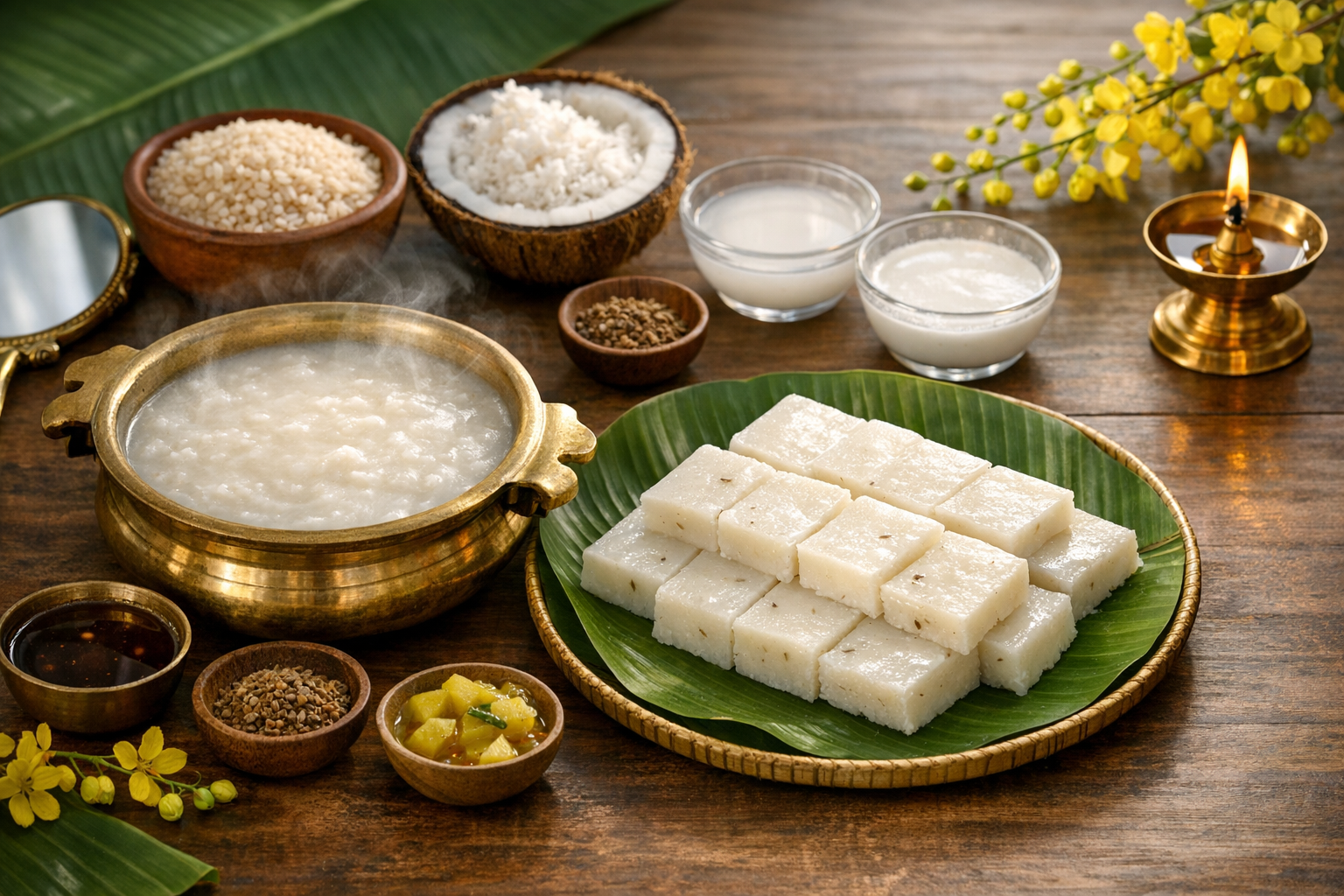
On the morning of Vishu, the Kerala New Year, Malayali households often begin the day with a quietly celebratory breakfast anchored in tradition: Vishu Kanji or Vishu Katta. This seemingly simple preparation embodies the festival’s values—freshness, auspiciousness, and restraint—offering a sattvic, comforting start after the early Vishu Puja and the darshan of the Vishukkani.
While both dishes share the same pantry, their textures and culinary logic differ. Vishu Kanji is a silken rice porridge enriched with coconut milk, best eaten warm by the spoonful. Vishu Katta, by contrast, is a thick, set coconut–rice preparation that slices cleanly once cooled, lightly perfumed with cumin and just enough salt to heighten the natural sweetness of coconut and rice.
Classical household notes summarize the core specification succinctly: raw rice -2 1/2 cup ( unakkalari or pacha ari), grated coconut-5, Cumin seeds-1/2tsp and Salt-to taste. The cooking time taken is just one hour. These proportions prioritize generosity with coconut while keeping the spice profile minimal, in harmony with Vishu Traditions.
Culinarily and ritually, this breakfast sits at the intersection of seasonality and symbolism in Vishu in Kerala. Prepared soon after sunrise, it aligns with the festival’s emphasis on beginning the solar year with purity, simplicity, and gratitude, themes that echo across Vishu Festival observances and Vishu Rituals in different regions of the state.
Rice choice matters. Unakkalari and pacha ari refer to raw rice varieties customary in Kerala that yield a wholesome mouthfeel and moderate glycemic response compared to highly polished grains. Rinsing until the water runs mostly clear and, if time allows, a brief 15–20 minute soak help promote even gelatinization within the one-hour cooking window.
Grated coconut-5 signals a generous use of fresh coconut, central to the dish’s aroma, mouthfeel, and festive character. In many kitchens, the coconut is pressed twice to produce a thin second-press and a rich first-press coconut milk; the thin extract supports longer cooking without curdling, and the thick extract is added toward the end for gloss and body.
Cumin seeds-1/2tsp appears modest but purposeful. Lightly bruised or coarsely crushed, the cumin opens into warm, nutty florals that knit the rice and coconut together while remaining subtle enough for a morning meal. Salt-to taste is intentionally restrained to keep the preparation sattvic and balanced.
Baseline method for Vishu Kanji within the stated specification begins by rinsing raw rice -2 1/2 cup ( unakkalari or pacha ari). The rice is simmered first in the thinner coconut extract with enough water to keep the grains submerged by a knuckle’s depth, stirred periodically to prevent sticking. Once the rice softens and releases starch, the thick coconut extract is incorporated gradually over low heat, followed by Cumin seeds-1/2tsp and Salt-to taste, adjusting liquid for a pourable, porridge-like consistency. The result is a gently sweet, aromatic kanji that remains light yet satisfying.
From a culinary science perspective, kanji relies on the steady gelatinization of rice starch granules around 70–90°C and the stable emulsion of coconut milk. Introducing thick coconut milk only after the rice is fully tender, and keeping the heat low during the final minutes, preserves emulsion stability and prevents splitting, ensuring a glossy finish.
For Vishu Katta, the same ingredients are leveraged for structure rather than flow. The rice is cooked down in thin coconut extract and water with frequent stirring until it thickens significantly; at this point, the thick extract is folded in and the mixture is seasoned with Cumin seeds-1/2tsp and Salt-to taste. The dense, velvety mass is then poured into a lightly greased plate or banana-leaf–lined tray, pressed level, and allowed to set at room temperature before being cut into neat diamonds or rectangles.
The setting of Vishu Katta reflects starch retrogradation, wherein amylose chains realign as the mixture cools, forming a delicate gel that slices cleanly. Consistent stirring during the concentration phase prevents scorching and ensures uniform starch dispersion, while adding the thick coconut extract late preserves its sweetness and sheen.
The one-hour schedule is realistic when tasks overlap. Coconut can be grated and pressed while the rice begins to simmer, and the thin extract can go in first to maximize active cooking time, with the thick extract reserved for the finish. Vishu Kanji typically reaches service faster, whereas Vishu Katta needs a short, passive cooling period to set.
Service is intentionally simple. Many households enjoy Vishu Kanji plain, or with a small spoon of jaggery syrup or a tart mango accompaniment; Vishu Katta is often served alongside a touch of jaggery syrup or a mild pickle. Such pairings remain optional and regionally inflected, keeping the focus on the elemental flavors of rice, coconut, and cumin.
Nutritionally, both preparations are naturally vegan and gluten-free, aligning with sattvic dietary ideals observed during Vishu Puja. Unpolished or minimally polished raw rice contributes fiber and slower-digesting starches, fresh coconut offers medium-chain triglycerides and lauric acid, and cumin provides digestive support with its carminative properties.
The spirit of this breakfast resonates with kindred spring–new year observances across dharmic communities, including Baisakhi in Sikh traditions and regional new years such as Puthandu, Pohela Boishakh, and Pana Sankranti. Each emphasizes gratitude for harvests, community well-being, and simple, nourishing foods, underscoring the shared cultural threads that connect Hindu, Buddhist, Jain, and Sikh households in the subcontinent.
Common pitfalls are easily managed. If kanji tastes flat, a pinch more salt-to taste and a slightly longer simmer to coax sweetness from the rice can restore balance; if it appears oily or split, it likely boiled too hard after adding thick coconut extract. For katta that refuses to set, continuing the concentration a few extra minutes and allowing a longer cool-down usually resolves texture.
For best festival-day quality, Vishu Kanji is prepared and served fresh. Vishu Katta can be made slightly ahead within the morning window and kept covered at cool room temperature until slicing; refrigeration firms it further but may dull the delicate coconut notes, which return with a brief rest at room temperature.
Rooted in Kerala’s seasonal rhythms and refined through generations, Vishu Kanji and Vishu Katta translate the essence of Vishu Festival into food—uncomplicated, auspicious, and welcoming. Whether ladled as porridge or set and sliced, this traditional Kerala breakfast offers a considered beginning to the solar year, uniting households in gratitude and gentle abundance.
Inspired by this post on Hindu Pad.