
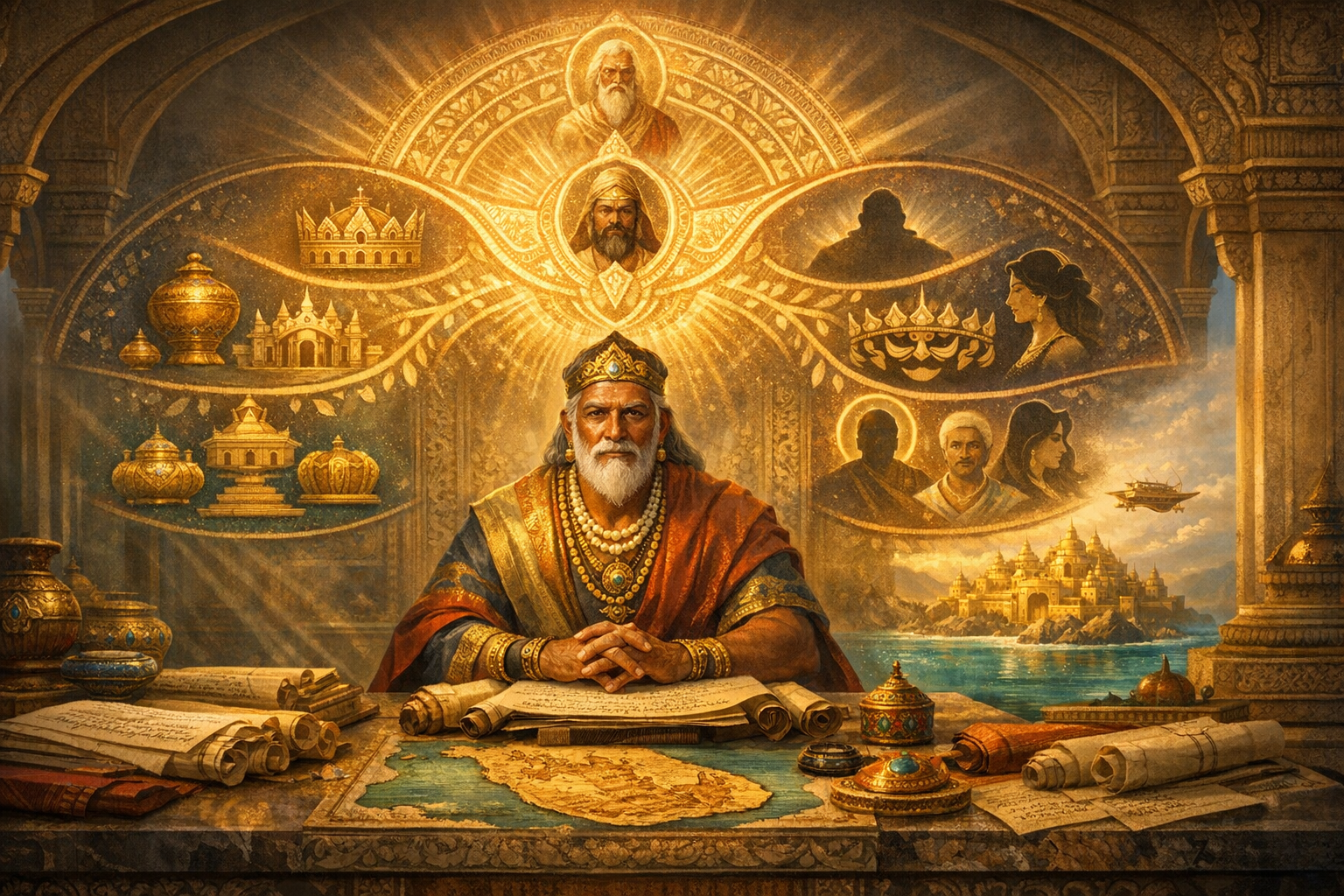
Sumali seldom occupies center stage in discussions of the Ramayana, yet his strategic brilliance and relentless ambition form one of the epic’s most decisive undercurrents. Framed by the genealogies preserved in the Valmiki Ramayana (Uttara Kanda) and echoed by later retellings, Sumali emerges as a political thinker whose calibrated movesmarriage diplomacy, dynastic engineering, and counsel in statecraftultimately forged the destiny of Ravana and, with it, the arc of the Ramayana itself.
This study examines Sumali’s grand design through the lenses of textual genealogy, political strategy, and ethics. It situates his actions within the complex interplay of lineagesrishi, rakshasa, and yakshailluminating how the union of Kaikesi and Vishrava engineered by Sumali became the fulcrum for a transfer of power from Kubera to Ravana and for a new phase of rakshasa ascendancy in Lanka.
Genealogically, the narrative begins with Brahma’s mind-born son Pulastya. From Pulastya descends Vishrava, a sage whose austerity legitimizes both yaksha and rakshasa claims to royal power. By Ilavida, Vishrava sires Kubera, the yaksha king; by Kaikesi, he sires the rakshasa siblingsRavana (Daśānana), Kumbhakarna, Vibhishana, and Shurpanakha. Sumali stands at the hinge of these lineages as Kaikesi’s father, using kinship as statecraft to redirect cosmic inheritance.
Rakshasa origins are presented in the Uttara Kanda alongside figures such as Sukesha and his sonsMalyavan, Mali, and Sumaliwho embody an early rakshasa polity. The traditions differ on the earliest tenure of Lanka: some recensions maintain that Viśvakarma constructed golden Lanka (at times associated with Śiva’s pleasure city) and that it later passed to Kubera; others recall an older rakshasa presence linked to Sumali’s house. The multiplicity of accounts is not a flaw but a hallmark of Itihasa-Purana literature, recording layered memories of sovereignty, displacement, and return.
Kubera’s sovereignty over Lanka and possession of the Pushpaka Vimana represent an ordered cosmic wealth (śrī) aligned to tapas and deva-sanctioned rulership. When Sumali, in exile with his clan, beholds Kubera’s resplendence, the sight catalyzes a calculated response. The problem before him is not only political loss, but genealogical misalignment: the seat of Lanka rests with a yaksha scion of Vishrava while the once-formidable rakshasa house fragments in hiding.
Sumali’s solution is marriage diplomacy of the highest order. He directs Kaikesi to approach Vishrava so that their offspring, ordained by tapas-rich paternity and rakshasa matrilineage, might be capable of reclaiming Lanka. The choice of Vishrava is not incidental: it fuses rakshasa vigor with the sanctity and authority of a brahminical line emanating from Pulastya, thereby conferring ritual gravitas on future rulers of Lanka.
The Valmiki Ramayana notes the liminal moment of Kaikesi’s approachVishrava warns that her timing is inauspicious, foretelling sons of formidable, even fearsome, disposition. Yet this very admixture yields a complex moral spectrum in her children: Ravana and Kumbhakarna embody overwhelming force; Vibhishana, born of Kaikesi’s piety and restraint, becomes an exemplar of dharmic counsel; Shurpanakha, unbowed, moves at the edges of politics and desire. Sumali’s calculus thus succeeds beyond measure: the brood possesses power adequate to transform the geopolitical order.
Education under Vishrava and subsequent tapas anchor the sons within the grammar of dharma, polity, and mantra-vidya. Their later quest for boons from Brahma and propitiation of Śiva sharpen capacities that are already the fruit of Sumali’s plan. In political terms, boons are not mere miracles; they are institutional levers in the epic economy of power, legitimizing and constraining rule within a transcendental legal order.
At the strategic moment, Sumali presses the claim to Lanka. He counsels Ravana to first displace KuberaVishrava’s elder son and thus their agnatic half-brotherbecause recovering the ancestral capital symbolically resolves a cosmic misallocation. The conquest of Lanka and seizure of the Pushpaka Vimana follow, marking the restoration of a rakshasa imperium with a sacral genealogy. In this act, Sumali’s long-range objectivereconstituting rakshasa sovereignty under a grandson of mixed but elevated lineageis realized.
Malyavan, Sumali’s elder kin, is presented in the Uttara Kanda as a senior statesman in Ravana’s court. His later counsel toward prudence and moral recalibration when faced with the Sita crisis echoes Vibhishana’s dharmic argument. These voices demonstrate that the rakshasa polity is not monolithic: it contains competing theories of ruleexpansionist might, dynastic preservation, and moral statecraftcontesting for precedence within the same family.
Ethically, the Sumali arc interrogates the relationship between intent (saṅkalpa), means (upāya), and outcome (phala). His design is lucid: to recover status and territory through genealogical fusion and instruction in statecraft. The methodmarriage diplomacyaligns with accepted epic realpolitik, yet its downstream effects include the entrenchment of adharma as Ravana’s personal choices diverge from counsel. The epic thus distinguishes between strategic brilliance and righteous kingship, reminding readers that legitimacy accrued through lineage and boons does not absolve rulers of dharma.
In the language of the three guṇas, Sumali’s foresight and patience show tamas transmuted into purposeful rajas, while the absence of sustained sattva in the sovereign to whom power is entrusted seeds decline. Vibhishana’s presence is the systemic corrective the epic offers from within the same dynastic experimenta brother who demonstrates that lineage does not dictate moral necessity, and that dharma can be chosen even against blood.
Comparative traditions underscore these nuances. Kamba Ramayanam amplifies the grandeur of Lanka’s courtly life and the moral gravitas of counsel, often deepening the tragic scope of Ravana’s refusal to heed it. Jain narratives such as Vimalasuri’s Paumacariya reframe the protagonists to foreground ahiṁsā and karmic causality, while Buddhist sources like the Dasharatha Jataka recast familiar motifs to emphasize ethical restraint and the law of intention. Across these dharmic traditionsHindu, Buddhist, and Jainthe shared lesson is unequivocal: mastery over self legitimizes mastery over realm.
Within this convergence, Sumali’s story functions as a cautionary primer on ambition. It validates strategic intelligence and kinship diplomacy but simultaneously reveals their limits when detached from ethical discipline. The Ramayana’s political theology allows for formidable power, yet it demands that sovereignty be reconciled with compassion, justice, and truth-speakingprinciples also celebrated in Sikh teachings on righteous living (gurmat) and seva.
Kaikesi’s role is equally pivotal. Too often reduced to genealogy, her agency marks a decisive turn: she chooses Vishrava, bears the consequences of auspicious and inauspicious timing, and raises children who embody divergent moral trajectories. The epic credits her piety for Vibhishana’s sattvic disposition, a reminder that maternal intention and practice shape not only bloodlines but also the moral texture of power.
Lanka itself becomes a palimpsest of sovereignty. Under Kubera, it represents wealth anchored to austerity; under Ravana, it becomes a theater of unmatched administrative sophistication and cultural efflorescence overshadowed by moral overreach. That duality is the epic’s signature critique: excellence in governance, arts, and technology cannot redeem a deficit of dharma.
Textual variation around Lanka’s earliest possessionwhether by rakshasas constructed by Viśvakarma, bestowed upon Kubera by Brahma, or associated with Śiva’s golden cityshould be read as interpretive windows rather than contradictions. Itihasa accommodates multiple memory-streams to convey truths about power, restitution, and the fragility of order when metaphysical consent (anugraha) is withdrawn.
From a statecraft perspective, Sumali anticipates three durable political instruments: alliance through marriage, consolidation through narrative (genealogy that legitimizes rule), and pedagogy through counsel. He identifies a legitimate source of sacral authority (Vishrava), integrates it into his house, and coaches the successor. The failure that follows is not Sumali’s strategy per se but the sovereign’s personal ethic. In contemporary terms, the lesson is straightforward: succession planning must include moral formation, not only institutional elevation.
A counterfactual underscores the point. Had Sumali pursued a broader coalition under Kuberareconciling yaksha stewardship with rakshasa participation through ministerial integrationthe polity of Lanka might have evolved toward shared sovereignty instead of violent displacement. The epic’s choice to stage recovery through conquest, not conciliation, heightens dramatic stakes while clarifying its moral claim: dharma must govern acquisition, not merely administration.
Vibhishana’s eventual ascent, endorsed by Sri Rama, completes the arc that Sumali initiates. The throne returns to a branch of the same house, but now ethically reconstituted. That outcome suggests that Sumali’s original hypothesisonly a scion of the Vishrava–Kaikesi fusion can securely rule Lankawas correct, yet the epic insists the correct ruler must also be a servant of dharma.
For many readers, the emotional timbre of this narrative is familiar: an elder’s ambition to restore family standing, the use of marriage to consolidate alliances, and the hope that the next generation will surpass the last. The Ramayana affirms the nobility of such aspirations while warning that ends and means must be equally purified. In that synthesis of realism and restraint lies the enduring relevance of Sumali’s design.
Methodologically, a careful reading of the Uttara Kanda, together with classical commentarial traditions, allows a technical mapping of actors, motives, and consequences: Pulastya’s sanctifying authority; Vishrava’s dual paternity producing Yaksha and Rakshasa lines; Kaikesi’s time-sensitive approach shaping the children’s dispositions; Sumali’s recurring counsel; Malyavan’s institutional presence; and the differing dharmic choices of Ravana and Vibhishana in crisis.
Keywords central to this analysisSumali, Kaikesi, Vishrava, Kubera, Ravana, Kumbhakarna, Vibhishana, Shurpanakha, Uttara Kanda, Pushpaka Vimana, Lanka, Pulastya, Brahma, asuras, rakshasas, yakshassignpost the epic’s integration of theology, ethics, and political economy. Each term indexes a doctrine: origin, authority, legitimacy, possession, and the cyclicality of rise and fall in Itihasa.
In conclusion, Sumali is best understood as the architect of a dynastic experiment whose success in state formation was eventually testedand correctedby the moral law. His vision forged the conditions for Ravana’s spectacular ascent; the same design, filtered through Vibhishana, ultimately enabled Lanka’s ethical renewal. The Ramayana thus preserves a nuanced verdict: strategy without dharma courts catastrophe, while strategy anchored in dharma yields enduring sovereignty. That lesson resonates across Hindu, Buddhist, Jain, and Sikh wisdom streams and remains as relevant to contemporary leadership as it was to Lanka’s golden city.
Inspired by this post on Hindu Blog.
