
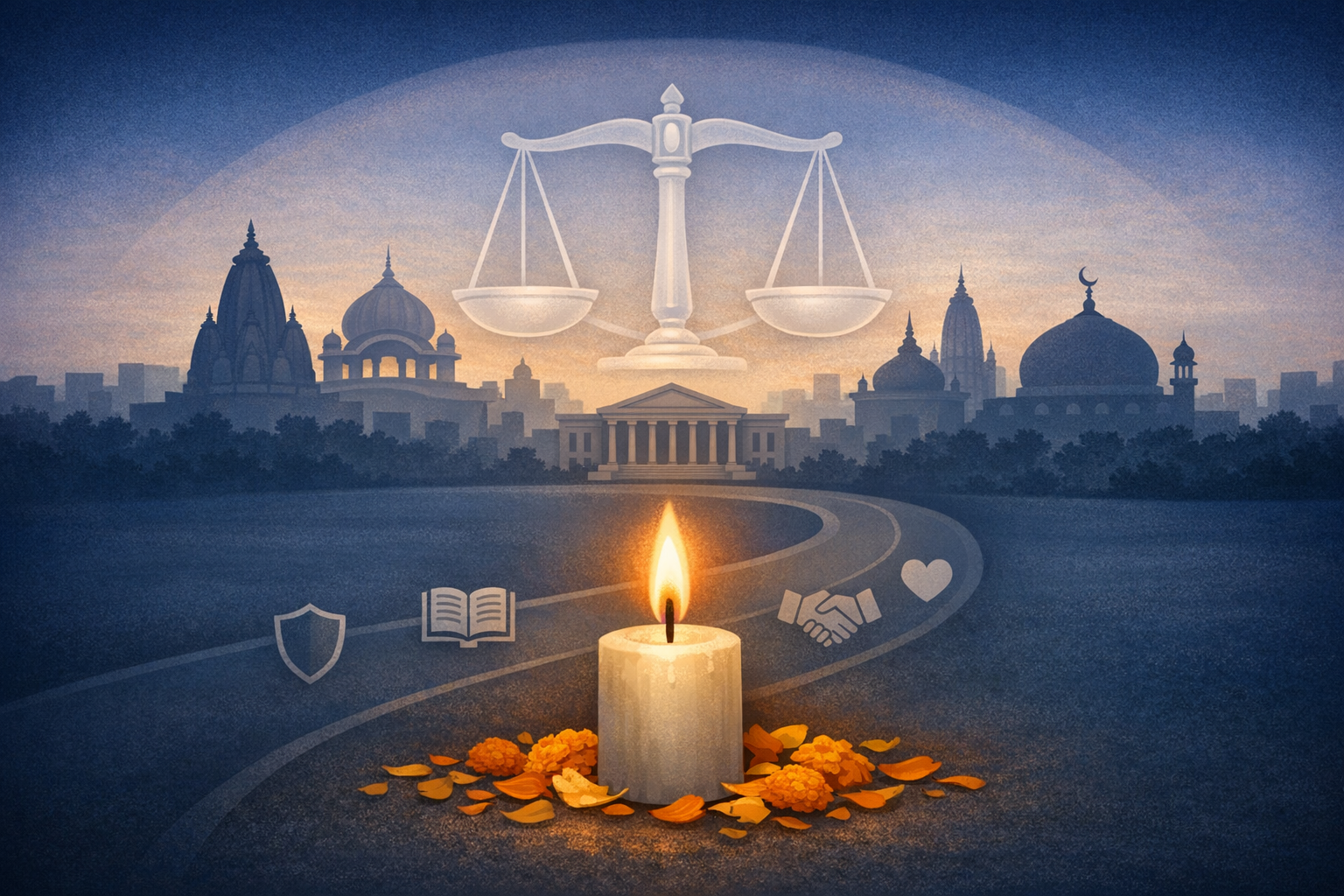
A 17-year-old school student, Surya Pratap Chauhan, was fatally stabbed in the Khoda area of Ghaziabad, Uttar Pradesh, on a Thursday coinciding with Eid (Bakri Eid/Eid al-Adha) celebrations. The incident has triggered public outrage, sharpened concerns about youth safety, and renewed debate on how communitiesand especially dharmic traditions of Hinduism, Buddhism, Jainism, and Sikhismcan respond ethically and cohesively to violence without descending into communal polarization.
According to initial local accounts and an eyewitness identified as Vicky, a confrontation allegedly involved individuals named Mohammad Arshad, Farhan, Atif, Shafiq, and Nawab. Early reports suggest that a conversation linked to witnessing goat slaughter for Bakri Eid at a residence preceded the assault. While these details are widely cited in media and neighborhood testimonies, they remain allegations and are subject to verification through a formal police investigation and court proceedings.
In a deeply distressing statement, the victim’s mother said: “On Eid, a boy named Arshad tricked my child into calling him. He was asked if he had ever seen a goat being slaughtered, to which he replied no. Then my child was stabbed… I want justice….” This personal plea underscores the gravity of the loss and the imperative for a rapid, transparent, and victim-centered justice process.
From a criminal-law standpoint, cases of fatal assault in India are typically investigated under provisions of the Indian Penal Code (IPC), most notably Section 302 (murder), along with allied sections such as 34 (common intention) or 120B (criminal conspiracy) if supported by evidence. Investigative steps generally include lodging a First Information Report (FIR), securing the crime scene, conducting medico-legal/post-mortem examination, recording witness statements under Section 161 of the Code of Criminal Procedure (CrPC), collecting CCTV and call detail records, and, where necessary, seeking non-bailable warrants. If any accused is found to be a minor, procedures under the Juvenile Justice (Care and Protection of Children) Act, 2015, apply to ensure due process and child-appropriate adjudication.
Public response in Ghaziabad has been intense, with residents expressing grief and anxiety over safety. Commentaries and on-ground coverage have circulated on social media and television. A segment by Anshul Singh amplified local concerns about recurring violent incidents and the perception that ordinary citizens feel vulnerable in such moments of crisis. Community perspectives featured by outlets like OpIndia.com reflect a shared apprehension and a strong demand for accountability, speed, and fairness in the investigation.
Amid the shock, it is vital to avoid collective blame or the vilification of any religious community. Violence must be unequivocally condemned, and accountability must be individual and evidence-based. Interfaith respect and the constitutional principles of equality before law demand that discourse remains measured, focused on facts, and aligned with due process. This approach not only upholds justice but also prevents the spread of rumors and retaliatory hate that can endanger more lives.
A trauma-informed lens helps clarify immediate priorities for families and neighbors: emotional first aid, access to counseling, dignified space for mourning, and practical support for navigating police stations, hospitals, and courts. Across dharmic traditions, rituals of remembrance, compassion, and community seva (service) can provide solace to grieving families while reinforcing a culture of non-violence and mutual care.
Media literacy is equally important. In high-tension situations, misinformation can travel faster than verified updates. Citizens are better served by relying on official police bulletins, responsibly reported news, and legally admissible evidence rather than unverified forwards. Responsible digital behaviorverifying sources, avoiding doxxing, and not sharing graphic contenthelps protect both the dignity of victims and the integrity of the legal process.
To channel the public call for justice into concrete outcomes, a clear procedural roadmap is necessary. Families may request updates from the Investigating Officer (IO), track FIR status, and seek legal aid through District Legal Services Authorities. Under Section 357A of the CrPC, victims’ families may be eligible for compensation through the Uttar Pradesh Victim Compensation Scheme, and the Witness Protection Scheme (2018) can be invoked in appropriate circumstances to safeguard those who come forward with testimony.
Prevention demands structural solutions. Urban local bodies and police can strengthen festival-time Standard Operating Procedures (SOPs) that include proactive patrolling, rapid response teams, CCTV coverage of known hotspots, and community liaison officers acting as single points of contact. Schools and resident welfare associations (RWAs) can coordinate youth-safety briefings, neighborhood escort/buddy systems for students, and route-risk assessmentsespecially on high-mobility days like public holidays and major religious observances.
Community-level de-escalation has proven benefits. Interfaith coordination committeesdrawing members from temples, gurdwaras, viharas, derasars, and local mosquescan establish early-warning circuits for rumor control, commit to non-provocative conduct near places of worship, and co-design shared codes of conduct for celebratory processions or gatherings. Such frameworks help ensure that diverse religious practices occur peacefully and with mutual respect in densely populated localities.
Dharmic institutions can play a constructive, unifying role consistent with their spiritual mandates. Rather than adversarial messaging, temples, gurdwaras, viharas, and derasars can host permanent educational exhibits on ahimsa (non-violence), shared ethics across dharmic traditions, citizens’ legal rights and responsibilities, and first-responder skills (basic life support, emergency hotlines, and bystander intervention). Inclusive, voluntary physical fitness and self-defense training for youthopen to all communities and supervised by qualified coachescan build confidence, discipline, and resilience without stoking division.
Parents, educators, and counselors share responsibility for protective factors that reduce youth violence. Evidence-based measures include structured after-school programs, sports and arts engagement, mentoring networks, conflict-resolution education, and school-to-home coordination on attendance, social circles, and late-evening movements. Where distress signals appear (sudden behavior change, social withdrawal, fixation on violence), timely professional support can prevent escalation.
Policymakers can further strengthen safety by enhancing police-community relations through beat constables who know their neighborhoods, routine joint walkthroughs with RWAs, and multilingual public advisories on festival days. Periodic social audits of urban lighting, walkability, and surveillance coveragecombined with targeted infrastructure fixesalso reduce opportunity for street crimes and assaults.
The moral center of a just society holds when grief is met with compassion and when anger is channeled into lawful, proportionate, and principled action. Justice for Surya Pratap Chauhan requires a meticulous investigation, fair trials, and institutional support for the bereaved. Harmony in Ghaziabadand in every Indian cityrequires the refusal to demonize entire communities, the discipline to uphold due process, and the courage to stand together across dharmic traditions for the safety and dignity of every child.
For context, several clips circulating online document on-ground reactions and reporting; readers may refer to the following links while exercising media literacy and awaiting official updates:
Ultimately, the most powerful tribute to Surya’s memory is a collective insistence on rule of law and a living commitment to non-violence. As investigations proceed, the call is clear: secure justice, support the family, reject communal hatred, and build practical, inclusive safeguards so that every festival in Indiabe it Eid, Deepavali, Vaisakhi, Vesak, Paryushan, or Guru Nanak Jayantiremains a celebration of life, not a prelude to loss.
Inspired by this post on Hindu Human Rights Blog.
