On 2 April 2026, Hyderabad will observe Hanuman Jayanti with a large Shobha Yatra. In alignment with the city’s traffic management protocol, the Hyderabad Traffic Police will implement rolling traffic diversions based on necessity and as the procession approaches particular junctions. This advisory provides a consolidated, reader-friendly explanation of the dynamic route map logic, likely movement patterns, and practical travel guidance so residents and visitors can plan confidently.
Hanuman Jayanti is revered across Sanatana traditions for its emphasis on seva, shaurya, and steadfast dharma. In Hyderabad, the Shobha Yatra is a participatory civic ritual that highlights shared values of discipline, compassion, and unity resonant with Hinduism, Buddhism, Jainism, and Sikhism. For many families, the yatra evokes childhood memories of walking beside elders, listening to bhajans, and sharing prasad, weaving devotion into everyday civic life.
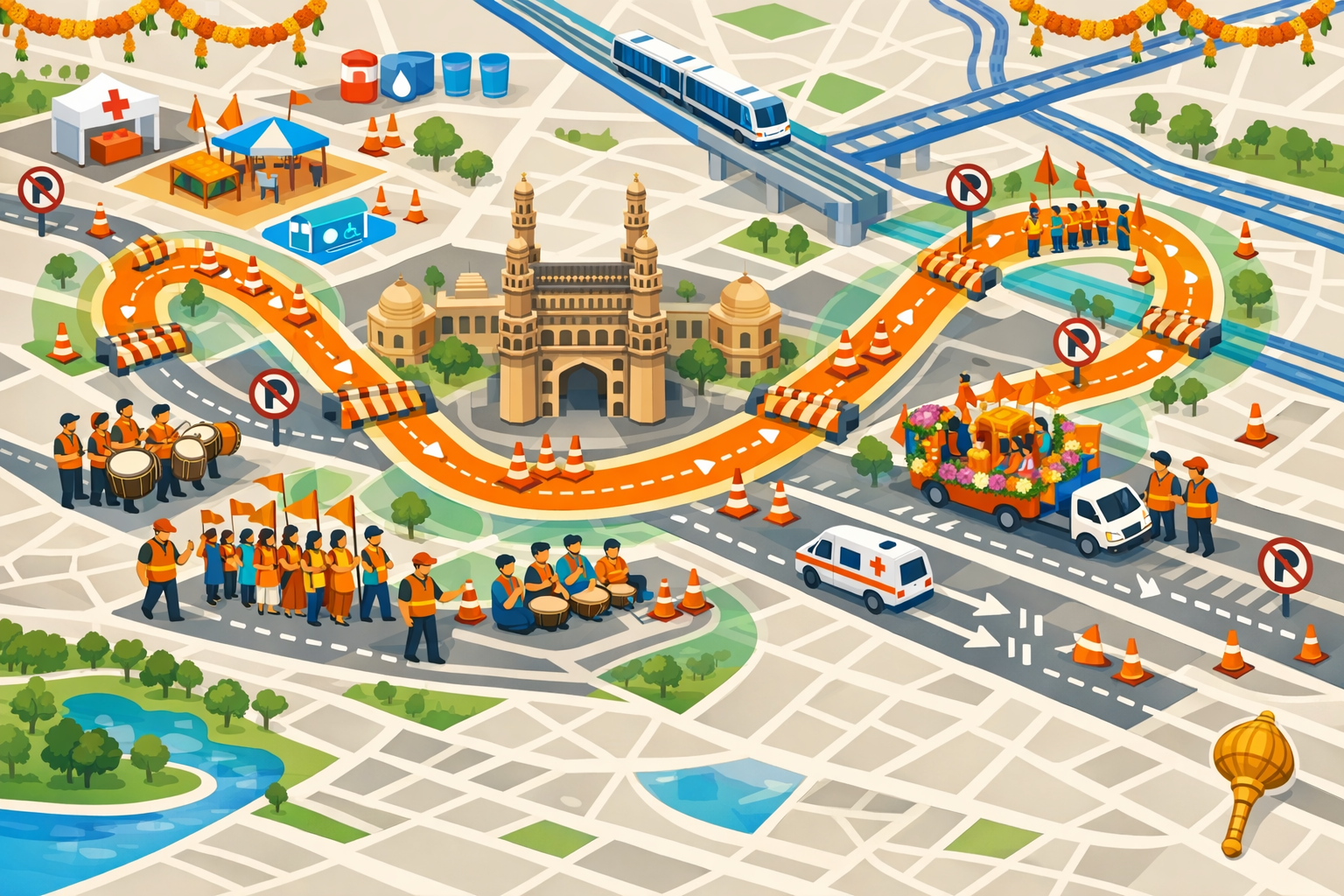
Typical procession anatomy includes lead banner units, bhajan and dhol-tasha groups, tableau vehicles, cultural troupes, and volunteer marshals coordinating pedestrian flows. Average forward speed rarely exceeds 3–4 km/h, and dwell times arise at temple gateways, narrow market segments, or at key intersections where blessings or cultural performances take place. These characteristics are central to understanding why diversions are adaptive and junction-triggered.
Official route map and diversions for 2 April 2026 are expected to be confirmed in the run-up to the event and activated in real time. As indicated in public advisories for this yatra, diversions will be enforced as and when the procession nears specific junctions. Residents should therefore treat any shared ‘static’ route sketch as indicative rather than final, and rely on live bulletins from Hyderabad Traffic Police for authoritative timing and segment closures.
Route architecture typically links temple clusters through contiguous market spines and arterial connectors. Organizers have indicated that the Shobha Yatra proceeds via prominent worship points beginning with a Ram Mandir and continuing through important junctions before reaching concluding shrines. The precise turn-by-turn sequence will be announced officially; however, the operational principle remains consistent: create a safe rolling corridor while maintaining emergency access and essential services.
Traffic engineering for the Shobha Yatra uses a rolling-closure strategy, contraflow where feasible, and kerbside management to preserve lane discipline. No-parking and tow-away zones are deployed around entry ramps to the corridor, with feeder-road gating to meter inflows. Public transport rerouting, pedestrian crossing marshals, and ambulance corridors are pre-designated, and junction controllers coordinate signal plans to flush queues once each procession segment clears.
Public transport is the most reliable option for attendees and bystanders. Hyderabad Metro Rail’s corridorsMiyapur–LB Nagar, Nagole–Raidurg, and JBS Parade Grounds–MGBSoffer resilient cross-city connectivity on event days, reducing dependence on constrained surface corridors. Commuters should complete last-mile travel on foot, respect barricading, and avoid stepping into the carriageway outside designated crossing points.
Motorists undertaking cross-town trips on 2 April 2026 should budget additional time and, where practical, prefer perimeter facilities such as the Outer Ring Road for long-haul movement. Within the core city, staggered departures, flexible routing, and trip chaining (combining errands to reduce multiple entries into congested cells) minimize exposure to rolling closures. Commercial fleets and delivery services are advised to front-load essential movements before peak procession hours.
Parking management on the day relies on park-and-walk sites located outside the rolling corridor. Roadside parking along the procession path or on feeder lanes will attract towing to keep the emergency shoulder clear. Rideshare drop-off and pick-up should occur at pre-marked dispersal zones, avoiding intersection approaches and hospital frontages.
Residents and businesses located along the likely corridor can reduce friction by scheduling deliveries in off-peak windows, moving private vehicles to off-street lots the night before, and coordinating staff reporting via Metro Rail. Waste bins should be placed behind storefront lines to retain the pedestrian envelope, and temporary signage should not protrude into the right-of-way.
Public safety protocols emphasize hydration, shade, and crowd stewardship. Families accompanying children should use name-and-contact wrist tags, pre-select rendezvous points, and teach youngsters to seek assistance from uniformed personnel or designated volunteers if separated. First-aid booths, water counters, and lost-and-found desks are generally placed at nodal points; attendees are encouraged to note these upon arrival.
Accessibility measurespriority seating for the elderly, barrier-free viewing bays for persons with disabilities, and shaded rest zonesform part of recommended good practice for large yatras. Those with medical needs should carry essential medication and a brief medical note; companions can assist by identifying the nearest aid post on entry.
A civic code of conduct safeguards the devotional atmosphere and inter-community harmony. Attendees are encouraged to maintain moderate sound levels near hospitals, keep processional music respectful in residential pockets, and refrain from littering. The yatra’s ethos honors the dharmic principle that multiple paths coexist peacefully; goodwill toward neighborsHindu, Buddhist, Jain, Sikh, and othersreinforces the shared moral fabric of Hyderabad.
For authoritative route map segments and diversion start-times on 2 April 2026, consult live bulletins from Hyderabad Traffic Police across official channels and verified media tickers. Community organizers and neighborhood associations often relay hyperlocal updates; nonetheless, the police advisories remain the single source of truth for motorists and commuters.
Day-of-yatra checklist: carry water and a cap; prefer Metro Rail; avoid parking near junctions; use marked crossings; keep emergency numbers handy; pre-arrange family rendezvous points; and allocate buffer time for essential appointments. These small steps compound to yield a safer and more serene Shobha Yatra experience for all.
With thoughtful planning and adherence to official guidance, Hyderabad’s Hanuman Jayanti Shobha Yatra on 2 April 2026 can be both spiritually elevating and logistically smooth. The combination of dynamic route management, public cooperation, and volunteer service embodies the very virtues celebrated on Hanuman Jayanti.
Inspired by this post on Hindu Pad.