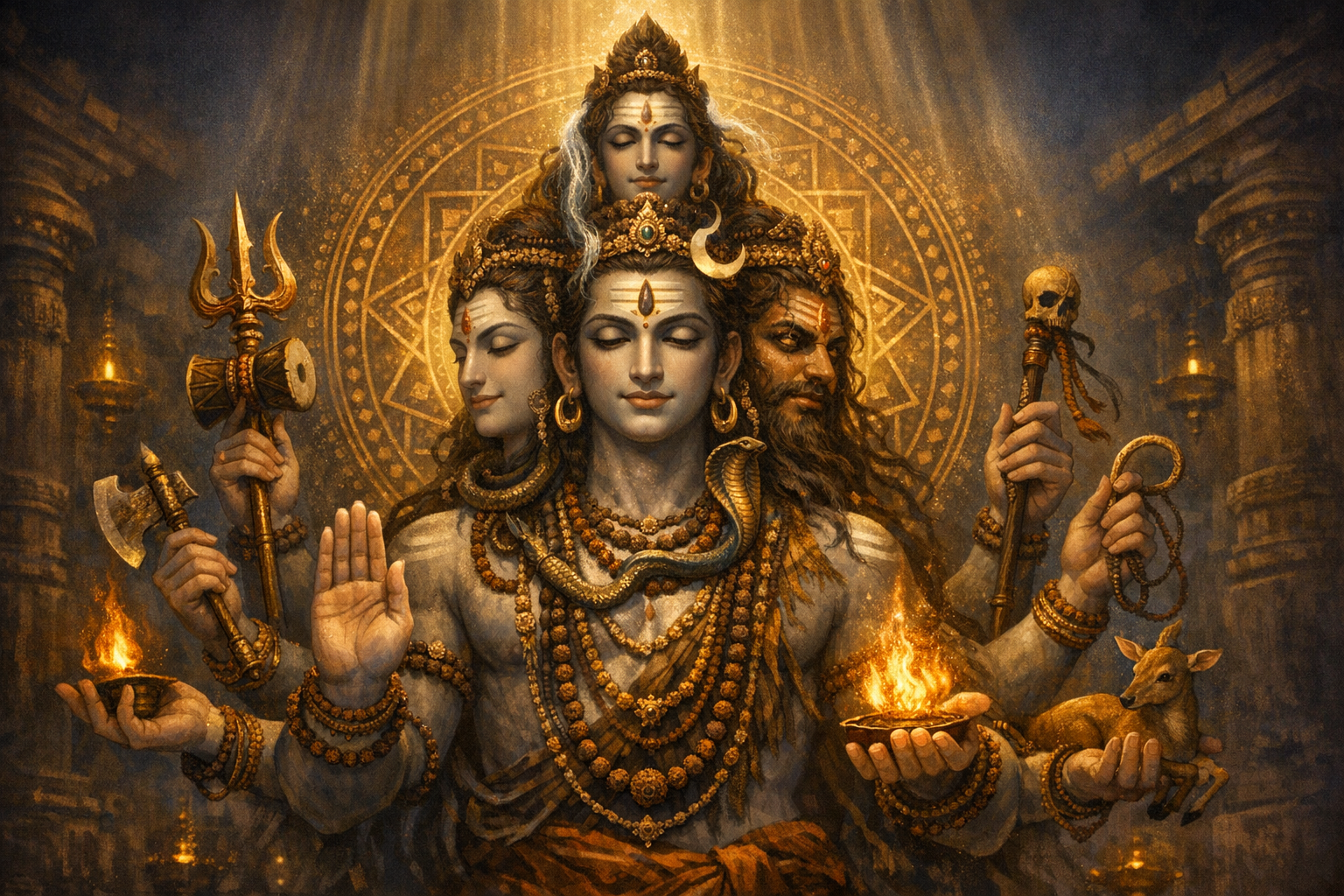
Sadashiva stands in the Shaiva Agamas and the broader tradition of Shaiva Siddhanta as the unified, sovereign presence of the divine — the highest principle of reality, the eternal, unchanging consciousness that pervades, sustains, and ultimately dissolves all of creation. In sculptural and liturgical practice, this supreme presence is most evocatively realized as Panchamukha (five-faced) and daśa-bāhu (ten-armed), an arresting icon that fuses metaphysics and image into a single, contemplative whole. The Unified Cosmic Form of the Pancha Brahma becomes visible here, not merely as art, but as embodied doctrine.
The very name ‘Sadashiva’ conveys the idea of the ever-auspicious and ever-awakened: ‘Sada’ (ever) and ‘Shiva’ (auspicious, beneficent). In Shaiva Siddhanta’s map of reality, Sadashiva corresponds to a refined ontological stratum where icchā (will), jñāna (knowledge), and kriyā (action) harmonize in the light of anugraha (grace). This is the liminal, radiant threshold between the absolute (Pati) and the unfolding of experience (paśu and pāśa), where consciousness recognizes itself as the source and end of all manifestation.
As icon, Sadashiva is Panchamukha — the five-faced embodiment of the Pancha Brahma: Sadyojāta, Vāmadeva, Aghora, Tatpuruṣa, and Īśāna. These faces, prescribed in Agamic canons such as the Kāmikāgama, Suprabhedāgama, Ajitāgama, and others, are oriented to the cardinal directions with a subtle ascent toward the zenith. A commonly transmitted arrangement reads: Tatpuruṣa to the east (the forward, contemplative visage), Aghora to the south (the awe-inspiring transform), Vāmadeva to the north (the soothing preservation), Sadyojāta to the west (immediate creation), and Īśāna upward (transcendent grace). Together, they articulate the pañcakṛtya — creation, preservation, dissolution, concealment, and gracious revelation — suggesting that all directions and all states are already encompassed within consciousness.
Across textual lineages, these faces also carry resonances with Vedic currents, mantric clusters, and elemental matrices. While specific correlations vary by school and period, a stable doctrinal insight endures: each face is not an isolated deity but a differentiated facet of a single, indivisible awareness. Thus, when sculpture presents five faces turned to the horizons and the sky, the icon teaches that the field of reality — space, time, and the subtle interior — is one, continuous presence.
Equally instructive is the daśa-bāhu (ten-armed) configuration. Agamic prescriptions allow two, four, eight, or ten arms, but the ten-armed Sadaśiva serves as a comprehensive visual liturgy. Variants differ across regions and manuals, yet a broadly attested vocabulary of attributes appears: triśūla (trident) and ḍamaru (drum) to declare rhythm and sovereignty; paraśu (axe) and khaṭvāṅga (club-staff) to sever bondage; pāśa (noose) and aṅkuśa (goad) to guide and restrain; agni (flame) for purificatory transformation; mṛga (antelope) for the mind’s leap mastered; akṣamālā (rosary) for contemplative continuity; and kapāla (skull cup) to signify the transcendence of form. Abhaya and varada mudrās commonly occupy prominent hands, bringing fearlessness and benefaction to the fore. The precise combination reflects both doctrinal emphasis and local stylistic norms, but the teaching is consistent: infinite capacities flow from, and resolve into, one auspicious awareness.
Other attributes complete the canonical image. The third eye (ūrṇanābha) proclaims interior vision; the crescent moon and the presence of Gaṅgā in the jaṭā (matted locks) anchor cosmic time and flow; serpents serve as the yajñopavīta (sacred thread) or ornaments, denoting awakened energies subdued and sanctified. The jaṭā-mukuṭa (matted-hair crown) rises like a vertical axis mundi, and the body, adorned with rudrākṣa, often bears the vibhāti (sacred ash), signaling the wisdom of impermanence and the clarity of detachment.
The Panchamukha orientation is not solely symbolic; it is spatial pedagogy. As a viewer circumnavigates the murti, each face and attribute comes to meet the gaze from a different quadrant. This choreographs contemplation: from the contemplative stillness of Tatpuruṣa, through the transforming awe of Aghora, to the restorative poise of Vāmadeva, the freshness of Sadyojāta, and the upward, unbounded vision of Īśāna. Many temple-goers report a felt sense of being seen from all sides — an affirmation that no direction lies outside compassion and no moment falls beyond insight.
In practice, Sadashiva may appear either as a full-bodied icon (sakala) or as a mukhaliṅga, where one or more faces emerge from the liṅga’s cylindrical core. The latter remains especially prevalent across South and Southeast Asia. Khmer and Cham ateliers, influenced by Agamic currents, developed refined mukhaliṅgas; in India, from the Chalukyas and Pallavas to the Cholas and Hoysalas, sculptors carved or cast multi-faced Shiva forms in stone and bronze, translating theology into line, texture, and poise. Regional grammars differ, yet the aesthetic constant is a synthesis of alertness and repose — a body that moves without motion, a face that speaks through silence.
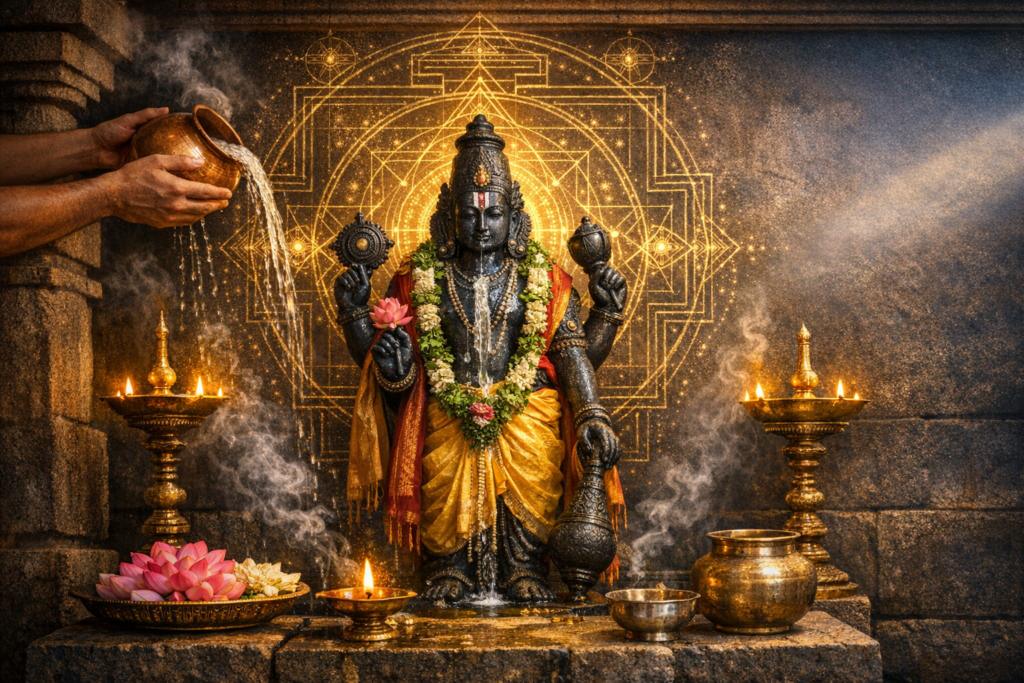
The ritual context enlarges the icon’s meaning. In many temples, pañcabrahma-related worship infuses daily or festival liturgy, with mantras and offerings calibrated to the five functions. Abhiṣeka (ritual bathing), alaṅkāra (adorning), and arcana (offering) to Panchamukha Sadaśiva are not pageantry but pedagogy: they align outward gestures with inward recognition. When the ten arms display instruments of rule and liberation, the devotee sees a mirror of the inner path — effort, surrender, discernment, discipline, remembrance, and finally, grace.
From an art-historical perspective, the most instructive approach is comparative. Textual descriptions (śilpaśāstra and āgama), surviving bronzes and stones, and regional workshop signatures must be read together. Chola bronzes tend toward rhythmic elegance; Hoysala stones favor intricate surface geometry; Orissan ateliers emphasize muscularity and ornament. Southeast Asian mukhaliṅgas often reveal a refined idealism in facial modeling. These variations, rather than dilute meaning, illustrate the Agamic insight that one reality expresses through infinite form without forfeiting its unity.
For curators, scholars, and temple visitors, a practical reading sequence helps decode Panchamukha Sadaśiva on site: first, confirm the five faces and their orientations; second, inventory the attributes by quadrant; third, note the presence of ḍamaru, triśūla, mṛga, pāśa, aṅkuśa, agni, kapāla, and the layout of mudrās; fourth, observe the jaṭā, crescent, Gaṅgā, serpent-yajñopavīta, and rudrākṣa; fifth, correlate features with specific Agamic prescriptions known for the region. Inscriptions, if present, and nearby parivāra devatā icons (Nandi, Gaṇeśa, Skanda/Śivagāṇa, the Dikpālas) refine identification. Small discrepancies in attributes typically reflect lineage or workshop choice, not error.
The philosophical grammar of the icon is as exacting as its sculptural one. The five faces imply that consciousness conducts the pañcakṛtya ceaselessly; the ten arms demonstrate that sovereignty and compassion are not opposites. Abhaya and varada visibly temper the fiercer attributes, teaching that transformation (Aghora) is inseparable from refuge and gift. The upward tilt of Īśāna reminds that transcendence is not escape but immediacy — the ever-present clear sky of awareness.
Read in a broader Dharmic horizon, the Panchamukha idiom resonates with shared Indic intuitions about cosmic order and the many-in-one. Buddhists may recall the pañca-tathāgata schema and its directional wisdoms; Jains recognize the chaumukha (four-faced) shrine form that honors the Tīrthaṅkaras in all directions; Sikhs contemplate the nirguṇa, formless Ek Onkar that pervades without boundary. These are not identical doctrines, yet they converge on a unitive insight: ultimate reality neither excludes diversity nor is confined by it. The Panchamukha Sadaśiva icon, therefore, becomes a bridge — a reminder of common ground across Hinduism, Buddhism, Jainism, and Sikhism in the shared pursuit of liberation, wisdom, and compassionate living.
The presence of Sadashiva in temples also clarifies the relationship between aniconic and iconic forms. The liṅga signifies the axis and infinitude of consciousness; the Panchamukha and daśa-bāhu embodiments articulate that infinitude into legible teaching. Where a mukhaliṅga appears, the boundary dissolves altogether — the axial form itself speaks, wearing the faces of the directions and the sky. In each case, the devotee is invited from symbol to insight: from seeing to knowing, from knowing to being.
Scholars note that Agamic manuals allow measured variation so that local traditions can serve living communities without losing doctrinal integrity. This explains why, in some images, a hand that holds agni elsewhere extends in varada, or why the mṛga appears leaping from the palm in one region and steadied close to the chest in another. The discipline lies not in rigid uniformity but in coherent transmission — a discipline well-observed across centuries of stone and bronze.
In museums and galleries, careful labeling should present both the philosophical and iconographic matrices: name (Sadashiva, Panchamukha), textual anchoring (Shaiva Agamas; Shaiva Siddhanta), directional faces (Tatpuruṣa, Aghora, Vāmadeva, Sadyojāta, Īśāna), principal attributes (triśūla, ḍamaru, mṛga, pāśa, aṅkuśa, agni, kapāla, akṣamālā), and regional workshop signatures. Doing so empowers viewers — including those new to Hindu art — to meet the image not as exotic ornament but as a worked-out visual philosophy of consciousness and compassion.
For many, the most profound encounter with Panchamukha Sadaśiva is experiential: circumambulating the murti while the ḍamaru’s rhythm and mantra recitations weave through the sanctum, a feeling arises that every direction opens inward. The five faces do not multiply the divine; they multiply the ways in which the divine becomes intelligible — to the heart seeking refuge, the mind seeking clarity, and the will seeking freedom. The ten arms do not threaten; they reassure that the tools of awakening are already present and perfectly placed.
In sum, Sadashiva — the Panchamukha, daśa-bāhu Lord — renders the Shaiva insight transparent: one consciousness lives as all directions and returns as grace. The Unified Cosmic Form of the Pancha Brahma is both doctrine and presence, inviting a contemplative gaze that finds unity in variety and repose in the very heart of change. To study this icon carefully is to learn how Hindu sculpture teaches, how temples think, and how Dharma across traditions recognizes itself as a shared path to liberation.
Inspired by this post on Hindu Blog.