The Mahanarayana Upanishad (Mahānārāyaṇa Upaniṣad), also known in the tradition as the Yājñikī Upaniṣad, occupies a distinctive place in the Krishna Yajurveda as the tenth prapāṭhaka of the Taittirīya Āraṇyaka. It weaves together liturgical detail, meditative practice, and metaphysical insight into a single continuum, demonstrating how Vedic ritual (yajña), contemplative upāsanā, and liberating knowledge (jñāna) are intended to converge rather than compete. In doing so, it serves as a vital bridge between the Brāhmaṇa and Upaniṣadic idioms, preserving mantras while opening them toward inward realization.
Situated at the cusp of practice and theory within the Vedic corpus, the text is both encyclopedic and integrative. Its inclusion within the Taittirīya Āraṇyaka underscores an ashrama-appropriate pedagogy: after a grounding in śrauta ritualism, the student is guided into interiorization—first through upāsanā that sacralizes breath, mind, and senses, and ultimately through the nondual inquiry characteristic of the Upanishads. This progression reflects the traditional curriculum in which karma, upāsanā, and jñāna form a graded path to mokṣa.
Textually, the Mahānārāyaṇa Upaniṣad shows signs of layered composition. Recensional variation across surviving Taittirīya manuscripts affects both the ordering of anuvākas (sections) and the presence of particular hymns. Scholars generally place its core material in the late Vedic period, with editorial accretions over time as ritual and contemplative sections were curated into a liturgical compendium. This multivocality is a strength: it preserves early Vedic diction alongside reflective prose that anticipates classical Vedānta.
Thematically, four strands interlace throughout the work. First, precise ritual and benedictory usages situate mantras in the context of homa and domestic worship. Second, an anthology-like preservation of celebrated Vedic hymns ensures their recitation within a coherent soteriological frame. Third, systematic upāsanā internalizes sacrificial symbolism, transposing the outer altar to the body and breath. Finally, philosophical passages articulate the Upanishadic vision of Brahman and ātman as the single, all-pervading reality.
Among its best-known selections are the Nārāyaṇa Sūkta, the Medhā Sūkta, and the Durga Sūkta, preserved here in a manner that allows both independent recitation and thematic integration with surrounding passages. The Nārāyaṇa Sūkta affirms Nārāyaṇa as the immanent and transcendent ground of cosmos and consciousness. The Medhā Sūkta seeks steadfast intelligence and memory—qualities prized in Vedic pedagogy. The Durga Sūkta invokes protective, purifying energies aligned with inner fortitude. In many recensional traditions, the text also preserves invocations and śānti mantras that frame practice with an ethos of calm clarity.
The theology of the Mahānārāyaṇa Upaniṣad is unifying rather than sectarian. While honoring Nārāyaṇa as the highest Brahman, it repeatedly affirms the sarvadevatā-sāmānya—an insight that various deities are luminous facets of a single reality. Passages that align Rudra and Viṣṇu within the same absolute ground exemplify a characteristic Vedic inclusivism. The result is a vision in which devotion (bhakti), ritual duty (dharma), and nondual discernment (advaita-vidyā) reinforce one another.
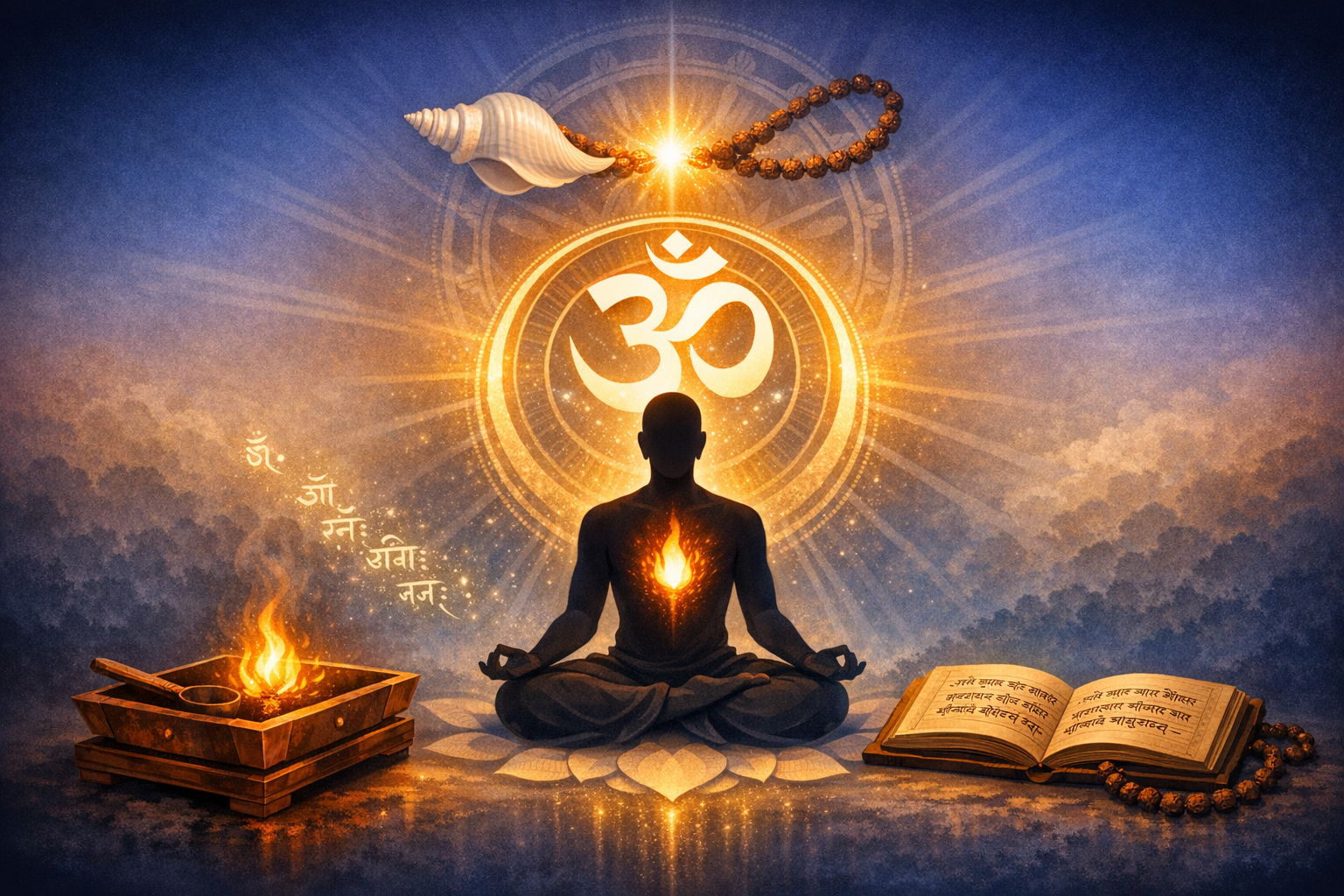
One of its enduring contributions is the interiorization of yajña. Fire is not merely external; prāṇa becomes the inner flame, the senses the priests, and awareness the sacred ladle. This prāṇāgnihotra recodes sacrificial grammar into a contemplative physiology, guiding practitioners from symbolic offering to sustained attention and insight. Closely related are contemplations on Oṃ and the vyāhṛtis (bhūr, bhuvaḥ, svaḥ and their extended series), which map cosmic layers onto speech, breath, and mind.
As a handbook of meditation, the Upanishad places mantra-japa, breath awareness, and imaginal contemplation (bhāvana) at the heart of practice. The rhythmic recitation of seed verses stabilizes attention, while targeted upāsanās align inner perception with cosmic order (ṛta). These techniques resonate with the wider dharmic ecology: breath-centered mindfulness parallels Buddhist meditation on the inhalation and exhalation, disciplined equanimity echoes Jain dhyāna and vrata-based ethics, and the sanctification of sound harmonizes with Sikh nām-simran and the primacy of śabda. Such convergences highlight shared commitments to nonviolence, truthfulness, and interior freedom across Hinduism, Buddhism, Jainism, and Sikhism.
In lived tradition, the Mahānārāyaṇa Upaniṣad informs both temple and domestic liturgy. Vaiṣṇava worship often incorporates the Nārāyaṇa Sūkta; Smārta practice frequently includes the Durga Sūkta and Medhā Sūkta; Śaiva recitations draw on sections that integrate Rudra within the text’s nondual horizon. This cross-sect usage exemplifies the Upanishad’s ecumenical reach, enabling communities to chant common mantras while retaining distinctive devotional accents.
Linguistically, the text exhibits a rich interplay of mantra and explanatory prose. Hymnic segments display classical Vedic metrical patterns such as gāyatrī and triṣṭubh, while prose clarifications guide ritual usage or contemplative focus. The diction is archaic yet supple, with semantic fields that support both sacrificial precision and philosophical generalization. This stylistic duality allows the same mantra to function as liturgy, meditation seed, and metaphysical pointer.
Ethically, the Upanishad locates liberation within a life of dharma. The cultivation of medhā (lucid intelligence), satya (truth), ahiṃsā (non-harm), and dāna (generosity) appears not as optional adornment but as the moral framework that makes contemplative knowledge transformative. In this moral-spiritual synthesis, one recognizes a family resemblance with the Buddhist triad of śīla–samādhi–prajñā, the Jain emphasis on ahiṃsā and aparigraha, and the Sikh spirit of sarbat da bhala (welfare of all).
For students of Vedānta, the Mahānārāyaṇa Upaniṣad is an ideal text through which to observe the transition from karma-kāṇḍa to jñāna-kāṇḍa in real time. Its pedagogy moves from outer precision to inner simplicity, ultimately resting in the insight that ātman is not other than Brahman. For practitioners, it offers a repertory of mantras and contemplations that can be modulated to household rhythms, temple festivals, or dedicated retreats.
Modern readers often find that the Upanishad’s integrative method reduces the perceived tension between ritual observance and meditative stillness. By teaching how to internalize sacred action, the text invites a continuity of awareness that extends beyond the sacrificial enclosure into daily life. In this way, it models a dharmic unity where diverse methods complement a single purpose: the stabilization of insight and the flowering of compassion.
A sound study approach begins with reliable editions of the Taittirīya Āraṇyaka and careful attention to recensional notes. Selected daily chants—such as the Nārāyaṇa, Durga, and Medhā Sūktas—can be coupled with periodic, slower readings of contemplative sections that map prāṇa, speech, and mind onto cosmic structures. Reflection and journaling of insights support the classical cycle of śravaṇa (listening), manana (reasoned assimilation), and nididhyāsana (steady contemplation).
In sum, the Mahānārāyaṇa Upaniṣad preserves the living grammar of Vedic spirituality: liturgy that consecrates life, meditation that clarifies mind, and wisdom that recognizes oneness. Its inclusive theology and practical guidance continue to nourish a shared dharmic culture across Hindu, Buddhist, Jain, and Sikh traditions, affirming unity without erasing the unique contributions of each path.
Inspired by this post on Hindu Blog.