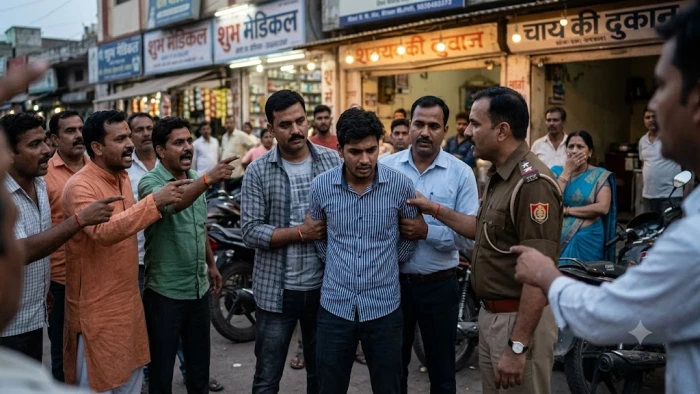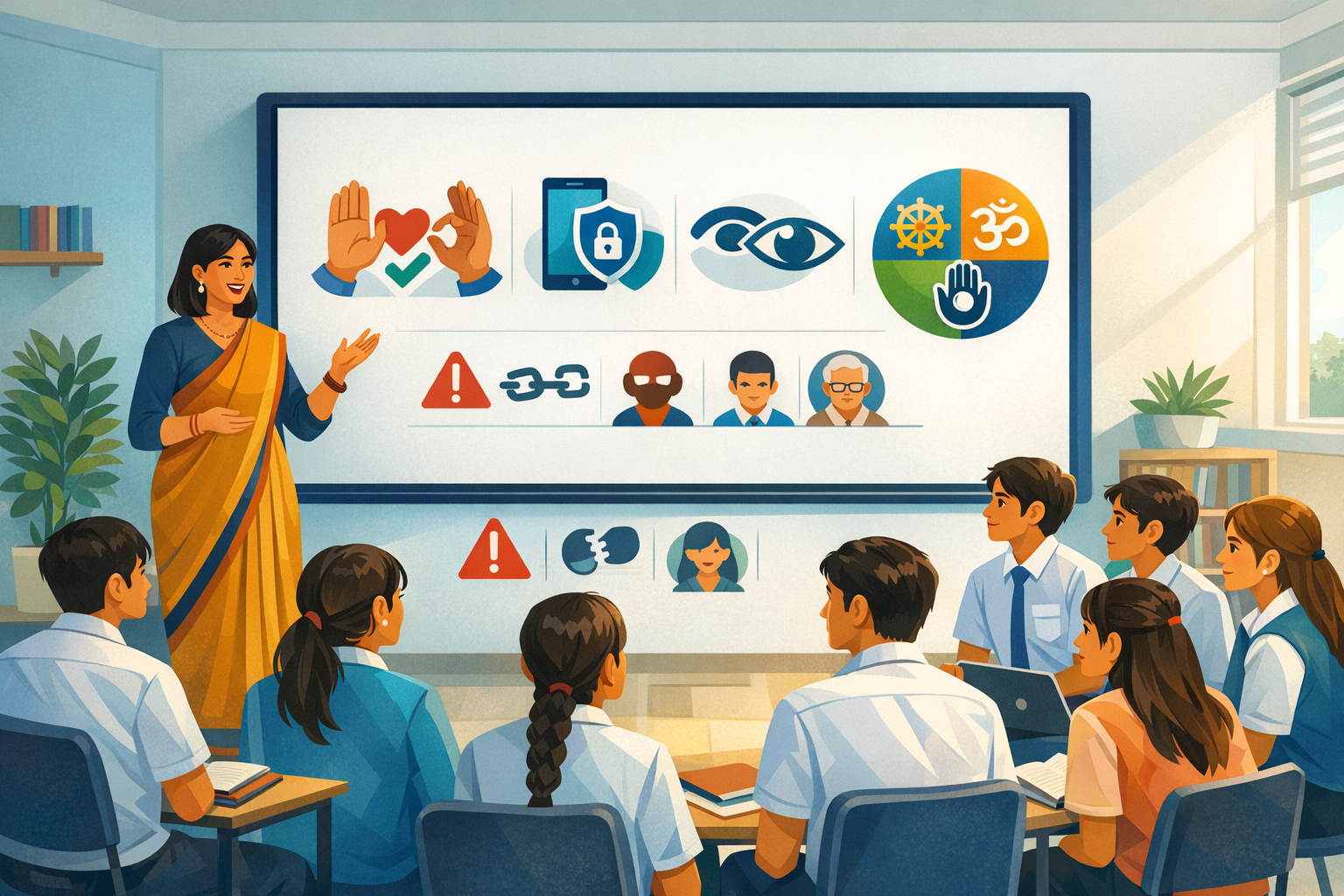
At a Noida school in Uttar Pradesh, Hindu Janajagruti Samiti (HJS) conducted a student-safety awareness lecturedescribed in public discourse as a talk on ‘Love Jihad’that drew nearly 100 students. The session sought to build awareness about potential implications and consequences of coercive relationship dynamics and online grooming, while foregrounding informed consent, legal literacy, digital safety, and interfaith respect within a school-based learning environment.
Positioned within a unity-first framework appropriate to a diverse classroom, the session was framed as a safeguarding and ethics conversation rather than a community-versus-community narrative. The instructional emphasis aligned with the broader educational goal of equipping adolescents to recognize manipulative behaviors in any relationship context, uphold constitutional values, and make safe, lawful, and respectful choicesirrespective of religious identity.
The term ‘Love Jihad’ is socially contested and does not constitute a defined category in Indian criminal law. In school settings, an evidence-informed, rights-based pedagogy is essential: students benefit most when taught the universal markers of coercion and the protections available in law, without attributing malfeasance to any faith group. This approach advances both student well-being and interfaith harmony, supporting unity among dharmic traditionsHinduism, Buddhism, Jainism, and Sikhismthrough shared ethical commitments to non-harm, truthfulness, compassion, and mutual respect.
Adolescents today navigate a smartphone-first world where intense emotions, nascent identity formation, and peer influence intersect with algorithmic feeds and persistent online contact. Students often report uncertainty about boundaries, confusion around consent, and difficulty parsing attention from manipulation. Addressing these lived realitiescalmly, factually, and empatheticallyhelps translate abstract rules into practical, protective behaviors they can apply immediately.
Across contexts, coercive relationships tend to share recognizable red flags: rapid escalations of intimacy, secrecy requests, attempts to isolate a student from family or friends, persistent pressure to change personal beliefs, demeaning comments or threats, financial or reputational extortion, identity misrepresentation, and the use of shame to control behavior. Training students to name these patterns, seek help early, and document concerning interactions increases personal agency and reduces vulnerability.
Cyber safety is central. Practical guidance for teens includes strong authentication and privacy defaults; verifying identities before trust is extended; avoiding geotagging and oversharing; understanding that “disappearing” messages can be saved; declining requests for intimate content; recognizing sextortion attempts; and knowing how to preserve evidence (screenshots, logs) for formal reporting. A clear, judgment-free pathway to approach trusted adultsteachers, counselors, or guardiansencourages early intervention.
Legal literacy anchors ethical decision-making. Key frameworks relevant to adolescent protection include the Protection of Children from Sexual Offences (POCSO) Act (age of consent is 18), the Prohibition of Child Marriage Act (PCMA), and applicable sections of the Indian Penal Code on stalking, intimidation, abduction, and cheating. Provisions of the Information Technology Act addressing identity theft, impersonation, privacy violations, and the non-consensual circulation of intimate content are also pertinent. Where interfaith relationships are freely chosen by consenting adults, the Special Marriage Act, 1954, offers a lawful civil pathway that respects personal liberty and equality before the law; where coercion is alleged, due process and evidence-based investigation are paramount.
A unity-affirming civic lens is equally important. Article 21 of the Constitution safeguards personal liberty, and Article 25 guarantees freedom of conscience and religion. Framing classroom dialogue around these principlesalongside the norms of consent, dignity, and non-discriminationreinforces that student safety and interfaith cohesion are mutually reinforcing goals, not competing agendas.
Pedagogically, scenario-based learning, social-emotional learning (SEL), and critical media literacy (distinguishing rumor from evidence) help students internalize protective habits. Role-play around boundary-setting, refusal skills, and bystander intervention cultivates confidence. Short pre- and post-session reflections (or surveys) allow schools to gauge comprehension gains, identify gaps, and plan follow-on modules.
School-level safeguarding works best when anchored in clear, student-friendly reporting protocols and a multidisciplinary response. Age-appropriate child protection policies, designated points of contact, counselor availability, and documented escalation pathways to external child protection services, where necessary, strengthen trust. Confidentiality, non-retaliation assurances, and timely feedback to students who seek help are essential to an ethical response system.
Parents and educators are most effective when they combine vigilance with non-judgmental listening. Regular family check-ins about online experiences, guidance on balancing autonomy with safety, and shared decision-making about digital boundaries reduce secrecy and increase help-seeking behavior. In parallel, educators can normalize conversations about consent and respectful relationships in life-skills curricula, ensuring that safety is taught proactively rather than reactively.
From a dharmic perspective, the shared ethical core across Hinduism, Buddhism, Jainism, and Sikhismahimsa, satya, daya/karuna, and sevanaturally supports student safeguarding and interfaith goodwill. Classroom emphasis on these convergences demonstrates that dignity, consent, and mutual respect are not only civic values but also deeply rooted civilizational imperatives, thereby strengthening unity in diversity.
Early feedback from similar school-based awareness programmes indicates that students value clear examples, plain-language legal explanations, and actionable “what to do next” steps. Sessions that avoid pejorative labels, present verified information, and consistently affirm respect for all communities tend to elicit more candid student questions and lead to stronger retention of safety practices. Such outcomes are feasible to replicate across schools in Noida and the wider Uttar Pradesh education ecosystem.
In sum, the Noida lectureattended by nearly 100 studentshighlights a scalable, student-centered approach to safeguarding: teach universal warning signs, strengthen cyber hygiene, clarify legal rights and responsibilities, and anchor all guidance in constitutional values and dharmic ethics. When schools foreground consent, due process, and interfaith respect, they help adolescents navigate relationships with confidence and compassion, while reinforcing a cohesive and harmonious social fabric.
Inspired by this post on Hindu Jagruti Samiti.