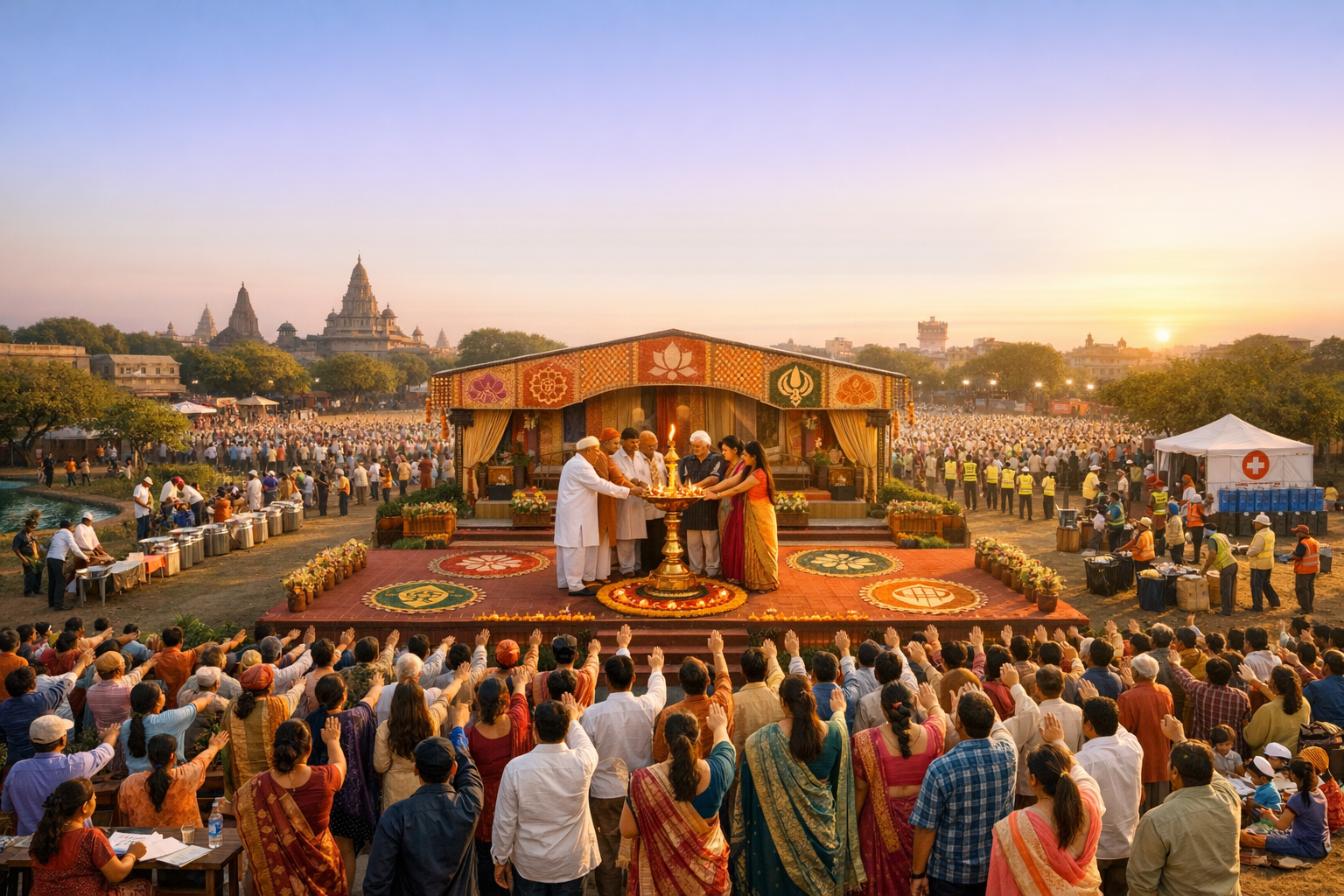
Over 10,000 participants gathered in Solapur for the Hindu Rashtra-Jagruti Sabha, publicly pledging to protect Dharma and to foster an awakened, self-reliant Hindu society. The scale and discipline of the assembly signaled a civic-minded commitment to translate spiritual values into ethical action within the bounds of law and non-violence.
In practical terms, the pledge emphasized safeguarding Sanatan Dharma’s living traditionsritual, learning, seva, and community harmonythrough everyday conduct rather than adversarial posturing. The animating idea, akin to lokasangraha (the welfare of the world), is to elevate shared well-being over performative rhetoric and to privilege constructive service over polarization.
Clarifying the lexicon is essential. In this context, Dharma denotes duty, virtue, and right order; Rashtra refers to the civic-political community; jagruti signals ethical awakening; and sabha is the deliberative assembly. Read together, the phrase Hindu Rashtra-Jagruti Sabha communicates a program of cultural awakening directed toward responsible citizenship, not theocracy.
A rights-based framing aligns such commitments with Articles 19(1)(a) and 25–28 of the Constitution of India, which safeguard freedoms of expression and religion subject to public order, morality, and health. This legal context provides a principled foundation for peaceful association, open dialogue, and inclusive community-building.
Crucially, the ethical vocabulary invoked at the sabha resonates across dharmic traditions. The shared emphasis on ahimsa and compassion (Buddhism), aparigraha and self-restraint (Jainism), and seva and Sarbat da Bhala (Sikhism) converges with Hindu understandings of dharma, enabling a broad platform for unity without erasing doctrinal diversity.
The pledge naturally lends itself to service-first implementation. High-impact pathways include annadanam, cleanliness drives around temples and public spaces, support for seniors and the differently abled, tutoring for students from underserved backgrounds, and blood-donation campsinitiatives that embody dharma in action and produce visible civic benefits.
Safeguarding cultural heritage is a continuum that includes documenting local rituals, conserving temple architecture and manuscripts, supporting Samskritam and regional languages, and curating public exhibitions. Such work strengthens social memory while encouraging accurate, non-polemical presentations of India’s plural civilizational history.
Managing a 10,000-person gathering requires disciplined logistics. Volunteer marshals, first-aid points, hydration stations, clear entry–exit lanes, child-safety protocols, and reliable public-address systems are standard best practices that convert large assemblies into safe, dignified spaces and foster public trust.
Ethical communication is indispensable for preventing polarization. Digital literacyfact-checking workflows, source triangulation for images and videos, and respectful social-media engagementkeeps advocacy truth-based and non-inflammatory, aligning discourse with both dharmic ethics and constitutional responsibilities.
Women’s leadership and youth participation deepen resilience and continuity. Programs that integrate self-defence with civic education, vocational mentoring, and leadership labs translate symbolic pledges into durable human capital while broadening participation across age and gender.
Inclusion is best framed as an affirmative recognition that multiple sadhanas flourish within Sanatan Dharma. Conscious efforts to avoid sectarian gatekeepingwhether across sampradayas or along caste and regional linesfortify social trust and reflect India’s constitutional pluralism.
Environmental stewardship naturally aligns with dharmic duty toward prakriti. Tree-planting near water bodies, heritage seed exchanges, plastic-waste audits at festivals, and sacred-groves restoration operationalize reverence for nature through measurable public goods and community participation.
Clear metrics translate intent into accountability. Suggested indicators include volunteer-hours logged, number of beneficiaries served, literacy and scholarship outcomes, temple and public-space cleanliness indices, quantities of food redistributed, and participation diversity across age, gender, and socio-economic groups.
Solapur’s position at a cultural crossroads in Maharashtra makes it a strategic venue for such mobilization. The city’s weaving traditions, educational institutions, and temple networks provide platforms for year-round service, dialogue, and heritage conservation that can amplify the sabha’s momentum.
Assemblies as instruments of ethical deliberation have deep rootsfrom Vedic sabhas and samitis to medieval panchayats and modern civic associations. The Solapur sabha fits this long arc of participatory self-strengthening within India’s civilizational ethos and exemplifies how public vows can reinforce shared norms.
Replicability depends on modular design and transparent governance. Neighborhood teams, partnerships with accredited NGOs, open financial reporting, and periodic community dashboards help avoid personality cults while keeping focus on dharma-aligned outcomes and measurable improvements in local quality of life.
Where concerns arise about majoritarianism or exclusion, the most credible reassurance is conduct: consistent adherence to ahimsa, respect for constitutional limits, collaboration with inter-dharmic partners, and unequivocal rejection of hate speech or coercion. Clarity on these guardrails sustains moral authority and invites broad cooperation.
By drawing over 10,000 citizens into a public pledge to protect Dharma, the Hindu Rashtra-Jagruti Sabha in Solapur signaled energy, discipline, and resolve. When channelled into service, heritage conservation, and inclusive leadership, that energy becomes a peaceful blueprint for dharmic unitystrengthening Hindu society while honoring the shared ethical horizons of Buddhism, Jainism, and Sikhism.
Inspired by this post on Hindu Jagruti Samiti.