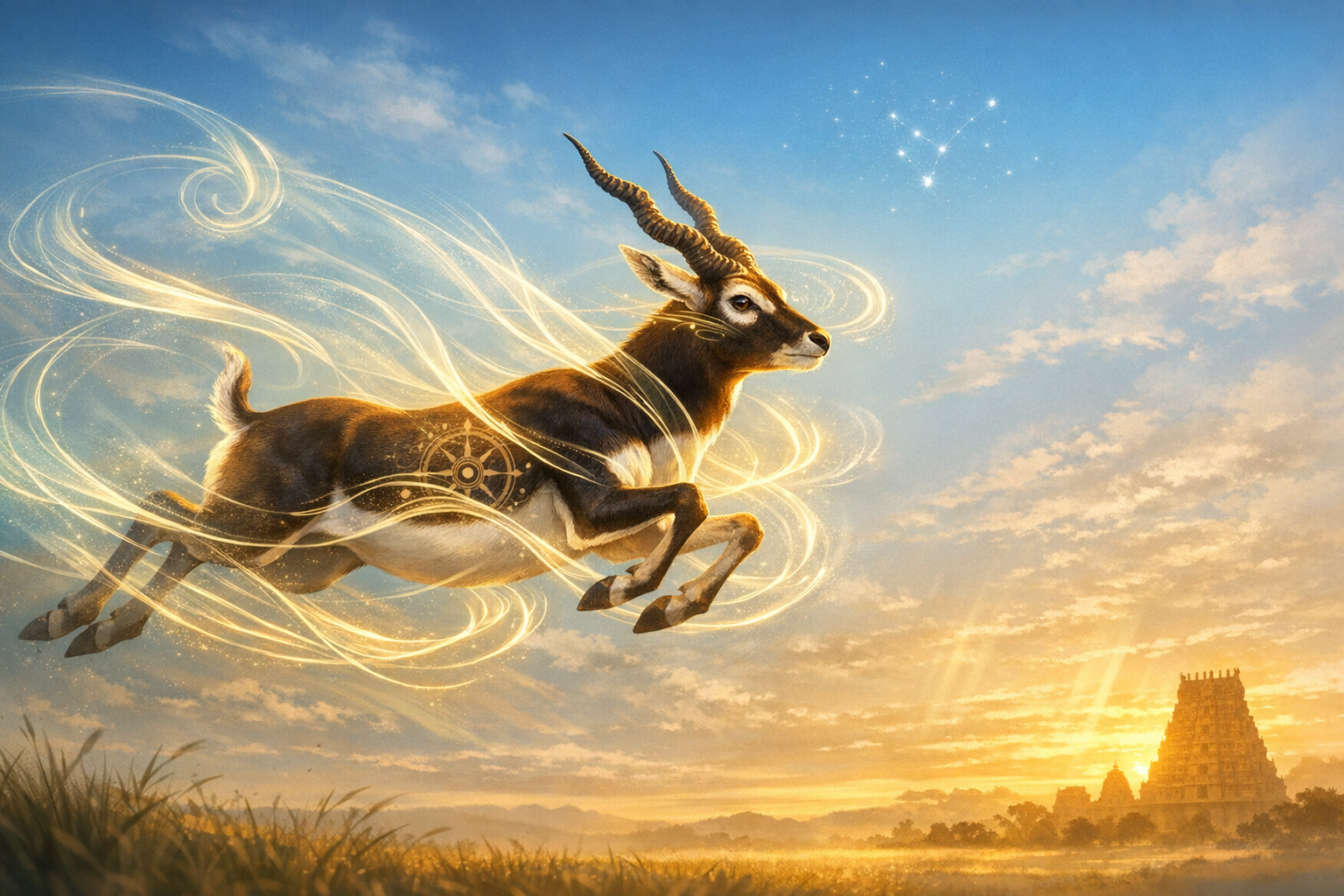
Within the sacred visual grammar of Hinduism, every deity’s vahana (vehicle) functions as a condensed theological statement. The pairing of Vayuthe Wind God and lord of prana (vital breath)with the gazelle or antelope (mriga) is among the tradition’s most eloquent images. Far more than a motif of motion, this icon conveys the speed, subtlety, and liberating lightness of breath that animates body, mind, and spirit. Read as a spiritual diagram, the gazelle of Vayu maps how life-force moves swiftly yet gently, guiding aspirants from mere vitality toward inner freedom (moksha). This essay interprets the symbol across scriptures, iconography, yogic physiology, classical astrology, and living practices, while situating it in a wider dharmic conversation that also embraces Buddhism, Jainism, and Sikhism.
Vahanas in Hindu iconography are not transport devices but semiotic carriers that exteriorize a deity’s qualities. As a rule, the animal or emblem mirrors the god’s guna, domain, and mode of action: Agni’s ram signals heat and vigor; Varuna’s makara evokes depth and liminality; and Vayu’s gazelle/antelope communicates velocity, attentiveness, and an almost weightless grace. Classical shilpa and agama traditions develop these visual codes so that devotees can “read” the metaphysics at a glance. In this sense, Vayu upon the mriga is an invitation to contemplate breath as a disciplined, auspicious force rather than a merely automatic function.
Historical sources and regional schools present Vayu in multiple iconographiessometimes riding an antelope or gazelle, at other times in a chariot drawn by swift steeds or antelopes. This variation is typical of Puranic and shilpa traditions, where local aesthetics and textual lineages interact. The constant is the accent on speed and subtlety: wind as the first to arrive, the ever-moving principle, the messenger that touches all beings without clinging to any. The mriga, light-footed and hyper-alert, becomes a natural emblem of that presence.
Why the gazelle or antelope? Biologically, these animals are built for economy and accelerationmuscle and tendon tuned to sudden turns, a stride that covers ground with astonishing efficiency, and senses that register change before it becomes danger. Symbolically, they teach how life-force operates: not in lumbering exertion but in precise, elastic bursts that are effective because they are unobstructed. In spiritual terms, this is prana freed from heavinessvitality flowing where attention is clear and attachments are light.
The Sanskrit “mriga” carries the sense of “seeking” or “tracking,” which nuances the icon further. The mind, too, seekssometimes wisely, sometimes in mirage (mriga-trishna), chasing images that dissolve on approach. Vayu upon the mriga instructs that breath is the first regulator of this impulse. When prana steadies, seeking becomes inquiry rather than pursuit; attention turns from moving after objects to resting in insight. The vehicle thus encodes a method: guide the seeker by guiding the breath.
Vedic hymns honor Vayu for precedence and speedcalled first to the soma offering and praised for motion likened to swift steeds. The earliest textual images emphasize velocity and primacy rather than a single fixed vehicle. The antelope/gazelle association emerges with particular clarity in later iconographic corpora and regional temple traditions, where the animal’s recognizable grace made Vayu’s qualities visible to the eye. The continuity from Vedic speed to Puranic subtlety marks a deepening interpretive arc rather than a contradiction.
Upanishadic and yogic literature align Vayu with prana, the life-force that sustains and coordinates the organism. Breath is not incidental here; it is formative, the organizing rhythm of embodied life. When a form stops breathing, it returns its borrowed motion to the great wind. In this light, Vayu’s vehicle is not merely the faster creature; it is the emblem of the subtle, self-regulating intelligence of breath that animates mind and body with minimal waste and maximal alertness.
Yogic physiology articulates five principal movements of vital windprana (inward, nourishing), apana (downward, eliminating), samana (inward, assimilative), udana (upward, expressive), and vyana (pervasive, integrative). Each can be glimpsed in the gazelle metaphor: prana as the poised intake before the leap; apana as grounded stability; samana as efficient conversion; udana as elevation from ground to air; and vyana as the coordinated, whole-body spread of motion. The vehicle therefore becomes a teaching device: by observing the animal’s economy of movement, one learns to sense the five vayus within one’s own practice.
Classical texts also describe upaprana (auxiliary winds)naga, kurma, krikara, devadatta, and dhananjayagoverning reflexes like belching, blinking, sneezing, yawning, and the residual energy that lingers after death. These map to micro-adjustments seen in a prey animal’s vigilance: the blink, the twitch, the sudden nostril flare before a shift in direction. In meditation and pranayama, cultivating sensitivity to these micro-movements refines attention; what appears trivial is, in fact, the grammar of embodied awareness. In this way, Vayu’s mriga teaches that mastery is won in the subtleties, not the spectacles.
From a practical standpoint, pranayama translates the symbol into method. Gentle, even inhalations (prana) and complete, unforced exhalations (apana) steady the nervous system; kumbhaka (skillful pause) introduces the poised stillness that precedes the leap. As patterns settle, the “gazelle” quality emerges in daily actionresponses become precise and timely rather than hurried or inert. Over time, such breath-centered living turns velocity into clarity, and clarity into freedom from reactivity.
Astrologically, Mrigashira Nakshatra, the “Deer’s/ Gazelle’s Head,” resonates with themes of seeking, curiosity, refinement, and gentle alertness. While Mrigashira is classically associated with Soma (the Moon) rather than Vayu, the shared mriga archetype deepens the icon’s interpretive reach. Where Mrigashira highlights tender inquisitiveness and the discernment to track truth without aggression, Vayu’s gazelle amplifies the dynamic potential of that search when breath is disciplined. The convergence suggests a practical synthesis: a mind that seeks with softness and a life-force that moves with precision.
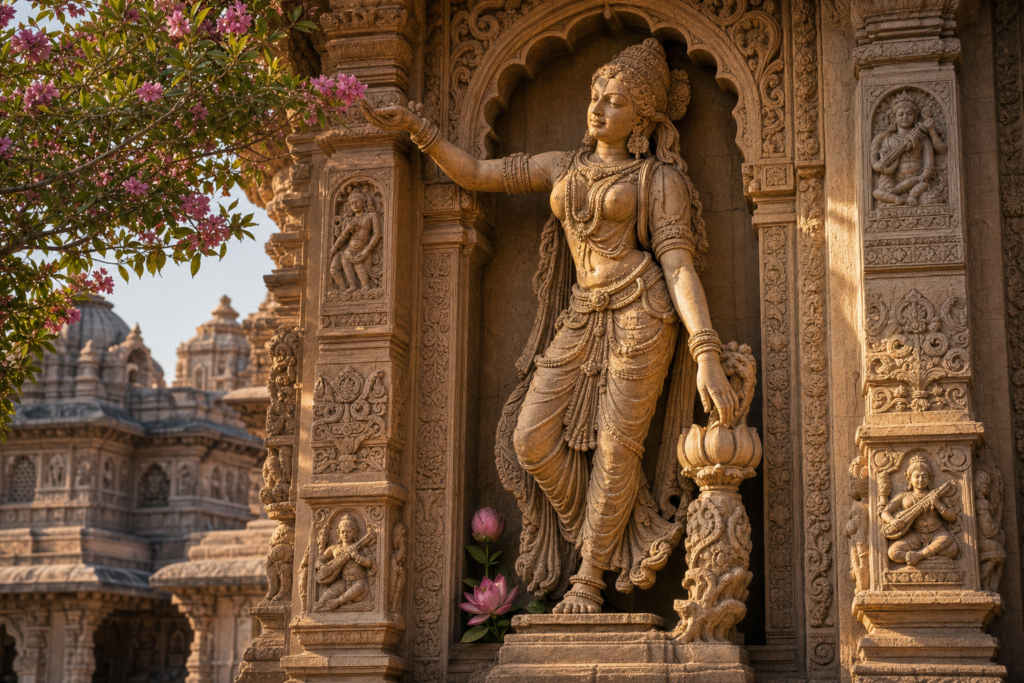
Temple tradition anchors these ideas in place and ritual. Among the Pancha Bhoota Sthalas of Shiva, Sri Kalahasti represents Vayu (wind) and has long been associated with the sanctification of breath and prana. Here, the cultic and the contemplative meetflame and incense trace wind’s contours, and chants ride the currents that carry prayer beyond individual breath. In many shrines, sculptures and reliefs of antelope and deer recall the mriga motif, reminding devotees to move through the templeand the daywith the gazelle’s mindful lightness.
Historically, ascetic manuals note deer-skin seats for meditation as insulation against dampness and as a symbol of steadiness amid nature. Contemporary practice, guided by ahimsa and ecological ethics, replaces animal skins with alternatives such as kusha-grass mats or cotton, retaining the symbolism without harm. The point remains pedagogical: sit where the “gazelle” qualitylight, poised, sustainablecan be felt, not merely imagined.
The mriga also opens a broader, unifying conversation among dharmic traditions. In Buddhism, the Deer Park at Sarnath and the two deer flanking the Dharmachakra symbolize a receptive, gentle mind listening to the first turning of the Wheel of Dharma. Contemplative traditions emphasize mindfulness of breathing (ānāpāna), and Abhidharma analyses of the wind element (vāyo-dhātu) echo the centrality of motion and lightness. The deer’s softness mirrors the non-harming spirit that sustains meditative culture.
In Jain philosophy, reverence for life reaches into the subtlest domains: air-bodied beings (vāyu-kāyika jiva) testify that what seems intangible is teemingly alive. This insight guards conductcare in movement, speech, and breathrecognizing wind as a living continuum that deserves non-violence. The ethical intuition aligns seamlessly with Vayu’s icon: one does not slash through wind; one harmonizes with it.
Sikh wisdom sings this reverence succinctly: “Pavan Guru, Pani Pita, Mata Dharat Mahat.” Air (pavan) is honored first as Guruthe teacher ever-present, subtle, and life-sustaining. In this shared dharmic ethos, breath is not private property; it is a commons of grace that obliges gratitude, restraint, and service. The gazelle of Vayu, read through this lens, becomes an ethic as much as an icon: move through the world as if every breath is a teaching.
The ecological corollary is immediate. Species such as the blackbuck (krishna mriga) have long been protected by communities like the Bishnoi, whose stewardship mirrors the dharmic respect for life and the winds that sustain it. Safeguarding habitats where antelope and gazelle thrive is not a modern addition but a natural extension of the symbol’s meaning. Protecting the “vahana” honors the “deity”; conserving the creature conserves the teaching encoded in its motion.
Ritually, invoking Vayu through stotra and mantra aligns with the icon’s message: clarity arrives on the wind. In narrative memory, Vayu’s qualities continue through Hanuman and Bhima (Vayu-putras), whose strength and speed are disciplined rather than chaotic. The continuity from deity to devotee demonstrates the symbol’s pedagogical reach: when breath is trained, courage expresses as service; when motion is mindful, power protects rather than harms.
Psychologically, the gazelle’s alertness models sattvic attentionluminous, steady, and responsive without panic. Restlessness is transmuted into readiness; sensitivity becomes strength. Here the image also cautions against rajasic overdrive (agitation) and tamasic inertia (heaviness): the right measure of movement, like the right length of stride, is what serves awareness. In this balance, Vayu’s swiftness becomes an instrument of discernment (viveka).
For contemplative practice, the symbol suggests a sequence. Begin with breath awareness: silent, unforced observation that lengthens and softens the inhalation and exhalation. Introduce simple kumbhaka to sense the clear pause before actionthe poised moment embodying the gazelle’s readiness. Extend this into daily life by pacing speech, refining posture, and moving with precision rather than hurry. Over weeks and months, this “gazelle discipline” yields a calm energy that feels lighter, clearer, and more available for ethical action.
A hermeneutic caution is also useful: iconographies differ, and in some lineages Vayu is shown primarily with a chariot. Such diversity is typical of Hindu symbolism and does not diminish the mriga reading; instead, it presents complementary doorways into the same teachingwind as motion, breath as intelligence, and life as a practice of lightness. What matters is the through-line: the Wind God’s vahana, whether read as antelope or chariot-drawn antelopes, signifies swiftness disciplined by awareness.
Taken together, the gazelle of Vayu integrates metaphysics, ethics, and method. It renders prana visible; it encodes ahimsa and ecological care; it prescribes a yogic path where breath crafts character. Read alongside the Buddhist deer of Sarnath, the Jain respect for vāyu-kāyika beings, and the Sikh invocation “Pavan Guru,” the symbol becomes a shared dharmic meditation on breath and freedom. In honoring the Wind God’s vahana, one honors the teacher in the air itselfever swift, ever gentle, ever liberating.
Inspired by this post on Hindu Blog.