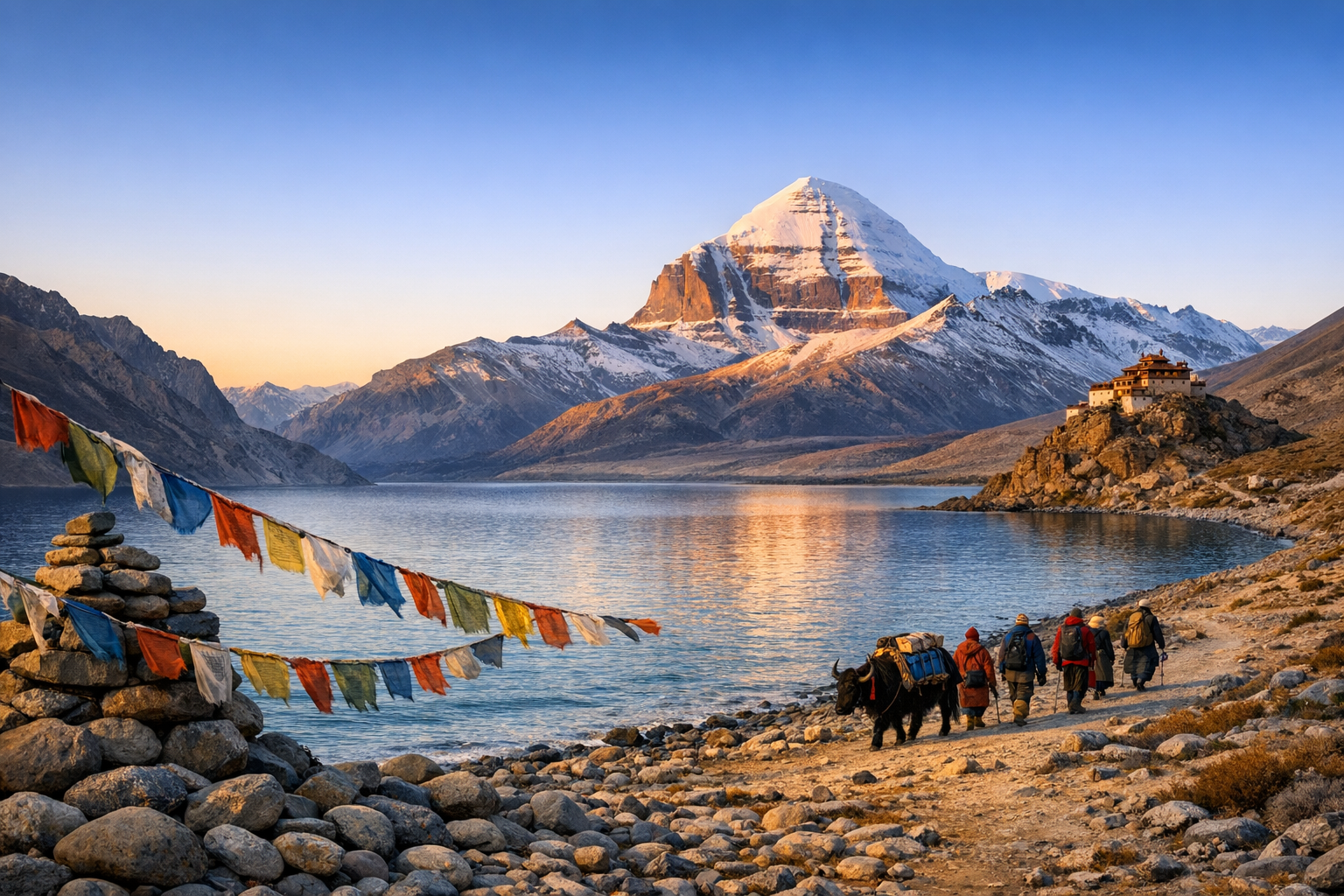
Mount Kailash, the highest summit of the Kailash Range at approximately 6,638 meters, rises in serene majesty beside Lake Manasarovar and Lake Rakshastal on the Tibetan Plateau. For countless generations across dharmic traditions, the mountain has been venerated as a sacred axis of the world, a place where spiritual geography, ritual practice, and inner transformation converge.
Within Hinduism, Mount Kailash is revered as the abode of Lord Shiva, residing with Mata Parvati, Lord Ganesha, and Kartikeya. The impulse to undertake Kailash Giri Pradakshinacircumambulating the mountain as an act of devotion (Girivalam)is anchored in this profound vision of divine presence and the timeless aspiration for inner purification, humility, and moksha.
The sanctity of Kailash extends meaningfully across Buddhism, Jainism, and the indigenous Bon tradition, nurturing a shared ethos of reverence that exemplifies unity in diversity. Buddhists know the mountain as Kang Rinpoche, “Precious Snow Mountain,” and associate it with the enlightened energy of Demchok (Chakrasamvara). Jain tradition identifies the region with Ashtapada, linked to Rishabhanatha (Adinatha). Bon pilgrims honor Kailash as a locus of primordial power. This interwoven tapestry of meanings turns the Kailash Manasarovar Yatra into a living emblem of dharmic harmony.
The circumambulation itself is known by several termspradakshina or parikrama in Sanskrit, Girivalam in Tamil, and kora in Tibetaneach capturing the same essential movement: walking mindfully around a center of sacred power. While Hindus and Buddhists customarily proceed clockwise, Bon pilgrims proceed counterclockwise. These orientations reflect diverse ritual grammars united by the same devotional intent.
Geographically, Mount Kailash anchors one of Earth’s most extraordinary watersheds. From its environs rise the headwaters that feed four great river systems of Asia: the Indus (Sengge Zangbo), Sutlej (Langqen Zangbo), Brahmaputra (Yarlung Tsangpo), and Karnali (Mapcha Tsangpo). Lake Manasarovar, a near-circular freshwater lake at roughly 4,590 meters, and Lake Rakshastal, a saline waterbody at a comparable elevation, form a striking hydrological and symbolic pair. In Puranic literature, Manasarovar is celebrated as formed from the “mind” of Brahma; its waters are approached with reverence, restraint, and ecological care.
For many, the Kailash Manasarovar Yatra begins with a journey through organized routes from India or Nepal into Tibet (Xizang). Indian pilgrims often travel through Ministry of External Affairs–facilitated routes via Lipulekh Pass (Uttarakhand) or Nathu La (Sikkim). Others proceed via Nepal, commonly using the Kathmandu–Nepalgunj–Simikot–Hilsa corridor to reach Purang (Taklakot) across the border. International travelers frequently enter through Lhasa and then cross the western plateau to the Kailash region. Regulations, permits, and group travel requirements are periodically updated; responsible planning includes verifying current policies and traveling with authorized agencies.
Acclimatization is central to a safe and meaningful yatra. The plateau’s elevationsoften above 4,500 metersrequire slow ascent profiles and rest days. Many itineraries schedule one or two days near Lake Manasarovar or Darchen to stabilize at altitude before attempting the Kailash Parikrama (Outer Kora). Pilgrims who are elderly or have medical conditions sometimes offer worship at Lake Manasarovar without undertaking the high-pass trek around the mountain.
The Parikrama typically extends 51–56 kilometers over three days, beginning and ending at Darchen (approximately 4,575 meters). The route traverses deep valleys and high passes, culminating at the Drolma La Passalso transliterated as Dolma Laat about 5,630 meters, the trek’s spiritual and physical climax. While some segments can be assisted by porters, yaks, or ponies, the pass crossing remains demanding and should be approached with humility, adequate conditioning, and weather awareness.
Lake Manasarovar is often visited before the parikrama. Pilgrims may perform sacred snana (bathing) and tarpan (oblations) on its shores, meditating on the serenity of its mirror-like surface. From an ecological perspective, this is a fragile environment: soaps and detergents should be avoided, waste must be carried out, and wildlife observed respectfully. Nearby Chiu Gompa, perched on a rocky outcrop, provides a contemplative vantage over the lake’s luminous expanse.
Lake Rakshastal, with its brackish waters and austere beauty, lies adjacent to Manasarovar. Traditional narratives associate it with intense, ascetic energies. Contemporary pilgrims across traditions approach both lakes with reverence, recognizing that differentiated mythic connotations still coexist within a single sacred landscape deserving of care and gratitude.
Darchen serves as the gateway to Kailash Parikrama. A short drive leads to the Tarboche flagpole and Yamadwarritually significant thresholds marking the formal commencement of the kora. During the Saga Dawa festival, the raising of the Tarboche pole becomes a thunderous, prayer-filled celebration of the Buddha’s birth, enlightenment, and parinirvana, reinforcing the mountain’s pan-dharmic sanctity.
Day 1 of the parikrama moves from Darchen to Dirapuk Monastery, typically 18–20 kilometers along the Lha Chu valley. The trail ascends gradually past broad alluvial fans and moraine-like terrain, with the river coursing beside. As the path curves toward Dirapuk, the mountain’s iconic north face reveals itself with mesmerizing clarity, often backlit by alpenglow at dusk. Dirapuk’s simple monastic lodgings and tented facilities offer rest amid the silence of high country.
Day 2the most strenuouscrosses the Drolma La Pass at approximately 5,630 meters en route to Zuthulphuk. Early start times are standard to minimize exposure to mid-day winds and potential storms. En route, pilgrims pass Shiva Tsal (Shivatsal), a place of symbolic renunciation where Tibetans may leave a strand of hair or an old garment, enacting a ritual of ego-shedding and spiritual rebirth. Descending from the pass, the trail skirts Gauri Kund (also known as Tso Tuksum), a high, emerald pool revered in Hindu tradition. The descent continues along steep, scree-like paths before easing into the valley that leads to Zuthulphuk.
Day 3 generally follows a gentler valley along the Zhong Chu back toward Darchen, covering roughly 10–14 kilometers. With the pass behind, the energy shifts from ascetic exertion to reflective integration. Many pilgrims describe this final stretch as a meditative walk, allowing the insights of the preceding days to settle inwardly.
Beyond the Outer Kora, an Inner Kora (often associated with the Nandi Parikrama) traverses higher, more exposed terrain and additional passes. It is attempted only by well-acclimatized, experienced pilgrims in stable conditions and remains inadvisable for most visitors due to objective risks. Local guidance and weather clarity are indispensable for any advanced variant of the kora.
The trekking window generally spans May to September, with mid-May to mid-September regarded as the most favorable. Although the Tibetan Plateau is arid, July and August can bring precipitation and muddy sections, especially for those approaching via Nepal. Temperatures on the parikrama may range from 5–15°C during the day, frequently dropping below freezing at night, with windchill significant near the pass. A flexible schedule that accommodates buffer days for weather is prudent.
Altitude management underpins the Kailash Kora. Pilgrims should learn to recognize the signs of acute mountain sickness (headache, nausea, poor sleep, unusual fatigue) and follow the principle of ascending slowly while hydrating well. If symptoms worsen with ascent, the safest course is to halt or descend. Medications for altitude acclimatization, if considered, should be undertaken only under qualified medical advice, recognizing that no drug replaces a sensible ascent profile. Supplemental oxygen is not a substitute for acclimatization.
Physical preparation typically includes 8–12 weeks of progressive conditioning that blends aerobic work (brisk walking, cycling), strength training (particularly legs and core), and balance. Practicing on varied gradients with a daypack similar to trek loads improves efficiency and reduces injury risk. Those with prior high-altitude experience adjust more readily but should still respect the mountain’s demands.
Appropriate equipment enhances safety and comfort. Layered clothing systems (base, insulating, and shell), a warm hat, sun hat, UV-rated sunglasses, and high-SPF sunscreen are essential. Waterproof trekking boots with ankle support, moisture-wicking socks, and lightweight gaiters handle mixed terrain. Useful accessories include trekking poles, a headlamp, a hydration system, a compact first-aid kit, blister care, and dry bags for gear organization. At altitude, sipping water regularly is more effective than infrequent gulps.
Local logistics often involve porters and pack animals. Yaks or ponies can carry gear through much of the Outer Kora, while porters assist with personal loads. Confirm permitted weight limits in advancetypically 10–15 kilograms per pilgrim for porterageso essential items travel with reliability and non-essentials remain behind.
Environmental stewardship is a shared responsibility on the Kailash Manasarovar Yatra. All waste should be packed out. Single-use plastics are discouraged. Biological sensitivity near water bodies, especially Lake Manasarovar, calls for refraining from soaps and shampoos. Birdlife and pastoral herdskiang (wild asses), yaks, and bar-headed geeseshould be observed from respectful distances. The ethic is simple: leave the sacred geography more pristine than it was found.
Cultural etiquette deepens the yatra’s meaning. Monasteries such as Dirapuk and Zuthulphuk welcome quiet presence; hats are removed indoors, thresholds are stepped over rather than on, and prayer rooms are navigated clockwise unless local custom indicates otherwise. Prayer flags, mani stones, and Tibetan inscriptions are not souvenirs but living offerings in place; photography near military or border installations may be restricted.
The annual Saga Dawa festivities near Tarboche visibly embody the region’s spiritual heartbeat. The raising of the great prayer flagpole, upheld by communal strength and aspiration, is an enactment of shared devotion that transcends sectarian lines and celebrates the Buddha’s life across lineages.
Scriptural and philosophical frames illuminate why circumambulation resonates so deeply. In Hindu traditions, pradakshina mirrors a cosmic principle: moving around the divine center as planets circle the sun, symbolizing alignment with dharma. The Skanda Purana extols the sanctity of Manasarovar and the power of tirtha-yatra to refine the inner being. On the trail, this theology becomes practicebreath by breath, step by step.
In Buddhism, the Kailash Kora is steeped in the meditative disciplines of mindfulness, compassion, and insight. Kang Rinpoche is associated with Demchok (Chakrasamvara), a deity embodying the union of wisdom and method. Tibetan custom speaks of accumulating merit through korasone, thirteen, or even a life-spanning aspiration of 108each turn a gesture of dedication toward awakening for all beings.
Jain narratives of Ashtapada draw the mind toward the exemplary life of Rishabhanatha (Adinatha). The tale of an ancient temple possibly established by Bharata in honor of his father points to a civilizational memory that venerates the attainment of kevala jnana (perfect knowledge). For many Jain pilgrims, the Kailash region evokes that radiant ideal of non-violence, self-restraint, and inner clarity.
While Sikhism does not center Mount Kailash in its liturgical geography, Sikh teachings affirm a universal reverence for the Divine and a steadfast ethic of humility and service. In that spirit, Sikh travelers and communities often express deep respect for all tirthas, recognizing the sanctity of others’ paths as integral to the harmony of a pluralistic society.
The convergence of Hindu, Buddhist, Jain, and Bon reverence at Kailash offers a powerful lesson in dharmic unity. Diverse ritualsclockwise or counterclockwise, mantra recitation or silent mindfulness, prostrations or quiet contemplationconstitute a shared aspiration to reduce ego, cultivate compassion, and live in truth. This is not a contest of claims but a chorus of devotion, where many streams meet in a single lake of meaning.
From a practical standpoint, the Kailash Parikrama is neither a race nor a test of spiritual entitlement. It is an invitation to patience. Weather shifts rapidly; winds increase near passes; snowfall can obscure the trail. Proceeding with humility, attending to companions, offering assistance to those who struggle, and receiving help gratefully when needed are as much a part of the yatra as the prayers murmured at dawn.
For some, the most transformative moment occurs at Shiva Tsal, where a token of the past is consciously released. For others, it is the first sight of the north face at Dirapuk, the stillness of Gauri Kund, or the reflective shoreline of Manasarovar at twilight. Each pilgrim’s encounter is specific yet resonant, testifying to a sacred geography that speaks many spiritual languages fluently.
As an ethical practice, the Kailash Manasarovar Yatra thrives when undertaken with informed preparation, ecological responsibility, cultural respect, and an embrace of dharmic plurality. In that frame, Kailash Giri Pradakshina becomes more than a journey around a mountain; it becomes a journey toward the center of one’s own being, guided by the timeless companionship of Shiva and honored through the shared wisdom of Hinduism, Buddhism, Jainism, and related traditions.
In the end, those who approach Mount Kailash and Lake Manasarovar with reverence find not only a place of pilgrimage but also a practice of presence. The mountain remains still; the pilgrim moves. Through that movement, a quiet alignment emergesone that is both ancient and urgently contemporary, pointing to unity, compassion, and responsibility as the true waymarks of the path.
Inspired by this post on Hindu Pad.