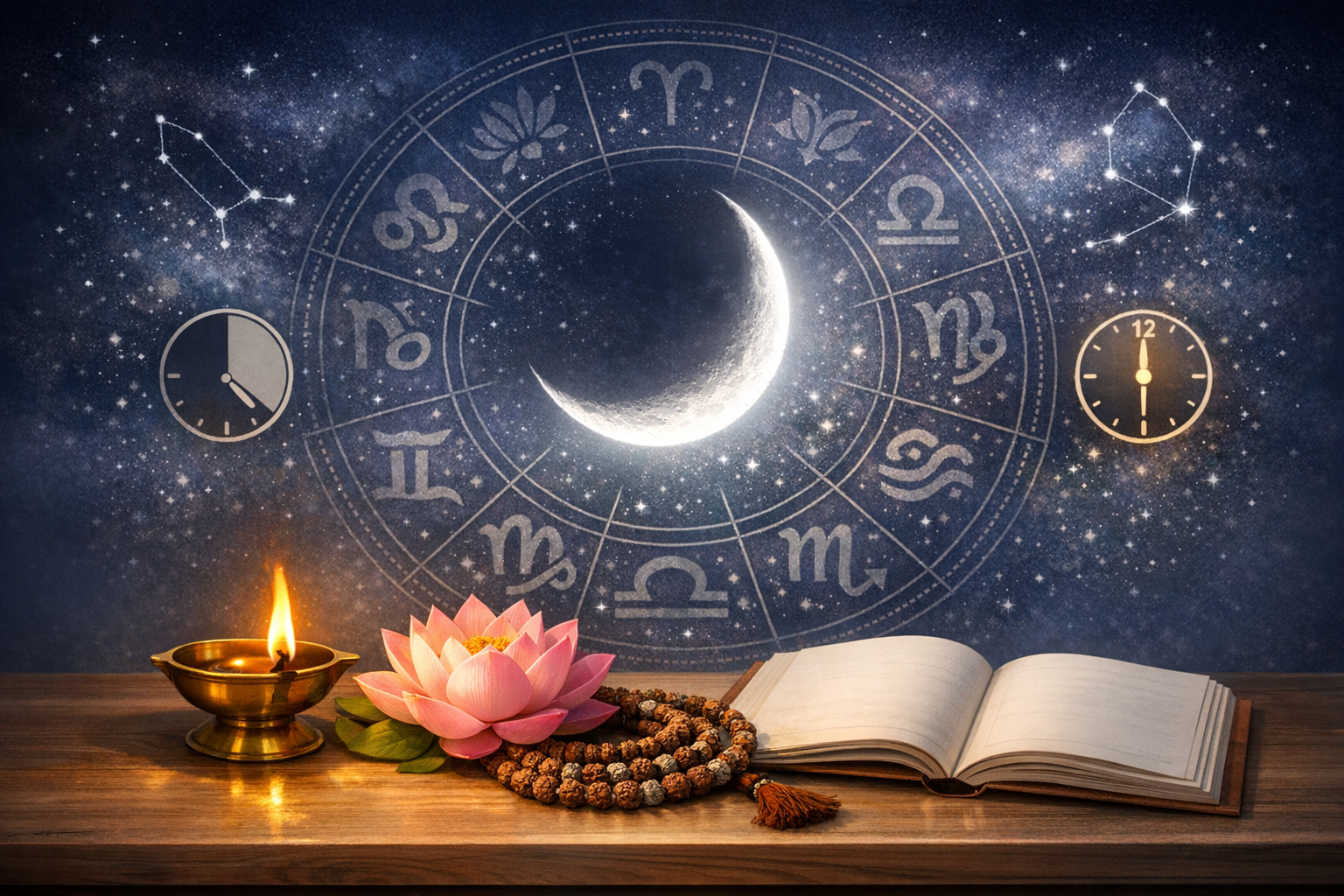
On Friday, March 13, 2026, the Hindu calendar (Panchang) records a transition from Krishna Paksha Navami to Krishna Paksha Dashami. In most regions, Krishna Paksha Navami tithi prevails until 4:12 AM on March 13. From 4:12 AM onward, it is Krishna Paksha Dashami—the tenth lunar day of the waning (dark) fortnight—for the rest of the civil day in those locations.
In the framework of the Hindu calendar, a tithi marks a precise lunar day determined by the relative positions of the Sun and Moon. Krishna Paksha denotes the fortnight after Purnima when the lunar disc appears to wane, inviting reflection, simplification, and inward focus. Dashami within this half is often seen as a measured, steady day that supports disciplined sadhana, household harmony, and methodical preparation for the upcoming Ekadashi.
Technically, a tithi is defined by the angular separation (elongation) between the Moon and Sun increasing (Shukla) or decreasing (Krishna) in steps of 12 degrees. Each 12-degree interval constitutes one tithi, yielding 30 tithis per synodic month. Panchang computations use geocentric longitudes and, in most Indian almanacs, a sidereal (nirayana) reference frame. Small differences in ayanamsa and local observational parameters can shift transition times by minutes; this accounts for the customary qualifier “in most regions.”
Day assignment follows a traditional rule: the tithi present at local sunrise generally defines the tithi of the civil day in many regional Panchang traditions, though festival rules may reference the tithi at moonrise, sunset, or the period of maximal overlap. Consequently, published tables can differ slightly by city and by the computational school followed in a given Panchang.
As the weekday is Friday (Shukravar), the day carries the aesthetic, relational, and refinement-oriented qualities associated with Shukra (Venus). Many families offer prayers to Goddess Lakshmi on Fridays, cultivate satvika cleanliness at home, and emphasize gratitude and gentle speech. These Shukravar sensibilities align well with the contemplative tenor of Krishna Paksha Dashami, encouraging balance between devotion and daily responsibilities.
Regarding Good Time (Shubh Muhurat), three universal reference windows are frequently consulted across Panchang traditions: Brahma Muhurta (roughly 1.5 hours before sunrise) for meditation and japa; Abhijit Muhurta (centered around local midday, typically about 24 minutes before and after) for swift, success-oriented undertakings; and the evening sandhya for calm, reconciliatory worship. Conversely, Rahu Kalam is traditionally avoided for initiating new tasks. Its exact interval is calculated by dividing daylight into eight equal parts and selecting a weekday-specific segment; for accurate results, computation should use the local sunrise and sunset times for March 13, 2026.
Nakshatra and Rashi add further nuance to the day’s reading. The Moon’s Nakshatra reflects the emotional tone and psychological “weather,” while the Moon’s Rashi (zodiac sign) modulates temperament and receptivity to particular actions. Because both parameters change with time and place, authoritative values for March 13, 2026 should be taken from a reliable regional Panchang or a Jyotisha software configured to the observer’s latitude, longitude, and chosen ayanamsa. Interpreting the day holistically involves synthesizing Tithi, Nakshatra, Rashi, weekday, and local muhurta factors.
Practically, Krishna Paksha Dashami favors disciplined routines: steady japa (mantra repetition), mindful seva (service), quiet study of Shastra, and thoughtful daana (charity). Many households find that the day is well suited for clearing minor backlogs, simplifying spaces, and resetting family rhythms. In some Vaishnava lineages, Dashami is also treated as a preparatory day for the Ekadashi that follows, with gentle dietary and mental moderation adopted ahead of any planned upavasa (fasting), where health permits.
Across dharmic traditions, the lunar day remains a subtle but shared compass. In Buddhism, Uposatha observances track lunar phases to renew sila and meditation; in Jainism, tithi-based practices such as pratikraman and special fasts cultivate ahimsa and inner purity; in Sikh communities, many gurpurabs have historically been coordinated with the lunar calendar even as the Nanakshahi system brings solar regularity. This shared attentiveness to the Moon’s rhythm underscores a deeper unity: diverse paths, one cosmos-guided cadence toward ethics, self-mastery, and compassion.
For decisions of consequence—marriage rites, property registrations, or major medical procedures—customary guidance is to consult a qualified Jyotisha who can weigh Tithi, Nakshatra, Rashi, and individual charts alongside practical constraints. For everyday activities—initiating study sessions, beginning a modest savings plan, or arranging a family temple visit—aligning with Brahma Muhurta, avoiding Rahu Kalam, and honoring the prevailing tithi offers a balanced, tradition-informed approach.
Regional Panchang traditions (amanta versus purnimanta month reckoning, festival assignment rules, and preferred computational parameters) can introduce legitimate, small differences in daily listings. The time noted here—Krishna Paksha Navami until 4:12 AM, then Krishna Paksha Dashami for the rest of the day in most regions—should therefore be cross-checked against a trusted local almanac for the precise city of observance.
March 13, 2026 thus presents a thoughtful, steady Dashami during Krishna Paksha, harmonized by the gentler notes of Shukravar. When approached with clarity and compassion—qualities venerated across Hinduism, Buddhism, Jainism, and Sikhism—the day becomes an opportunity to simplify one’s schedule, nourish community bonds, and recommit to daily sadhana anchored in ahimsa, dana, and dhyana.
Inspired by this post on Hindu Blog.