A mass shooting at a downtown Austin bar on 6th Street claimed the lives of three people, including 21-year-old University of Texas at Austin student Savitha Shan. The other victims were identified as 19-year-old Ryder Harrington and 30-year-old Jorge Pederson. The incident has reverberated through the UT Austin community and the wider city, prompting grief, vigilance, and a collective call for dignity in public discourse.
Authorities identified the suspect as 53-year-old Ndiaga Diagne, who was shot by responding officers and died at the scene. Investigators reported that Diagne wore a “Property of Allah” sweatshirt over a shirt “emblazoned with a design similar to the Iranian flag.” They also noted the recovery of a copy of the Quran from his vehicle and, following a lawful search, “an Iranian flag and pictures of Iranian leaders” at his residence. While these details inform investigative hypotheses, they do not, in isolation, establish motive under U.S. law.
Local coverage and campus communicationscaptured in videos titled “Austin mass shooter identified, wore ‘Property of Allah’ sweatshirt,” “UT students hold vigil for victims of 6th Street mass shooting,” and “Parents of 6th Street mass shooting victim release statement”documented the evolving facts and the community’s response. The vigil scene, with students and residents gathered in quiet remembrance, underscored the centrality of compassion in the aftermath of violence.
From a legal and analytical standpoint, early investigative steps in a mass shooting of this nature typically include forensic ballistics; toxicology; structured witness interviews; video and license-plate data correlation; and digital forensics across phones, computers, cloud accounts, and social media. Where ideology is a potential factor, investigators look for explicit indicators: target selection linked to protected characteristics, statements of intent, manifestos or pledges, and patterns of communication or material support. Possession of religious or political symbols, by itself, remains constitutionally protected and is neither unlawful nor determinative of criminal intent.
At this stage, public communications generally distinguish between criminal homicide, hate crime, and terrorism designations. In U.S. practice, hate-crime charges require evidence that victims were targeted because of actual or perceived protected characteristics, while a terrorism-related determination demands proof of violent acts intended to intimidate a civilian population or influence government policy. Any eventual classification is made by prosecutors, often in consultation with federal partners, once corroborated evidence meets statutory thresholds.
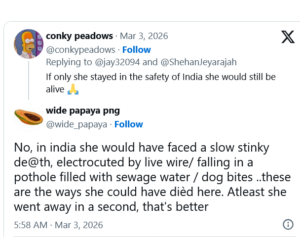
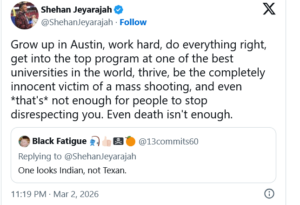
Community sentiment around the tragedy has been overwhelmingly empathetic toward the victims and their families, particularly toward the UT Austin cohort grieving the loss of a classmate. The parents’ public remarks, reported in local media, focused on remembrance and dignity. At the same time, social media monitoring revealed a small number of posts weaponizing grief through disparaging or racially coded commentary, including remarks such as “One looks Indian, not Texan” and comments insinuating that the victim’s Indian origin somehow made the loss less deserving of compassion. Such responses, while unrepresentative of the broader public, exemplify the harm of reductive narratives that dehumanize victims or vilify entire communities.
A trauma-informed, ethics-centered approach to public discussion emphasizes five principles: foreground the victims and survivors; avoid sensationalizing the suspect’s imagery or rhetoric; cite only verified facts; steer clear of generalizations about faith, ethnicity, or nationality; and focus on community healing and prevention. These standards are equally aligned with the dharmic values of ahimsa (non-harm), karuna (compassion), and seva (selfless service), which guide many in the Hindu, Buddhist, Jain, and Sikh communities toward solidarity and constructive action after violence.
The UT Austin vigil illustrated how shared grief can become a platform for unity. Students, faculty, and residents gathered to mourn Harrington, Pederson, and Shan, to affirm the worth of every life lost, and to reject attemptsonline or offlineto frame the tragedy through the lens of xenophobia or sectarian blame. Across dharmic traditions, the imperative is clear: confront violence without amplifying hatred, and insist that public safety reforms proceed alongside a rigorous defense of pluralism and mutual respect.
From a prevention perspective, campuses and cities can reinforce multi-layered safety protocols: bystander intervention training, threat-assessment teams integrating mental-health expertise, rapid alerting and lockdown drills, and robust pathways for reporting concerning behavior. In parallel, online platforms and community organizations can partner to counter disinformation and harassment with timely, fact-checked updates and support channels for affected families.
For readers seeking clarity, the present knowledge base consists of verified identities of the victims; the identification and death of the suspect; and the documented apparel and items reported by investigators. Unknowns include the suspect’s precise motive, potential accomplices (if any), and the evidentiary weight of ideological indicators that may or may not meet prosecutorial standards. Responsible engagement, therefore, centers on what is known, reserves judgment on what remains under investigation, and resists narratives that stigmatize any religious or ethnic community.
Remembering the individuals lostRyder Harrington, Jorge Pederson, and Savitha Shangrounds the conversation in humanity rather than speculation. The ethical path forward is twofold: honor the victims with accuracy and care, and strengthen community resilience by uniting across differences. In this way, civic institutions, interfaith networks, and dharmic communities can together transform mourning into a sustained commitment to compassion, truth, and public safety.
Inspired by this post on Hindu Human Rights Blog.