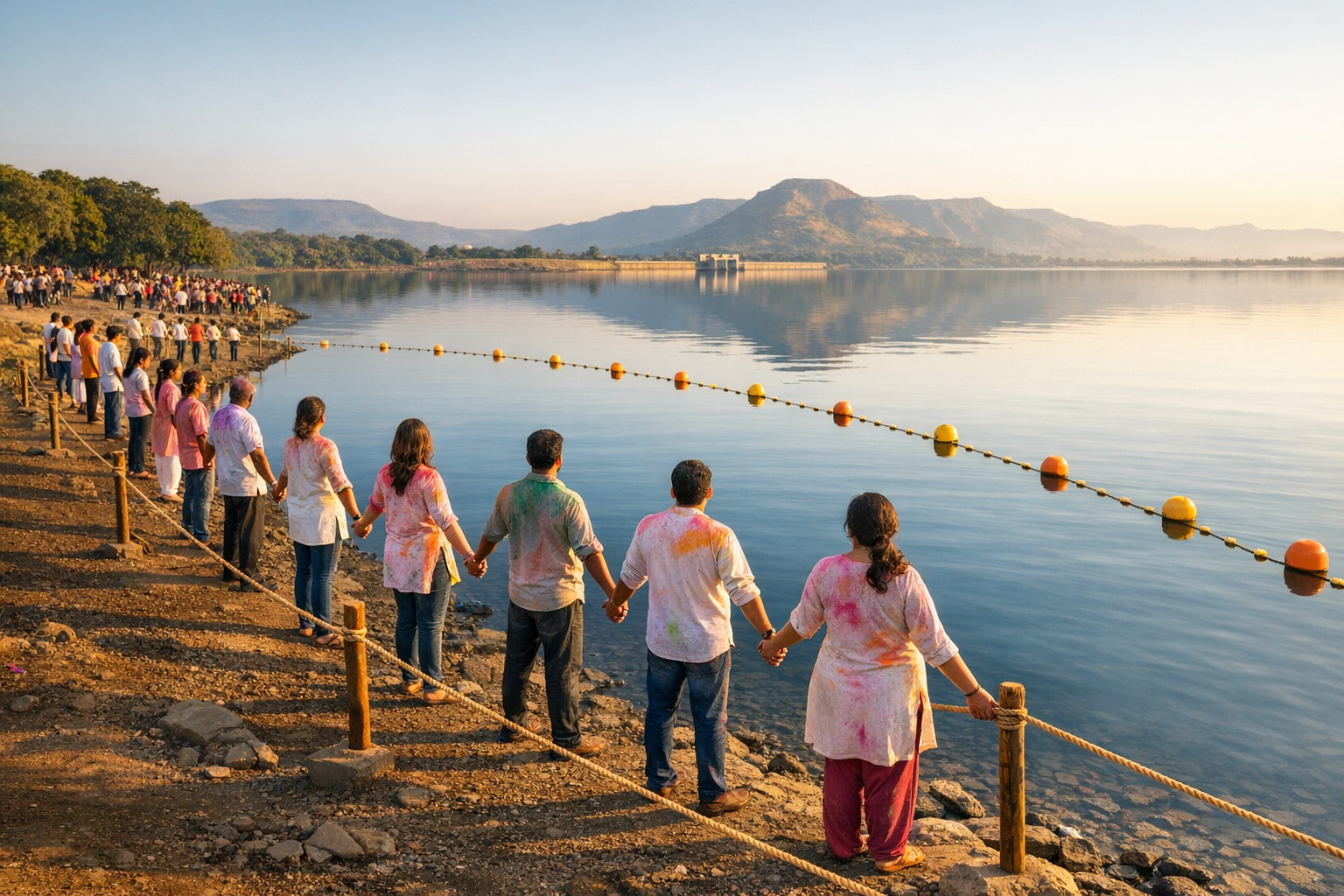
For the 24th consecutive year, Hindu Janajagruti Samiti (HJS) coordinated the Khadakwasla Reservoir Protection Campaign in Pune, Maharashtra. During Dhulivandan, a visible, volunteer-led human chain of more than 200 citizens ensured that no one entered the drinking water reservoir, preventing direct contamination and reducing public-safety risks. The continuity of this effort demonstrates a rare blend of civic discipline, cultural sensitivity, and environmental stewardship. It also signals how festivals and water security can coexist when communities accept shared responsibility.
Khadakwasla Reservoir is a critical component of the region’s urban water infrastructure, supplying potable water to a large population and supporting downstream ecological flows. Any influx of colorants, festive residues, or litter during peak cultural gatherings can compromise water quality management, impose additional treatment burdens, and threaten aquatic organisms. Protecting the catchment edge during high-footfall days therefore functions as a first line of defense for both human health and biodiversity.
In Maharashtra, Dhulivandan marks a joyful phase of the Holi season, a time associated with color, kinship, and community celebration. While the cultural dimension is vital, unmanaged interactions with sensitive water bodies during such occasions can amplify avoidable hazards. The campaign’s approach respects the spirit of Dhulivandan while carefully separating high-energy revelry from the reservoir’s protected waters, maintaining a balance between tradition and ecological prudence.
From an environmental-science perspective, synthetic colors, foaming agents, microplastics, and residues from food or single-use items can elevate turbidity, nutrient loads, and oxygen demand, undermining aquatic balance. Even small inputs during a short window can trigger localized stress for fish, plankton, and benthic communities, especially in calmer near-shore zones where contaminants tend to accumulate. Preventing physical entry into the reservoir is therefore a highly effective source-control strategystopping pollution at the point where it would begin.
The human chain serves as a gentle but unmistakable behavioral ‘nudge.’ Its presence creates a socially reinforced perimeter, turning the idea of protection into a shared norm rather than an enforced restriction. Most people respond positively when the boundary is clear, the rationale is explained, and the guardianship role is visibly owned by fellow citizens rather than distant authorities. The result is high voluntary compliance with minimal conflict.
Beyond the immediate outcome, the campaign cultivates civic trust and competencies that compound over time. Volunteers practice calm communication, diffuse potential misunderstandings, and model courtesy in crowded settings. Such soft skills are transferable to other public-safety and environmental contexts, strengthening the region’s overall capacity for community-led action.
The campaign’s ethic resonates across India’s dharmic traditions. Principles such as Ahimsa, seva, and reverence for prakriti align with the choice to keep waters clean and life-supporting. Whether viewed through the lenses of Hindu, Buddhist, Jain, or Sikh thought, protecting a shared natural resource like a reservoir affirms a common commitment: celebration need not come at the expense of the living systems that sustain society.
As a replicable model, the Khadakwasla initiative highlights several enabling practices: early, respectful public messaging about the reasons for keeping out of the water; clear demarcation of sensitive zones; strategically positioned volunteers who engage through dialogue first; and post-event review to refine layout and training. These steps maintain cultural continuity while safeguarding a vital utility.
Technical reinforcement can further enhance outcomes. Where feasible, community science can support pre- and post-festival water-quality snapshotstracking parameters such as pH, turbidity, dissolved oxygen, biochemical and chemical oxygen demand, nutrients, and microbial indicators. Basic shoreline audits for litter, along with rapid response for accidental spills, provide additional safeguards without intruding on festivities.
Risk management remains essential in high-footfall waterfronts. Simple, low-cost measuresclearly visible caution markers, accessible first-aid kits, and rapid communication channelsreduce the likelihood and severity of incidents. By eliminating unsanctioned entry during Dhulivandan, the campaign simultaneously mitigates drowning risk and ecological disturbance.
The Khadakwasla experience also underscores the value of constructive alignment with local water managers and civic bodies. While the volunteers operate at the front line, their work complements broader urban water-safety protocols and catchment-protection norms, creating a coherent framework that is easier for the public to understand and follow.
After 24 years, the most important result may be cultural: protecting a reservoir during a beloved festival now feels natural, even expected. That normative shiftrooted in care, competence, and continuityoffers a pragmatic blueprint for cities across India. It shows how community-led environmental stewardship can preserve joy, honor tradition, and secure the shared commons that festivals depend on.
Inspired by this post on Hindu Jagruti Samiti.