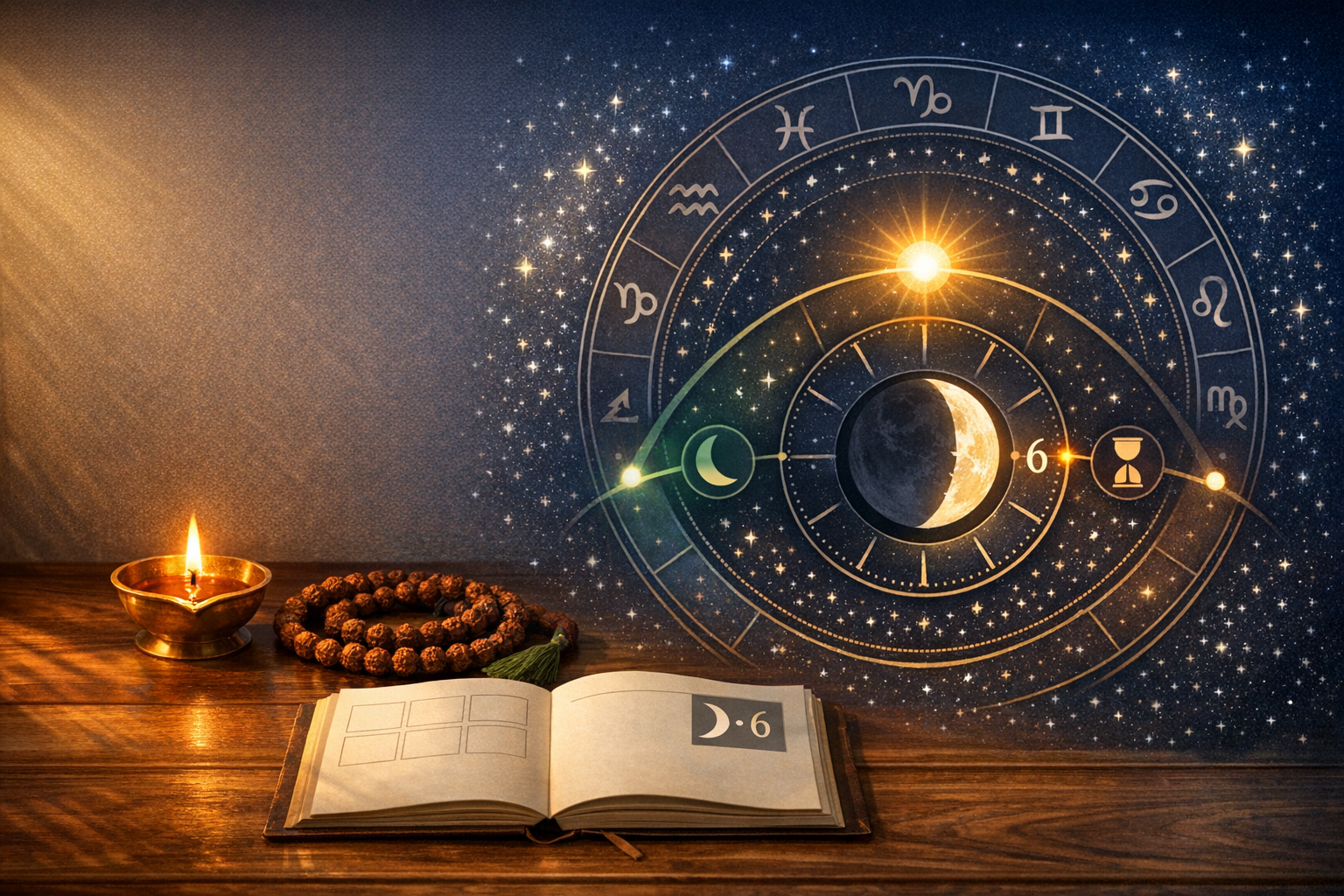
On Sunday, March 8, 2026 (Ravi-vāra), the Hindu Panchang marks Krishna Paksha Panchami, the fifth lunar day of the waning phase of the Moon, in most regions. This Panchami tithi continues until 8:07 PM on March 8, after which the lunar day transitions to Krishna Paksha Sashti. As with all Panchang data, locality, time zone, and the almanac tradition followed can produce small variations, so regional Panchang references should be consulted for final observance.
Krishna Paksha signifies the fortnight when the Moon’s illumination decreases daily from Full Moon (Purnima) to New Moon (Amavasya). Panchami, the fifth tithi, is traditionally aligned with consolidation, refinement, and thoughtful planning. The waning fortnight often invites introspection and steady effort, an orientation many households find conducive to clearing backlogs, streamlining routines, and deepening personal sādhanā.
The shift to Krishna Paksha Sashti at 8:07 PM on March 8 marks the sixth lunar day of the dark half. In lived practice, evening and late-night hours following such a transition are often used for disciplined, unhurried work: organized study, quiet recitation (japa), meditation, and preparing schedules for the week ahead. While major events can be planned by muhurta, everyday life benefits from the calm, incremental progress associated with the early Krishna Paksha tithis.
Panchami across the lunar months can host different regional observances, yet there is no single pan-Indian ritual exclusive to every Krishna Paksha Panchami. Households and temples may perform routine pūjā to one’s Ishta Devata, read from scriptures, or undertake charity (dāna). The emphasis in the waning half typically falls on steadiness and clarity, values that resonate across dharmic traditions.
A complete Panchang for the day will list Tithi (Panchami→Sashti), Nakshatra, Yoga, and Karana, along with sunrise/sunset, moonrise/moonset, and daily time windows such as Abhijit Muhurat, Rahu Kaal, Gulika Kaal, and Yamaganda. Because these depend on local sunrise and sunset, authoritative regional almanacs (or reliable apps configured for the exact location and time zone) remain essential for precise timings.
Nakshatra and the Moon’s Rashi (sign) on March 8, 2026, will vary by locality and clock time since the Moon moves swiftly through the sidereal zodiac. Nakshatra is determined by the Moon’s position against one of the 27 stellar sectors, while Rashi references the 12-fold sidereal zodiac divisions. Practitioners commonly refer to Lahiri or other standard ayanāṁśa settings when computing these, and slight differences in reference frameworks can adjust final listings by small margins.
For “good time” selection (Shubh Muhurat), two practical layers are typically used. First, general daily filterssuch as avoiding Rahu Kaal, Gulika Kaal, and Yamaganda for initiating sensitive taskshelp refine choices. Second, a tailored muhurta considers Tithi, Nakshatra, Yoga, Karana, planetary strengths, and personal factors (janma nakshatra, dasha), providing a more custom-fit auspicious window when needed.
On Sundays, the commonly taught daytime filters (assuming a notional 6:00 AM sunrise and 6:00 PM sunset) give: Rahu Kaal approximately 4:30 PM–6:00 PM, Gulika Kaal approximately 3:00 PM–4:30 PM, and Yamaganda approximately 12:00 PM–1:30 PM. In practice, these intervals scale with the exact local day length: the daytime period from sunrise to sunset is divided into eight equal parts and assigned to these segments. Local sunrise/sunset always takes precedence, especially at high latitudes or near Daylight Saving Time changes.
Abhijit Muhurat is centered on local solar noon and is frequently considered favorable for many undertakings when a bespoke muhurta is not feasible. As a rule of thumb, it spans roughly 24 minutes on either side of local noon, but the exact duration in a given Panchang reflects the day’s calculated length. When precision matterstravel, ceremonies, legal filingsrelying on the day’s Abhijit as computed for the city of residence is advisable.
In western India and some diaspora communities, Choghadiya is also used for practical scheduling. Positive segments are typically labeled Amrit, Shubh, and Labh, whereas Rog, Kaal, and Udveg are generally avoided for initiating important tasks. As with other timing systems, Choghadiya windows are recalculated from sunrise and sunset, with a separate set for nighttime if needed.
Beyond logistics, many families observe that tasks planned to sidestep known inauspicious windows tend to proceed more smoothly, even when goals are modestrenewals, correspondence, health check-ins, or learning commitments. The early Krishna Paksha days like Panchami and Sashti align well with decluttering, budget reviews, and course-corrections, complementing the reflective energy pattern of the waning Moon.
Technically, Tithi is defined by the longitudinal separation between the Sun and the Moon in the sidereal zodiac. Each Tithi spans 12 degrees of this elongation: Panchami corresponds to a separation crossing 48°–60°, and Sashti to 60°–72°. Because the Moon’s apparent speed varies slightly and daily calculations are anchored to local sunrise, Tithi start and end times do not align perfectly with the civil clock across regions, leading to the familiar “in most regions” qualifiers in almanacs.
The other core Panchang elements are similarly astronomical. Nakshatra divides the ecliptic into 27 equal parts anchored to prominent star groups; Yoga is calculated from the sum of the Sun’s and Moon’s longitudes mapped to 27 segments; Karana subdivides each Tithi into two halves, cycling through a well-known sequence (Bava, Balava, Kaulava, Taitila, Gara, Vanija, and Vishti/“Bhadra,” among others). Each element contributes a qualitative tone, and their combinations refine muhurta judgment.
Regional traditions (Amānta versus Pūrṇimānta month reckoning) and local conventions shape how dates are presented, but the underlying astronomy remains consistent. Panchang compilers may also adopt different ayanāṁśa settings (e.g., Lahiri), accounting for small, acceptable variations between reputable sources. When planning vows or ceremonies with specific scriptural requirements, local custom should guide final decisions.
Time-zone and latitude considerations matter. March often brings Daylight Saving Time transitions in parts of North America and Europe (in 2026, many regions implement DST in March), and these changes must be reflected in Panchang computations. At higher latitudes where day lengths deviate significantly from 12 hours, the standard slotting of daily filters stretches or contracts, reinforcing the need for location-specific calculations.
These temporal disciplines are part of a shared civilizational matrix across dharmic paths. Hindu households align routine and ritual with Tithi and Nakshatra; Buddhists observe uposatha on lunar markers; Jains maintain fasts and svādhyāya schedules keyed to the Moon; Sikh families often plan seva and community gatherings mindful of broader cultural calendars. Read with mutual respect, lunar timekeeping becomes a unifying thread honoring diversity within a common quest for moral clarity, self-mastery, and compassionate action.
Practical observances on this Sunday may include morning or evening prayer, quiet scriptural reading, mindful charity (dāna), or meditative breathwork. Many practitioners report deeper focus for study and spiritual reflection during the early waning days, while families find value in using Shubh Muhurat windows for beginning modest yet meaningful taskshealth routines, learning projects, or acts of service (seva) that strengthen social bonds.
In summary: Sunday, March 8, 2026 features Krishna Paksha Panchami until 8:07 PM (in most regions), followed by Krishna Paksha Sashti. Selecting times with basic filters (avoiding Rahu Kaal, Gulika Kaal, and Yamaganda; favoring Abhijit when bespoke muhurta is not possible) provides practical benefits. For exact Nakshatra, Yoga, Karana, and Moon Rashi, consult a reliable regional Panchang configured for the precise location and time zone so that the day’s planning, worship, and service harmonize with the rhythm of the lunar calendar.
Inspired by this post on Hindu Blog.