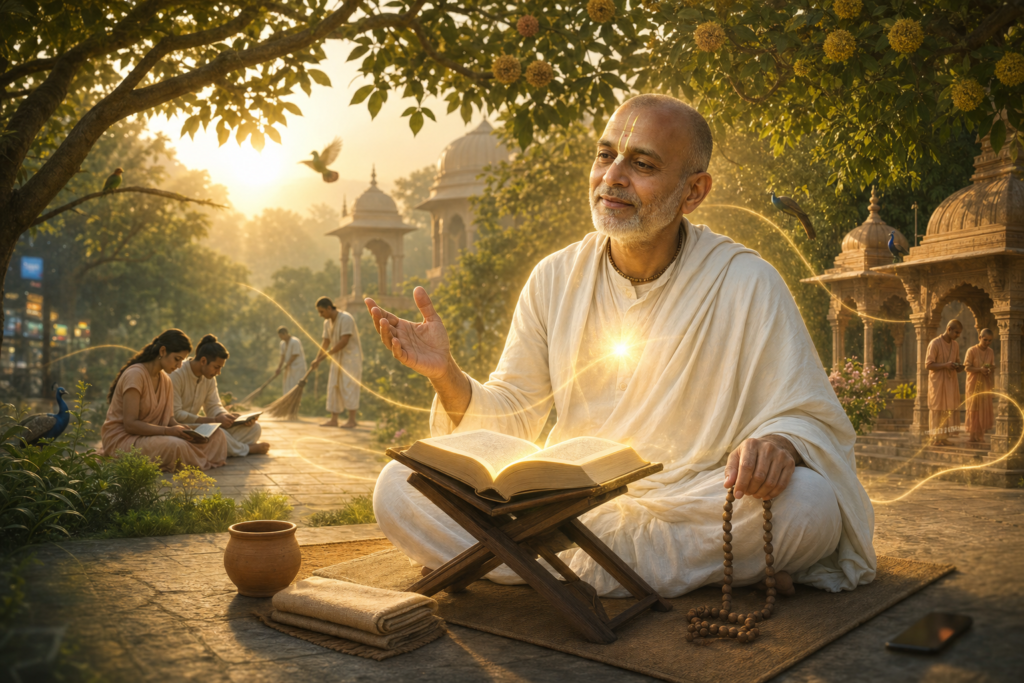
Twenty-two years earlier, during a summer sojourn in Sri Jagannath Kshetra (Sri Puri Dham), daily walks along the seashore and toward the sacred precincts of Narendra Sarovar, Loknath Mahadev, and the samadhi of Jatiya Baba created a contemplative rhythm that shaped a memorable spiritual encounter. In this setting, a conversation with Sri Makhan Gangulyan educated, humble, and deeply religious disciple (mantra-shishya) of Sri Vijaykrishna Goswamiintroduced two striking figures: a naked Vedantin known as Digambar Baba, then living near Tota Gopinath, and a Gaudiya Vaishnava sadhu, Sri Shyamdas Babaji.
In time, Digambar Baba moved to Sri Kashi (Varanasi), living for long periods across the Ganga on a boat. His massive jataajoot and serene demeanor expressed a powerful vairagya that left a distinct impression of renunciation and inner poise. Although the opportunity to meet him in Puri did not arise, a later darshan in Kashi would confirm his quiet radiance and inward intensity.
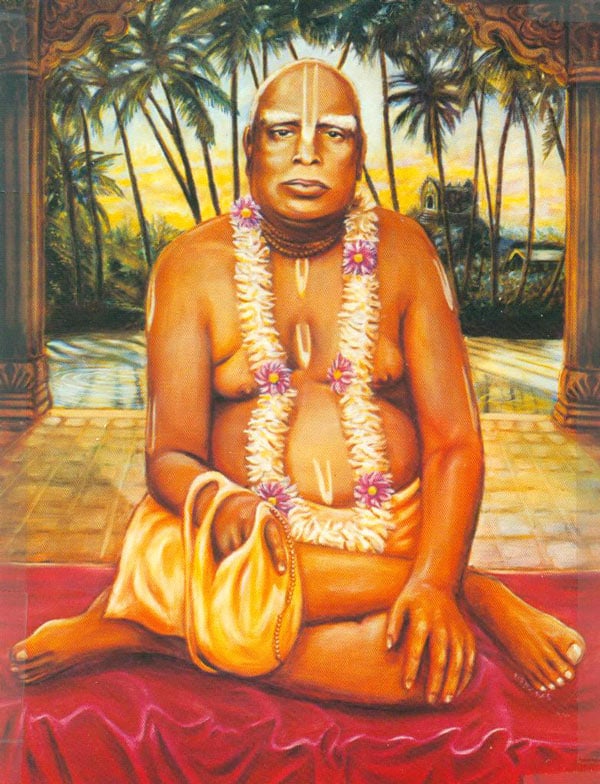
Sri Shyamdas Babaji, a Gaudiya Vaishnava of the highest refinement, resided near the famous garden historically linked to Sriman Chaitanya Mahaprabhu, located across Narendra Sarovar from Jatiya Baba’s samadhi. As an ardent devotee of Prabhupada Jagadbandhu, his hermitage became known locally as “Bandhu Ashram,” and it drew seekers attentive to the currents of bhakti and nondual insight flowing through his life.
One afternoon, an appointed visit to “Bandhu Ashram” with Sri Makhan Ganguly and a young boy unfolded with the gentle hospitality that often marks the lives of realized sages. Sri Shyamdas Babaji received the visitors with warmth, and at his earnest request they partook of Mahaprasad. A quiet, secluded conversation followed, opening a window onto his singular sadhana and the lineages that had shaped it.
Sri Shyamdas Babaji had earlier stayed at Haridas Math in Swargadwar. In early youth, he passed some time in Kashi while the great yogi Trailinga Swami still lived; later, he resided near Kusum Sarovar in Sri Vrindavan. Association with Prabhu Jagadbandhu brought decisive inner transformations. In later years, he openly and gratefully acknowledged the luminous influence of Sri Sri Maa Anandamayi on his spiritual life.
Through stories and subtle allusions, he described a pivotal transmission when Trailinga Swami placed a hand upon his forehead and imparted Shakti, catalyzing visionary experiences that became integral to his unfolding realization. These reminiscences were not offered as spectacle; they served to illuminate stages of awareness and the progressive refinement of svabhavaone’s true naturetoward a stable witness-consciousness.
At the time of this meeting, Sri Shyamdas Babaji was approximately eighty-four years old, robust in frame and dark in complexion, with a cheerful radiance softened by the humility characteristic of a Vaishnava. His nature was so gentle that even discourtesy could not draw a harsh response. He honored Trailinga Swami and Prabhu Jagadbandhu equally as Gurus and held Loknath Brahmachari in great esteem, maintaining long association in Kashi with the Brahmachari’s accomplished disciple, Brahmananda Bharati. He did not subordinate Knowledge (jnana), devotion (bhakti), or Yoga to one another; rather, he saw them as complementary pathways converging in Self-Realization.
When asked about his spiritual state, he spoke without pretense: his svabhava had awakened, and he had reached the steady posture of drashta bhava, the witness-state. From that stance, the play of nature appeared continuously, yet without attachment to pleasure or pain. A calm, blissful, and detached awareness prevailed.
He offered a key to this experience using the language of chidakasha, the sky of consciousness, which he equated with svabhava. With inner vision, a blue, circular sky appeared spontaneously; it receded during outward involvement but reappeared as soon as external dominance subsided. When attention rested in this inner sky, entanglement in outward awareness ceased. Within this akasha, the movements of mind and nature were seen clearlyyet seen with discrimination (viveka), refusing the shift from seer (drashta) to enjoyer (bhokta).
He described a stable realization of the Self (atma-darshan) in which the formless is perceived amidst the formed, and the entire play is witnessed within the formless sky, free of delusion. Any subtle sense of involvement that occasionally arose was attributed to purva-samskaras. As these impressions are purified, he said, even that fineness of involvement falls away, revealing the original, pure nature (praktana asamskrita prakriti).
Fond of solitude, Sri Shyamdas Babaji remained known to many but truly recognized by few. The joy of his association extended for more than a month; not long after that period, he gave up his mortal body. The distilled insights he shared form a coherent vision of practice that harmonizes jnana, bhakti, and yogaa vision with deep resonance across dharmic traditions.
1. How far does the Name go? The Name and Form (nāma-rūpa) extend up to Vaikuṇṭha. Beyond that, there is no Name. This teaching maps the ascent from devotion through subtle form toward the ineffable, aligning with Vedantic nonduality and the apophatic insight recognizable across Hinduism, Buddhism, Jainism, and Sikhism.
2. Pagal Haranath, considered as an avatar of Chaitanya Mahaprabhu, used to say: “What will come of calling upon that Śrī Kṛṣṇa whose name is uttered? What is needed is Nikuñja-vihārī Kṛṣṇa the One where words cannot reach. That is not attained without His grace.” This points to the intimacy of the Divine beyond speech, a theme that echoes the silence of nirvikalpa in Yoga and Vedanta, the unspeakable nature of nirvana in Buddhism, the inexpressible experience of kevala-jnana in Jainism, and the ineffable shabad in Sikh mysticism.
3. To worship one’s object of devotion through a devotee is a great wonder. The relational pathwayseeing the Beloved through the beloved devoteeaffirms the sanctity of satsanga and the Guru-Shishya Tradition, where grace often arrives through living exemplars.
4. The sky (ākāśa) that is seen is one’s own nature; it is the sky of consciousness (cidākāśa). The Self is formless, the witness (draṣṭā), and detached (nirlipta). Nature acts; awareness observes. This is discrimination (viveka). When discrimination is abandoned, the sky is veiled; the sense of doership (kartā) arises and entanglement begins.
5. In this inner sky there is sound (śabda); then a shadow appearsthat shadow is creation (sṛṣṭi). As the shadow condenses, the visible world emerges. This vision of emanation through vibration aligns with classical yogic cosmology and supports contemplative inquiry across dharmic streams.
6. Trailinga Swami once placed a hand upon his forehead. For five to seven days, everything appeared as a bindu (point), and the three states of timepast, present, and futurewere seen simultaneously. Such compression of perception into a point and the panoramic presence of time suggests the culmination of meditative absorption.
7. First, bestow grace upon yourself. Inner friendliness and compassionate discipline are prerequisites for sustained sadhana; this self-grace matures into grace for all beings.
8. The Guru calls three timesafter that, He lets go. Guidance is present, yet autonomy is essential; the path demands response, responsibility, and ripening discernment.
9. A favorable nature (prakriti) is required; great souls (mahāpuruṣas) come endowed with the competence for their work. Whatever unfolded here arose through sanga (holy association). Deep company shapes inward architecture.
10. The mind is extremely subtle; when it becomes so, the knots (granthīs) open. As attention refines, latent bindings release, revealing a lucid, unentangled awareness.
Viewed through the unifying lens of dharmic traditions, Sri Shyamdas Babaji’s sadhana affirms a shared trajectory: devotion ripening into direct knowledge, disciplined practice flowering into effortless witness-consciousness, and personal transformation opening into universal compassion. The language of drashta bhava, chidakasha, and viveka resonates with diverse vocabulariessati in Buddhism, samyak darshan and non-attachment in Jainism, and the Sikh emphasis on inner shabad. Far from sectarianism, the arc of his realization demonstrates how jnana, bhakti, and yoga converge in Self-Realization and in a compassionate embrace of all paths.
This account, grounded in Jagannath Puri, Varanasi, and Vrindavan; enriched by the presences of Trailinga Swami, Prabhu Jagadbandhu, Sri Sri Maa Anandamayi, Loknath Brahmachari, and Brahmananda Bharati; and articulated through the lived wisdom of a Gaudiya Vaishnava master, offers a rare and integrative portrait of practice. It invites contemporary seekers to steady attention in the inner sky, honor the Guru and the sangha, and embody a unity of heart and insight that strengthens harmony among Hinduism, Buddhism, Jainism, and Sikhism.
Inspired by this post on Dharma Dispatch.