“If you want to conquer the anxiety of life, live in the moment, live in the breath.” ~Amit Ray
The turning point arrived not as a thought but as a breath. After years of drinking and a final hospitalization with liver failure at thirty-six, relapse followed discharge, and a return to rehab seemed inevitable. In that setting—exhausted physically, mentally, and spiritually—survival was measured in hours rather than days.
When a yoga session was announced, attendance felt uncertain. Detox tremors made even standing unsteady. The first instruction in that small recreation room was simple: take a deep breath. The chest barely moved. That discovery—of how little air was entering—marked a profound shift. From that moment, breath became the most reliable resource.
The context was stark. Multiple treatment programs had not stopped the slide. Employment was gone, housing was at risk, and a court letter confirmed loss of custody. That was rock bottom. Yet even rock bottom can become fertile ground when the nervous system is given a chance to recalibrate.
Within rehab, yoga offered the first intervals of relief from feeling trapped in one’s own skin. The instruction often heard in class—root to rise—took on clinical relevance: grounding through body and breath preceded any stable upward change. Rising was impossible without rooting.
Years of relying on willpower, plans, and counting days had not repaired dysregulation. Cognitive strategies alone could not address a system primed for alarm. Recovery required rebuilding from the ground up—from the nervous system outward. Yoga became a safe container where the body could finally exhale.
Safety emerged in glimpses. Hands steadied while pouring coffee. Shoulders softened when hearing a name. Sleep arrived without panic. It was not perfection; it was presence. This gradual shift corresponded with somatic healing, a process recognizing that memory, emotion, and story are held not only in cognition but in tissues.
“Somatic” signifies of the body. Protective patterns—flinches, tightness, held breath—reflect imprints of survival. In yin yoga, as fascia released in long-held postures, unexpected memories sometimes surfaced, and tears followed—deep and clarifying. The mat became a sacred space to feel what had long been avoided; afterward, the burden felt lighter.
Each slow stretch and mindful breath functioned as a dialogue with the nervous system. Remaining present through discomfort instead of fleeing reframed healing: it was less about fixing and more about cultivating sufficient safety for release. Contemporary research supports this observation: breath forms a bridge between body and brain, consciously modulating autonomic function. Through paced respiration and intentional movement, vagus nerve pathways are engaged, fostering a shift from survival to safety.
During cravings or acute anxiety, breathwork served as a lifeline. Three practices—drawn from yoga and used widely in trauma-informed care—were repeatedly effective for stress modulation and relapse prevention: Anulom Vilom (Alternate Nostril Breathing), Sama Vritti (Box Breathing), and Dirgha Pranayama (Three-Part Breath).
Anulom Vilom (Alternate Nostril Breathing) balances hemispheric activity and stabilizes autonomic tone. Sit comfortably with a tall spine and relaxed shoulders. Close the right nostril with the thumb and inhale through the left for four counts. Close both nostrils and hold for four counts. Release the right nostril and exhale for eight counts. Inhale through the right for four, hold for four, and exhale through the left for eight. Continue gently for five rounds, maintaining soft, even breaths. Each inhale affirms presence—“I’m still here”—and each exhale supports release.
Sama Vritti (Box Breathing), often used in early recovery, creates symmetry and steadiness. Inhale through the nose for four counts, hold for four, exhale for four, and remain empty for four. Sustain this rhythm for several minutes, extending to six or eight counts if comfortable. This even pattern can stabilize heart rate variability, quiet racing thoughts, and provide a reliable anchor when the mind spirals.
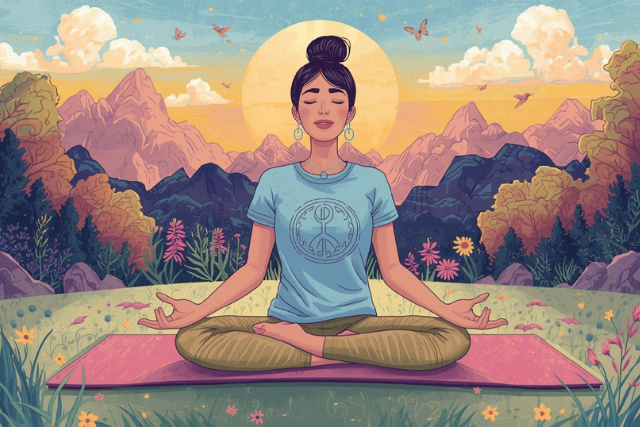
Dirgha Pranayama (Three-Part Breath) invites full, grounded respiration. Sit or lie down with one hand on the belly and one on the chest. Inhale through the nose, filling the belly, then the ribs, then the upper chest. Exhale in reverse—chest, ribs, belly—allowing a complete release. Count the inhale and lengthen the exhale to roughly double (for example, three in and six out). Repeat for at least five rounds. With each cycle, imagine breath drawing into the roots—an embodied reminder that peace is cultivated, not chased.
Consistent practice expanded capacity to face triggers without reaching for a drink. Multiple rounds of Sama Vritti, in particular, reliably shifted state with notable speed. Early sobriety felt like ascending a mountain barefoot, but days aggregated into months, and eventually sobriety no longer felt like a fight; it became a stable identity.
The maxim from class—how we show up on the mat is how we show up in life—proved accurate. Showing up to breathe when avoidance felt easier became a discipline. Over time, the practice of staying transformed from effort to habit.
Yoga trained a new relationship with pain: discomfort signaled sensation, not danger. With repetition, neural pathways reorganized, and the pause between trigger and reaction widened. When body and mind were no longer locked in opposition, daily life began to flow: family reunification became possible, work resumed, and existence shifted from surviving to living. The throughline was the breath.
As stability deepened, recovery reframed from staying sober to staying present. Trust returned to the body not through promises but through consistent attendance—on the mat, in the breath, and in the quiet moments. Healing followed a somatic timeline rather than a cognitive one. One day, hands no longer shook, shoulders rested, and breath moved freely; the body had relearned safety.
Recovery, viewed through a dharmic lens, is less about fixing brokenness and more about ceasing self-abandonment when things hurt. Each inhale offers a new beginning; each exhale releases what is complete. In that gentle rise and fall, past burdens soften and the future waits at the edge of the next breath.
These insights resonate across dharmic traditions. Pranayama in Hindu yoga, Ānāpānasati in Buddhism, Preksha meditation in Jainism, and breath-aligned simran in Sikh practice all affirm the breath as a unifying discipline for clarity, compassion, and self-mastery. Grounded in shared values of non-harm, awareness, and inner steadiness, breath-centered practice becomes a common thread that strengthens individual recovery and collective harmony.
Inspired by this post on Tiny Buddha.