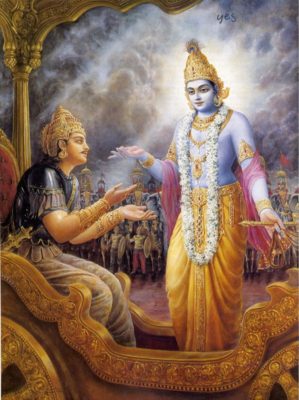
Srila Prabhupada’s first talks in America (New York, March 1966) centered on a profound and practical thesis: authentic knowledge dissolves confusion and restores purpose. Anchoring this insight is the Bhagavad-gita’s instruction on the disciplined approach to wisdom: tad viddhi pranipatena pariprasnena sevaya upadeksyanti te jnanam jnaninas tattva-darsinah “Just try to learn the truth by approaching a spiritual master. Inquire from him submissively and render service unto him. The self-realized soul can impart knowledge unto you, because he has seen the truth.” [Bhagavad-gita4.34]
This verse outlines a rigorous methodology for spiritual learning that is both time-tested and universally relevant: pranipata (humility), pariprasna (honest, reasoned inquiry), and seva (selfless service). Together, these cultivate receptivity to jnana, or liberating knowledge. In this framework, the guru is not a mere instructor but a tattva-darsione who has witnessed truth and can therefore transmit it with clarity and compassion. The emphasis on inquiry safeguards against blind acceptance, while humility and service refine character, aligning intellect with ethical action.
These principles resonate across the dharmic traditionsHinduism, Buddhism, Jainism, and Sikhismwhere the guru–shishya ethos appears in diverse forms: dialogic learning in the Upanishads, disciplined questioning in Buddhist monastic education, guidance from Jain acharyas, and reverence for the Guru in the Sikh tradition. Each honors the same core logic: truth is realized through disciplined inquiry guided by the experienced, and preserved through service to a living tradition. This shared heritage underscores unity in spiritual diversity and invites mutual respect rather than sectarian rivalry.
For contemporary seekers navigating information overload, this triad offers practical orientation. Many find that respectful questioning deepens understanding without breeding cynicism; humility prevents the ego from mistaking data for wisdom; and service transforms knowledge into lived experience. Such a path counters both relativism and dogmatismrelativism by insisting on tattva (truth), and dogmatism by demanding inquiry and character as prerequisites for learning.
Srila Prabhupada’s presentation in New York was therefore not merely historical; it marked a bridge between traditions and modernity. The Bhagavad-gita’s guidance affirms that knowledge is not accumulated as an abstraction but received as a transformative insight from one who has seen. This model unites reason and devotion, study and practice, and individual growth with communal harmony.
Ultimately, “knowledge is the solution” means more than problem-solving; it means inner alignment with reality. By embracing humility, sustained inquiry, and service, seekers in every dharmic path can access guidance that is at once personal and universal. In this shared pursuit, the guru–shishya tradition becomes a living conduit of wisdomfostering unity, integrity, and compassionate action across communities.
Inspired by this post on Dandavats.