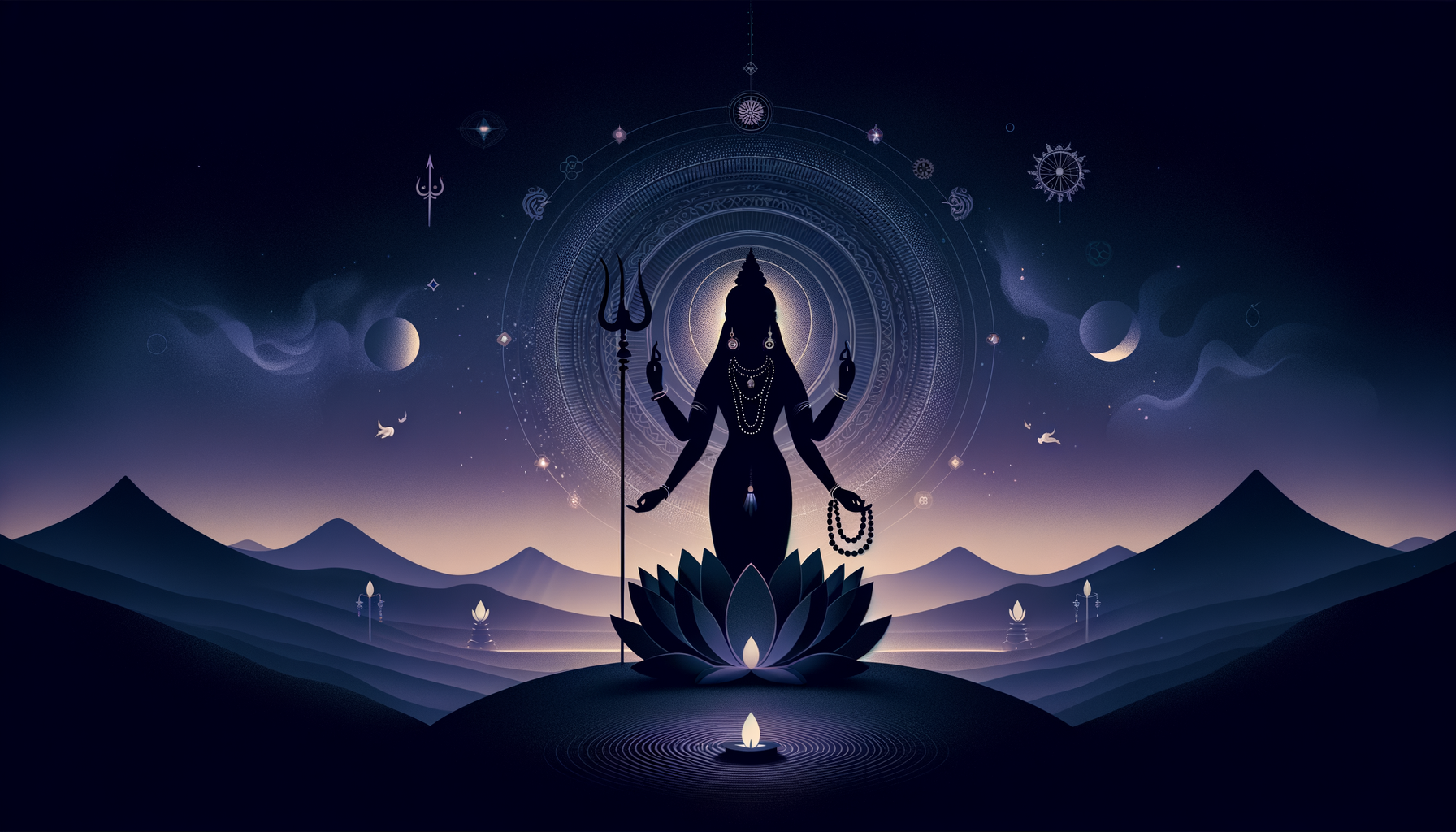
Goddess Kali stands in Hinduism as a luminous paradox: the black that reveals, the fierce that liberates. Her blackness is not a mere chromatic attribute but a precise symbolic gesture toward the infinite and the unmanifesteddimensions of reality that elude sensory measures and discursive certainty. In this sense, Kali’s presence points beyond both science and myth, toward a contemplative understanding of ultimate reality that transcends dualities.
In traditional symbolism, black absorbs all colors; as a sacred metaphor, Kali’s blackness signifies that which contains and dissolves all forms. It reflects the insight central to Advaita Vedānta that Brahman, the ground of being, is beyond name and form, while remaining the substratum of all names and forms. Thus, Kali’s blackness is not negation, but completenessan intimation of wholeness beyond conceptual contrast.
Iconography deepens this meaning. The garland of skulls and the imagery of time (kāla) emphasize the dissolution of ego and the impermanence of phenomena. Black, here, is not darkness-as-ignorance but darkness-as-origin: the fertile void from which manifestation arises and to which it returns. In Tantric lenses, this is Shakti in her most unbounded formthe dynamic energy that both births and absorbs the cosmos.
For many practitioners, encounters with Kali’s image evoke a disciplined courage: fear confronted, grief held, and identity softened. Devotees often recount moments in front of a murti or during japa when the mind’s chatter quiets and an unexpected calm appears, as if the very hue of Kali’s form absorbs inner turmoil. Such lived experiences, while personal and varied, align with a long-standing Hindu philosophy in which symbolism serves as a bridge from psychological insight to spiritual realization.
This symbolism resonates across Dharmic traditions while honoring their differences. Buddhism’s articulation of śūnyatā as the emptiness of inherent existence, Jainism’s stress on detachment as a pathway to kevala jñāna, and Sikhism’s emphasis on dissolving ahankār in the remembrance of Ik Onkar each reflect a movement beyond narrow self-identity. Read together, these perspectives underscore a shared civilizational intuition: liberation arises when the self relaxes its grip and opens to a reality that exceeds conceptual bounds. Kali’s blackness, in this broader Dharmic context, becomes a unifying symbol of transcendence and compassion.
Engagement with science is not foreclosed by this view; rather, a different register of meaning is invoked. If contemporary cosmology contemplates the depths of space and the limits of observation, Kali’s blackness speaks to an inner horizonthe contemplative knowledge that empirical method cannot adjudicate. The two are not adversaries; they are distinct modes of inquiry whose dialogue can refine humility, curiosity, and discernment.
Practice makes this symbolism experiential. Meditation on Kali, svādhyāya, and ethical living (dharma) collectively orient the mind toward clarity and courage. Mantras such as “Om Krim Kalikayai Namah” are employed to focus attention, steady breath, and cultivate resilience. In this way, Kali’s blackness becomes a pedagogy: an invitation to encounter fear, loosen attachment, and rest in a wider awareness.
In times of uncertainty, many find that contemplating Kali’s form provides a refugean anchor for emotional balance and a prompt for moral action. The symbol does not promise immunity from suffering; it offers a way to meet suffering with steadiness and compassion. This is why Kali’s imagery endures: it names the strength required to face impermanence while nurturing tenderness toward all beings.
Considered as a whole, the blackness of Goddess Kali is an academic and contemplative guidepost. It unites metaphysics (the infinite and unmanifested), psychology (the integration of fear and shadow), and ethics (courage and compassion) within a single symbol. Read through the shared lenses of Hinduism, Buddhism, Jainism, and Sikhism, it gently affirms a common aspiration in Dharmic traditions: to move beyond duality into a wiser, kinder, and more expansive way of being.
Inspired by this post on Hindu Blog.