Debates in historiography often hinge on the politics of recognition, where acceptance can depend as much on institutional power as on evidence. The long-running discussion around the Aryan Invasion Theory illustrates this dynamic. While influential scholars such as A. L. Basham once argued convincingly for an invasion, subsequent archaeological reassessmentscited by historians like Upinder Singhundermine the notion of a decisive Indo-Aryan rupture ending Harappan civilization. This episode underscores a larger point relevant to the history of science: interpretive frames can endure despite mounting counterevidence, and challenging them can entail professional risks. Readers may recognize in this pattern a broader lesson about how narratives are formed, defended, and, over time, responsibly revised.
Eurocentric historiography has shaped not only political history but also the global story of science. Indigenous contributions from the Indian subcontinent were frequently explained away as derivative or belated. For instance, in 1873, Sedillot suggested that Indian science owed a defining debt to Europe, even proposing that Indian numerals were simply abbreviated Roman numerals. Earlier, Bentley had re-dated Indian mathematicians much later than tradition holds and attributed chronological fabrications to Brahmins. While some historians conceded that brilliance persisted until Bhaskara, they still asserted that mathematical progress stagnated thereafter without European intervention. Such claims are now increasingly questioned through careful textual scholarship and contextual analysis.
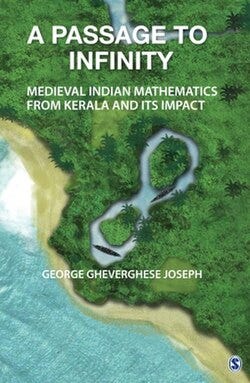
George Gheverghese Joseph challenges these assumptions with detailed evidence, tracing the indigenous roots of the Kerala School of Mathematics, which flourished from the 14th centurybeginning with Madhava of Sangamagramathrough to Sankar Varman in the 1840s. Although Kerala saw significant mathematical activity in the 9th, 12th, and 13th centuries, the systematic tradition identified as the Kerala School coheres with Madhava’s work near present-day Irinjalakuda. His achievements were extraordinary: precise lunar position calculations and derivations now recognized as the Gregory series for arctangent, the Leibniz series for π, and the Newton power series for sine and cosinecenturies before these became prominent in Europe.
Following Madhava, the guru-shishya parampara produced a lineage of eminent figuresVattasseri Paramesvara, Nilakantha, Chitrabhanu, Narayana, Jyeshtadeva, and Achyutawho advanced astronomy and mathematics with rigorous computational methods. They composed commentaries on Aryabhata, Bhaskara, and Bhaskaracharya; conducted careful eclipse observations; and developed results in spherical and planetary astronomy alongside new theorems and proofs. Nilakantha’s Tantrasangraha exemplifies this scholarly depth: revising interior-planet models inherited from Aryabhata, Nilakantha achieved equations of remarkable precision, at times surpassing those formulated later by Tycho Brahe. Joseph notes that many more contributors may still remain in uncatalogued Malayalam and Sanskrit manuscripts stored in Kerala and Tamil Nadu.
Understanding why this tradition flourished requires attention to Kerala’s social and institutional landscape. By the 14th century, temple-centered Namboothiri Brahmin communitiesmajor landholdershad developed a distinctive social organization. With the practice whereby only the eldest son entered a formal marriage alliance, younger sons often formed sambandham with Nair women and sought status through scholarship and service. This created a fertile environment for intellectual distinction. While rooted in temple institutions, the wider dharmic knowledge ecosystem of the subcontinent historically welcomed shared inquiry among Hindu, Buddhist, and Jain practitionersan inclusive culture of learning that nurtured computational astronomy, logic, and mathematics across regions and centuries.
For an agrarian society tied to the rhythms of the monsoon, precise calendars and accurate computation of celestial positions were indispensable. Astrology also shaped ritual timing for religious and personal life. Temples served as hubs of learning and community, employing priests, scholars, teachers, and administrators, and supporting students through residential arrangements. Readers may sense how such institutionswhen sustained by community trustfunction as living universities, transmitting knowledge, stewarding manuscripts, and maintaining scientific observation programs over generations.
The final and perhaps most intriguing historiographical question concerns transmission. Two signal developments of 17th-century Europethe emergence of calculus and the adoption of infinite series techniquesmirror results documented in Kerala from the 14th to the 16th century. How might such knowledge have reached Europe? One hypothesis considers Jesuit intermediaries, since knowledge transfers between India, the Middle East, and Europe are well-documented from late antiquity onward. However, careful surveys of Jesuit materials have not yet yielded conclusive evidence. Another challenge is interpretive: Kerala results are often embedded in cryptic metrical Sanskrit and Malayalam, demanding sustained linguistic and mathematical expertise. Although Sankar Varman interacted with Charles Whish in 1832, comparable exchanges in earlier centuries are not securely documented.
An alternate possibility is inadvertent diffusion. The computational outputs of the Kerala Schoolespecially for navigation and mappingwould have been valuable to pilots, cartographers, and surveyors in the Indian Ocean world. In this scenario, techniques could have circulated in practical contexts and been reconstructed elsewhere. At present, the question remains open and invites interdisciplinary researchacross philology, the history of science, maritime history, and manuscript studiesto map the precise trajectories of ideas. The inquiry itself can be deeply inspiring, reminding readers that scientific insight grows through conversation across cultures and through the cumulative labors of many hands.
Joseph’s study is rigorous rather than purely popular, unlike works such as Michel Danino’s The Lost River or Sanjeev Sanyal’s The Land of Seven Rivers. Significant portions present formal proofs and derivations that non-specialists may skim, and the placement of an appendix mid-volume may feel unconventional. The narrative begins with the “classical” period and Aryabhata (499 CE), though complementary pedagogical resourcesfor example, the course Mathematics in India – From Vedic Period to Modern Times by M. D. Srinivas, M. S. Sriram, and K. Ramasubramanianappropriately foreground the Sulvasutras (prior to 500 BCE). Recognizing this older stratum ensures that early geometric and computational practices inform the larger arc of Indian mathematics.
In a global discourse that often centers Greece or Europe, this body of work makes a measured case for the indigenous development of the Kerala School. Studies such as The Crest of the Peacock: Non-European Roots of Mathematics by Joseph and Mathematics in India by Kim Plofker have already broadened scholarly understanding. Yet, popular narratives still underrepresent these developments, in part because the computational model associated with Aryabhata differs from the Euclidean-deductive model more familiar in Western curricula. Books like A Passage to Infinity are therefore invaluable for illuminating mathematical practices that have remained marginal in general histories.
Beyond scholarly correction, this narrative carries a unifying civilizational message. The Kerala School’s achievements grew from institutions and values shared across the dharmic traditionsHinduism, Buddhism, and Jainismand resonate today with Sikh commitments to learning and community service. Rather than isolating one lineage, the record points to a common ethical culture of inquiry, humility, and transmission. Readers may feel both wonder and responsibility: wonder at how far-reaching the subcontinent’s mathematical imagination has been, and responsibility to preserve, translate, and teach this heritage so it strengthens a shared sense of identity and mutual respect across dharmic communities.
Inspired by this post on Varnam.