Across Hindu scriptures, the Hayagriva episode stands out for its striking interplay of cosmic duty (dharma), sacrifice (yajna), and transformation. The narrative links an act as minute as the creation of termites to a world-shaping outcome: the emergence of Lord Vishnu in his horse-headed form, Hayagriva. By tracing this chain of causes and effects, the tale underscores how subtle forces can redirect the flow of cosmic order.
Purana literature preserves several variations of this narrative, with references and motifs echoed in texts such as the Padma Purana and Skanda Purana. The common thread is clear: during a period often described as cosmic slumber, the gods required Vishnu’s active presence to sustain Brahma’s sacrificial rite. Without that presence, the sacrificial current, which nourishes and aligns the cosmos, could not proceed as intended.
In one widely retold version, Vishnu rested with his head on a taut bow. The devas, needing the sacrifice to continue, approached Brahma for a way to awaken the preserver without causing harm or upheaval. The solution employed was unexpectedly modest: the creation of termites (white ants), beings capable of working silently yet decisively upon the bowstring.
As the termites gnawed through the string, the bow snapped with sudden force, severing Vishnu’s head. The shock of this moment resonates through the narrative: a seemingly minor intervention precipitated a profound rupture. Yet the very extremity of the event gave rise to an equally profound restoration, aligning with the Purāṇic principle that dissolution and renewal are inseparable phases of a single cosmic rhythm.
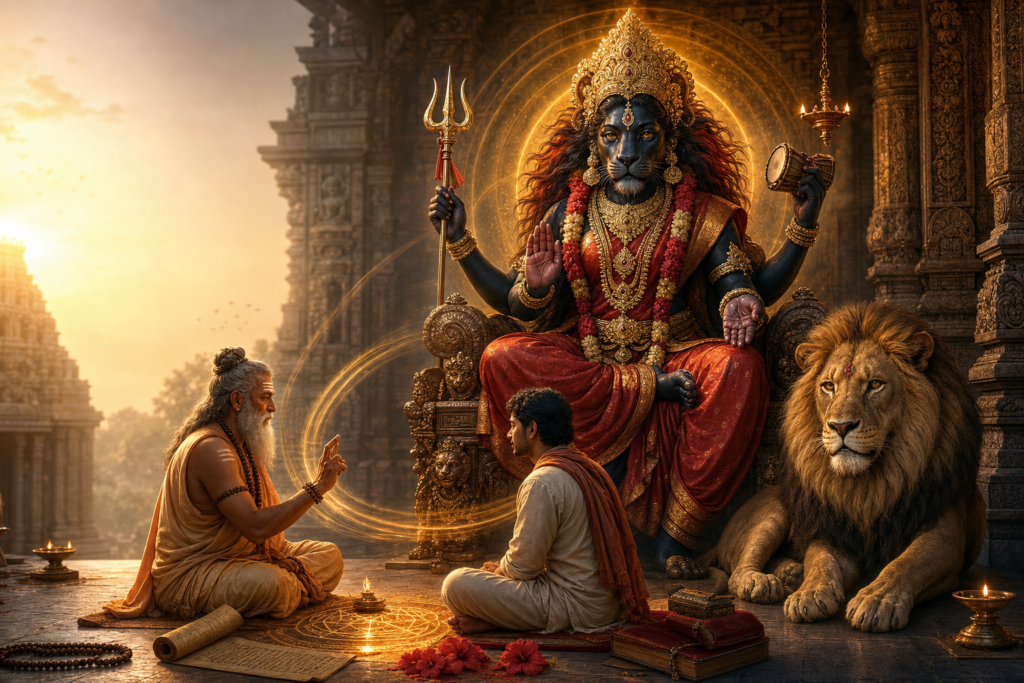
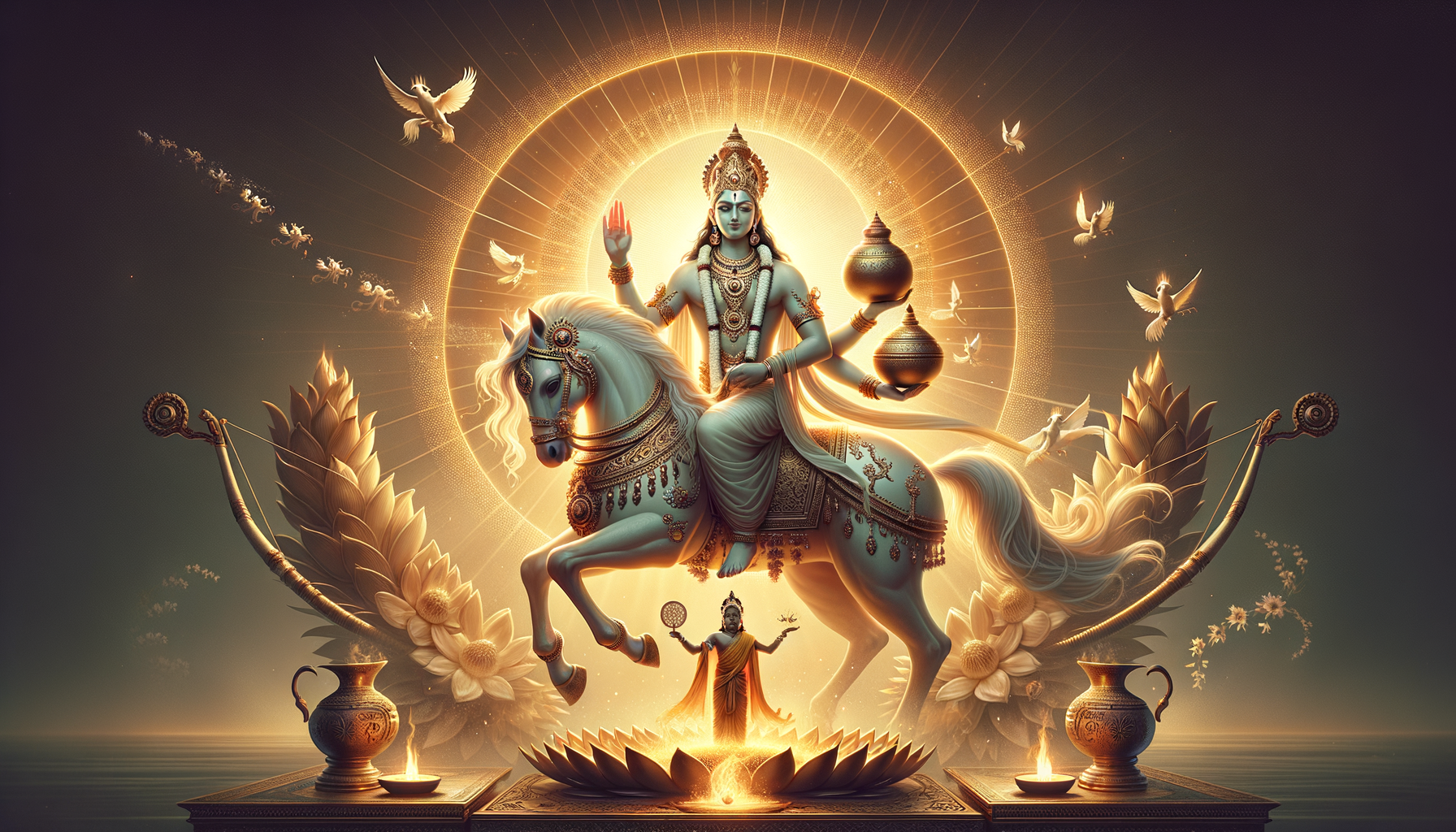
To restore cosmic balance and resume the sacrificial current, a sacred rite was performed in which a horse’s head was affixed to Vishnu. Thus arose Hayagriva“he of the horse’s head”a form associated with breath, mantra, and the articulated sound of the Veda. Hayagriva’s emergence is not presented as an accident but as a sacrificial transmutation, turning catastrophe into a higher equilibrium anchored in knowledge (vidyā) and order (ṛta).
Subsequent strands of the tradition emphasize Hayagriva’s role in safeguarding or retrieving the Vedas and conquering the forces of ignorance. Some accounts describe the subduing of an asura of similar name; others stress Hayagriva’s luminous wisdom and the re-establishment of dharma. Despite variations, the narrative consistently centers the themes of vigilance, knowledge, and the ethical commitment to preserve the universe’s moral architecture.
Symbolically, the termites embody the potency of the subtle (sūkṣma). They demonstrate that infinitesimal agents can set vast transformations in motion, reminding practitioners that small, repeated actsof discipline, remembrance, or neglectcan determine outcomes of great magnitude. The horse’s head, conversely, evokes prāṇa (vital energy), articulate speech, and the disciplined cadence of mantra, aligning Hayagriva with the living voice of the Veda.
This integrated vision resonates across dharmic traditions. In Buddhism, mindful attention prevents latent tendencies from “snapping” into unskillful actions; in Jainism, subtlety is honored in the careful, non-violent (ahimsa) discipline that guards even the smallest life forms; in Sikhism, simran and seva refine speech and action into instruments of truth. The narrative’s ethical insighthumility before small causes and reverence for all lifethus supports unity in spiritual plurality within Sanatan Dharma’s wider family of traditions.
Contemporary readers often find the story emotionally compelling because it frames vigilance and care as everyday dharma. Overlooked details in one’s conduct can have outsize effects, just as sustained, mindful practices restore balance after rupture. The tale encourages a shared commitment to harmony: to protect wisdom, to honor interdependence, and to allow transformation to arise through sacrifice properly understoodnot as loss, but as alignment with a larger good.
Read academically and lived reflectively, the Hayagriva episode illustrates how cosmic duty, sacrifice, and transformation converge. From Brahma’s creation of termites to Vishnu’s horse-headed reawakening, the narrative invites a unified dharmic appreciationHindu, Buddhist, Jain, and Sikhof how the smallest agents and the highest principles co-create order, knowledge, and compassion.
Inspired by this post on Hindu Blog.