The disappearance day of Sri Jayananda Prabhu invites careful reflection on the lived ideals of bhakti-yoga and the organizational energy that helped establish ISKCON’s public presence across the world. Remembered within Gaudiya Vaishnavism as a tireless servant-leader and colloquially as the “saint in the streets,” Jayananda Prabhu exemplified humility, relentless seva, and an ability to translate devotional theology into accessible civic practice.
Within the Vaishnava calendar, a disappearance day (tirobhava-tithi) is approached not as a loss alone but as a moment to honor an acharya’s or devotee’s life-work and the spiritual momentum they bequeath to a community. In this spirit, commemorations of Sri Jayananda Prabhu foreground both remembrance and application: study of his example is paired with renewed service in kirtan, prasadam distribution, and inclusive community building.
Accounts within ISKCON histories describe Sri Jayananda Prabhu as having studied engineering at Ohio State University before moving to San Francisco during the 1960s. Early engagement with A.C. Bhaktivedanta Swami Prabhupada’s teachings, coupled with hands-on assistance in fledgling temples, rapidly positioned him as a dependable pillar in ISKCON’s Bay Area efforts. He is widely remembered for supporting temple finances through practical work, engaging in sankirtana, and ensuring that guests, seekers, and neighbors were received with dignity and warmth.
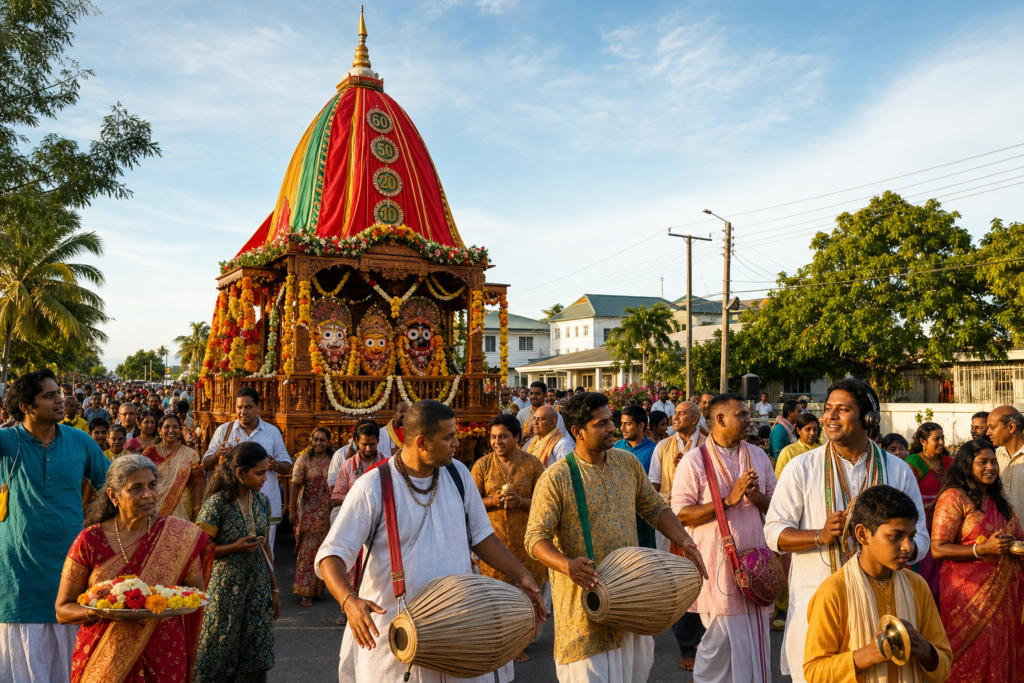
What makes Jayananda Prabhu’s legacy distinctive is not only personal asceticism or private devotion but a demonstrable capacity to organize devotion publicly and safely. He helped initiate and institutionalize the Ratha‑yatra festival in San Francisco (1967 onward)widely recognized as the first large-scale Jagannath Ratha‑yatra outside Indiaand refined it year after year so that city officials, neighbors, and diverse faith communities could engage comfortably. This achievement required more than enthusiasm; it demanded engineering acumen, logistics planning, civic negotiation, volunteer management, and pastoral sensitivity.
Technically, early Ratha‑yatra efforts hinged on several interlocking competencies: design and construction of robust chariots for Jagannath, Baladeva, and Subhadra; route design aligned with municipal codes; risk and crowd management; and service workflows for prasadam and sanitation. Oral histories emphasize that Jayananda Prabhu obtained permits, cultivated rapport with city departments, organized teams for carpentry and transport, and scheduled volunteers so the festival would remain joyous yet disciplined. The outcome was a repeatable model: devotional pageantry presented with professional reliability.
This organizational grammardevotional intent expressed through civic excellenceproved replicable. Over subsequent decades, ISKCON communities adopted Jayananda Prabhu’s festival blueprint in New York, London, Toronto, Sydney, Durban, and dozens of other cities. Public kirtan, vegetarian prasadam, and the darshan of Lord Jagannath on grand chariots became familiar fixtures in global urban calendars. In effect, a Gaudiya Vaishnava liturgical form, once geographically anchored in Puri, traveled transnationally through processes he helped normalize and dignify.
Equally important was his leadership ethic. Jayananda Prabhu’s manner was marked by unpretentious work, a refusal to seek credit, and a quiet, interpersonal attentiveness that made complex projects feel human-scaled. He is remembered for greeting others with respect, prioritizing the comfort of guests, and modeling bhakti not as abstraction but as service: lifting, cooking, repairing, fundraising, and consolingwhatever the situation required. In organizational terms, he embodied servant leadership: authority earned through responsibility, steadiness, and care.
In the final period of his life, Sri Jayananda Prabhu faced leukemia yet continued to contribute to Ratha‑yatra organization and temple needs as health allowed. He departed on May 1, 1977, in San Francisco. ISKCON leaders and communities have since observed his disappearance day annually, and many Ratha‑yatra committees place his photograph on chariots in acknowledgment that their festivals stand on foundations he laid. This remembrance is not merely ceremonial; it functions pedagogically, inspiring new generations of volunteers to couple devotion with competence.
Theologically, Gaudiya Vaishnavism esteems the disappearance day as an opportunity to internalize a devotee’s mood (bhava) and methods (acharana). In Jayananda Prabhu’s case, the convergence is instructive: the mood was humility; the method was practical excellence in service. He translated kirtan philosophy into public space, showing how inclusive religious festivals can welcome the curious while remaining faithful to core principles of nama-sankirtana and prasadam distribution.
His legacy also resonates across the broader dharmic family. The ethic of seva finds obvious parallels in Sikh langar and kirtan; the cultivation of compassion and mindful presence aligns with Buddhist metta and sangha-building; disciplined non-harm and truthful living echo Jain ahimsa and satya. By foregrounding hospitality, shared meals, and music-centered devotion, Jayananda Prabhu’s festival work offered a bridge for Hindus, Buddhists, Jains, and Sikhs to participate together in public celebrations rooted in dignity, non-violence, and mutual respect.
From a socio-historical perspective, the diffusion of Ratha‑yatra underlines a key feature of the Hindu diaspora: ritual forms adapt to civic frameworks without losing scriptural anchor. Jayananda Prabhu’s contribution lay in demonstrating that adaptability is not dilution; rather, carefully stewarded adaptation enhances accessibility while preserving theological clarity about Jagannath, bhakti-yoga, and Gaudiya Vaishnava practice under Srila Prabhupada’s guidance.
Practical lessons for contemporary organizers are concrete. First, pair devotional vision with engineering and safety standardssound chariot design, thorough risk assessment, and trained volunteer teams. Second, cultivate civic partnerships early by engaging municipal authorities, neighborhood associations, and interfaith councils. Third, embed hospitality: vegetarian prasadam distribution, multilingual signage, and accessible facilities broaden participation and reflect dharmic ethics. These measurescentral to Jayananda Prabhu’s methodtranslate idealism into durable institutions.
Emotionally, many attendees describe walking behind the chariots, chanting in kirtan, and sharing prasadam as experiences that dissolve social distance. Public devotion, handled with care, creates memory-making rituals where families, students, and elders encounter a living tradition that is simultaneously intimate and cosmopolitan. Such affective bondsformed in streets rather than cloisterswere precisely the terrain where Jayananda Prabhu excelled.
Observing Sri Jayananda Prabhu’s disappearance day, therefore, is more than homage; it is a reaffirmation of a dharmic civic imagination: devotion that is gentle, organized, and welcoming. In honoring his life, communities across ISKCONand across the wider dharmic spectrumare reminded that unity is cultivated not by erasing differences but by serving together under shared values of compassion, discipline, and reverence.
Inspired by this post on Dandavats.