After a visit to Nachiketa Tal, time in Yog Niketan Ashram unfolded along a balcony overlooking the Ganga, where an evening loudspeaker rendition of the Hanuman Chalisa drifted softly across the river. The cadence felt contemplative and gently wistful, an aural sign of how easily Uttarkashi welcomes a long, reflective stay within the Hindu Himalaya. The setting created the conditions to pause, absorb, and attune to the area’s deep spiritual ethos.
On the morning of October 21, the balcony view opened to the Bhagirathi Ganga moving steadily east. The river’s sound, cool air, and light combined to frame a day that would remain grounded in ritual, reverence, and inner stillness.
At the ghat below, a practitioner completed asana by the Ganga, then filled two copper pots, circumambulated a venerable pipal tree, poured water at its roots, offered the second pot at a nearby Shiva shrine, and proceeded to the Kedarnath Temple (Uttarkashi) for morning aarti. Such ordinary yet profound gestures attest to the living continuity of Sanatana Dharma and its intimate connection to place.
Reverence for rivers and trees is omnipresent. Rather than an isolated ritual moment, sacred ecology shapes ordinary life: a married woman offering a libation to Ganga, an elder meditating by the water, a quiet stream of worship at the pipal. This living relationship with the natural world remains visible at virtually every turn.

Across the valleyfrom Haridwar and Rishikesh to Uttarkashi, Gangnani, Gangotri, and Gaumukhthe prevailing spirituality centers on grateful communion with Nature: Ganga, Surya, trees, and mountains. Local residents regularly pause at the river during a walk to work, acknowledging the Ganga with sincere, unhurried devotion.
On this day, a complete snanam in the Ganga set the tone for extended prayer along the balcony. The devotional sequence included Ganesha Bhajan, Ganga Stotram, Shiva Ganga Stuti, Ganga Chalisa, Ganga Ashtottara Shatanamavali, and Ganga Sahasranama. Because it coincided with Rama Ekadashi, the recitations also included a Krishna Bhajan and Vishnu Sahasranama, with dhoop and golden raisins offered to Vishnu.
In the afternoon, a lightning strike temporarily disrupted the town’s electrical gridan unplanned prelude to an early Diwali atmosphere as sporadic fireworks sounded across Uttarkashi. Seasonal jewelry shops emphasized Dhanteras traditions, inviting purchases of gold for auspiciousness.

Study and practice deepened as Siddha Kunjika Stotram was chanted attentively and its mantric structure discussed in detail. Govatsa brought an opportunity for cow veneration; feeding golden raisins to a street cow outside the ashram gate lent the festival a simple, joyful intimacy.
Ramaa Ekadashi concluded with a special Rama aarti by Ramanandi monks at the Kedarnath Temple (Uttarkashi). The service featured resonant bells and the sonorous call of the conch. The monks’ hospitality, including printed bhajan sheets for congregational singing, exemplified the gentle welcome characterizing the town’s religious life.
Dawn on October 22 at Kedar Ghat presented silver light on fast water, the kind of moment that anchors memory. The weather proved idyllic for a quiet walk along the river, where worshippers gathered in small clusters.

A local teenager in contemporary attire approached with a copper pot, drew water from the Ganga, and offered it at the pipal tree without haste, demonstrating an authentic connection that bridges generations. Conversations with youth in Uttarkashi often reflect sincere engagement with traditional spirituality, suggesting its confident future.
Pradosh added another layer to the day: Rudrabhishek was performed at Kashi Vishwanath Temple (Uttarkashi) and again at the ancient Kedarnath Linga, sheltered beneath a five-headed golden Naga. The devotional atmosphere conveyed the profound, tender mystery of Shiva.
The same day also marked Shani Trayodashi on a Saturday, an auspicious alignment. West along the river from Kedar Ghat, the Punjab Ashram houses the Rudreshwar Temple, where Shani and Hanuman sit beneath a large pipal tree. Continuous offerings of mustard oil flowed over both murtis as worshippers sought protection, steadiness, and grace.
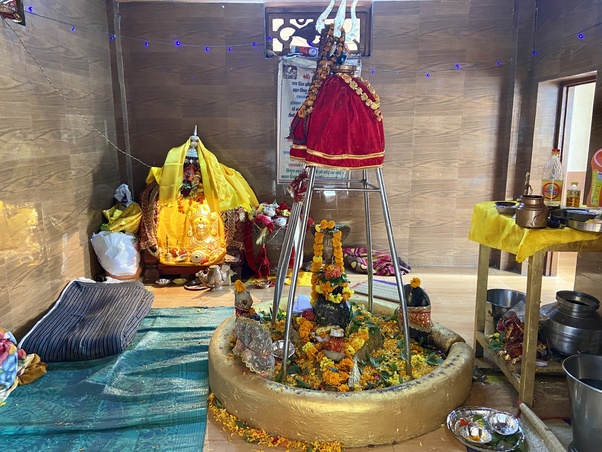
Later, a new footbridge near Kedarnath Temple (Uttarkashi) connected the main town to the south-side bypass road, making a 2 km ascent to Kuteti Devi Temple approachable via winding hill paths and household backyards. The temple’s origin story recounts a couple beseeching their KuladeviKuteti Devi, brought in devotion from Kota, Rajasthanand later discovering three fragrant stones on a hillside across from Kedar Ghat. Those sacred stones were enshrined as Kuteti Devi, establishing a pilgrimage site with sweeping views of Uttarkashi and the Bhagirathi Ganga.
At Kuteti Devi Temple, the priest received visitors warmly; Siddha Kunjika Stotram was chanted and its nuances discussed. A festive bhajan, Meri Akhiyon Ke Samne hi Rehna Maa Sherawali Jagadambe, added joyous cadence to the morning’s worship. Nearby, the ancient Maha Kaleshwar Temple, set amid green fields west of Manikarnika Ghat, remains a serene center for veneration of Shani and Maha Mrityunjaya, especially potent for overcoming death, disease, and obstacles on a Saturday Trayodashi.
That afternoon, the journey rose to the crest of Varanavata Mountain. A taxi delivered the group to the road’s end, followed by a 1 km woodland ascent. Along the way, a donkey rested in the shade, tail flicking lazily, and two mongeese darted between rocks. At the summit, Bimaleshwar Templeseventh and final of the Sapta Vishwanath templescrowned the ridge.

Inside Bimaleshwar, the presence behind a yellow curtain in a rear corner signified Kandar Devata. The sequence of worship encompassed quiet meditation in the inner sanctum, a private puja with the head priest, and then a full public aarti with prasad, offering the complete rhythm of temple life in one visit.
Descending through forest into Sangrali village revealed additional shrines, including another temple to Kandar Devata. Locals note that Kandar Devata traditionally resided more in the village shrine but is now largely “in town,” a reminder of living deity presences felt across the region.
Village homes displayed slate roofs and mud walls, elegant in their functionality. Women hand-quarried slate from the hillside, breaking it with hammers as toddlers ran about freelyscenes of rural resilience and everyday artistry in the Himalaya.

The footpath to town wound through terraced fields, its course confirmed by villagers’ friendly directions. As the sun set, grass-cutter women carried the day’s final loads uphill. Hill-pigs and monkeys appeared along the way, with cows and dogs ever-present. By nightfall, Diwali season’s lights and firecrackers signaled the coming festival in earnest.
On October 23the opening day of Diwalibells and cheerful decorations filled the streets. Travel then continued onward: a taxi to Dehradun Airport, a flight to Delhi, and then Kathmandu, leaving Uttarkashi’s sacred rhythms in the mind’s ear.
Throughout this journey, Uttarkashi stands as a living classroom of sacred ecology and shared dharmic values. The same reverence for nature, inner discipline, and compassionate service seen in Hindu practices is also deeply resonant across Buddhism, Jainism, and Sikhism. In the Himalayan context especially, these traditions converge around non-violence, gratitude, and seva, welcoming all who seek reflection, learning, and unity along the river and in the temple.
Note on recency: Though the travel occurred in autumn 2022, information about temples and places cited here reflects conditions as of mid-2025. Practical logisticstransport links, opening times, and local accesscan change quickly; verification from current sources is recommended.
Photo credits: © Devala Rees.
Inspired by this post on Hindu America.