The ancient hill-shrine of Sholingur, celebrated as one of the 108 Divyadeshams, continues to retain its sanctity as the home of the Yoga Narasimha Swamy Temple. The steep ascent is as memorable as the destination, often animated by a boisterous troop of monkeys whose watchful interest in offerings is well known to local devotees and visitors alike.
On one such ascent, a young local woman was suddenly surrounded by several monkeys intent on her offering bag. Even after they seized it and rummaged through its contents, they neither scratched nor harmed her. In a tone of familiar affection, she addressed them as if they were members of her extended family: “Narasimha! Anjaneya! Return my bag! Now! The temple will close.” A little further up the steps, a few monkeys followed, dropped the bag before her, and scampered back. The fruit was gone; flowers, a garland, and money remained. She rearranged the flowers and chided them gently, “Narasimha, if you do this again, I’ll beat you, Narasimha!” Then, she paused, offered a brief Namaskaram, and continued the climb.
This simple vignette illustrates an embodied Bhakti that remains deeply rooted in Tamil society. It signals not only continuity but also confidence—a living devotion that adapts to everyday realities without losing its tenderness or reverence. Such scenes, repeated across temple towns, reveal an intimate, personal relationship with the sacred that extends to the landscape, its creatures, and its rhythms.
Set against this lived devotion, Tamil Nadu has navigated layered cultural pressures over centuries, notably colonial-era missionary activity and modern linguistic-political movements often grouped under Dravidianism. These forces have influenced public discourse and identity in complex ways. Yet the endurance of Sanatana Dharma’s devotional practices—and related dharmic values shared across Hinduism, Buddhism, Jainism, and Sikhism such as ahimsa, dana, seva, and shraddha—has provided a resilient anchor in public life.
Historical records describe how certain missionary efforts adapted local idioms and symbols to communicate their message, from the early experiments of Robert de Nobili to later linguistic frameworks associated with Bishop Robert Caldwell. In Indian-language Bibles, for instance, the vocabulary often draws upon Sanskritic terms (e.g., Paramatma, Deva Putra, Deva Mata, Prabhu), reflecting strategic inculturation. Contemporary expressions—such as “Jesus Sahasranama,” “Jesus Gayatri Mantra,” and the erection of dhvajasthambhas near churches—further indicate an ongoing use of familiar devotional forms. An academic reading suggests that while inculturation seeks cultural proximity, it can also blur boundaries of meaning; public trust, therefore, depends on transparency, ethical persuasion, and respect for local traditions.
Despite these dynamics, the Bhakti tradition in Tamil Nadu remains notably robust. Over the last decade and a half, social media and the wider Internet have functioned as new public squares, enabling diverse communities to bypass older narrative bottlenecks. This has allowed a fuller representation of temple culture, Tirtha-Yatra, and Sampradaya practices, and has amplified the dharmic civilizational vocabulary—Sanatana Dharma, Bhakti Tradition, and sacred heritage—in mainstream conversation.
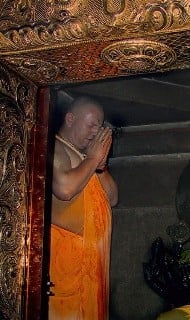
A defining example is the 2019 celebration of Atti Varadarajaswamy in Kanchipuram. Once every forty years, the deity sculpted from atti (fig) wood is brought out of an underground chamber within the Varadaraja Perumal Temple tank for forty-eight days of elaborate worship, allowing rare public darshana. Historical accounts suggest the murti was concealed centuries ago to protect it during periods of political turbulence and military incursions. The festival’s 2019 iteration drew lakhs of devotees, reaffirming how unbroken ritual continuities carry the weight of collective memory and identity.
The extraordinary visibility of the event also indicated a shifting media landscape. Leaders and supporters across the political spectrum—including figures associated with both DMK and AIADMK—visited Kanchipuram for darshana, underscoring the integrative social force of temple-based devotion. This was notable in the broader ideological context of E.V. Ramaswamy Naicker (Periyar), who famously expressed a stringent critique of theism: “He who created god is a fool, he who propagates god is a scoundrel, and he who worships god is a barbarian.” While such critiques remain part of Tamil Nadu’s political history, the continued vitality of temple worship suggests that lived devotion and cultural participation persist beyond ideological contestation.
From an academic perspective, this resilience can be understood as a long civilizational arc: devotional practices may bend under pressure but reassert themselves through family custom, local ritual ecosystems, and the rhythmic recurrence of sacred time. The Atti Varadarajaswamy festival—like many mass Hindu observances—requires little marketing; it thrives because it is embedded in community life. That embeddedness resonates with the shared dharmic ethos found across Hindu, Buddhist, Jain, and Sikh traditions: plural worship, ethical self-cultivation, and community service as expressions of the sacred.
Today, a quiet renewal appears to be underway. Non-institutional initiatives—cultural forums, scholarly channels, volunteer groups, and local temple ecosystems—are strengthening heritage literacy and encouraging inclusive participation. Their combined effect has reframed public conversation in Tamil Nadu, where Bhakti, Sanatana Dharma, and cultural heritage are increasingly discussed with nuance and pride. The trend is neither confrontational nor exclusionary; rather, it is constructive, seeking unity among dharmic traditions and mutual respect across faiths, while affirming the legitimacy and depth of Tamil temple culture.
Viewed in aggregate, episodes like the Sholingur vignette and the Atti Varadarajaswamy festival are less isolated events than living manifestations of an enduring civilizational grammar. They show how grassroots devotion, cultural memory, and digital-era participation together challenge reductive narratives and help restore balance in the public sphere. In that restoration lies a wider promise: a confident, plural, and dharmic Tamil Nadu that honors its temples, welcomes open discourse, and strengthens social cohesion.
Inspired by this post on Dharma Dispatch.