
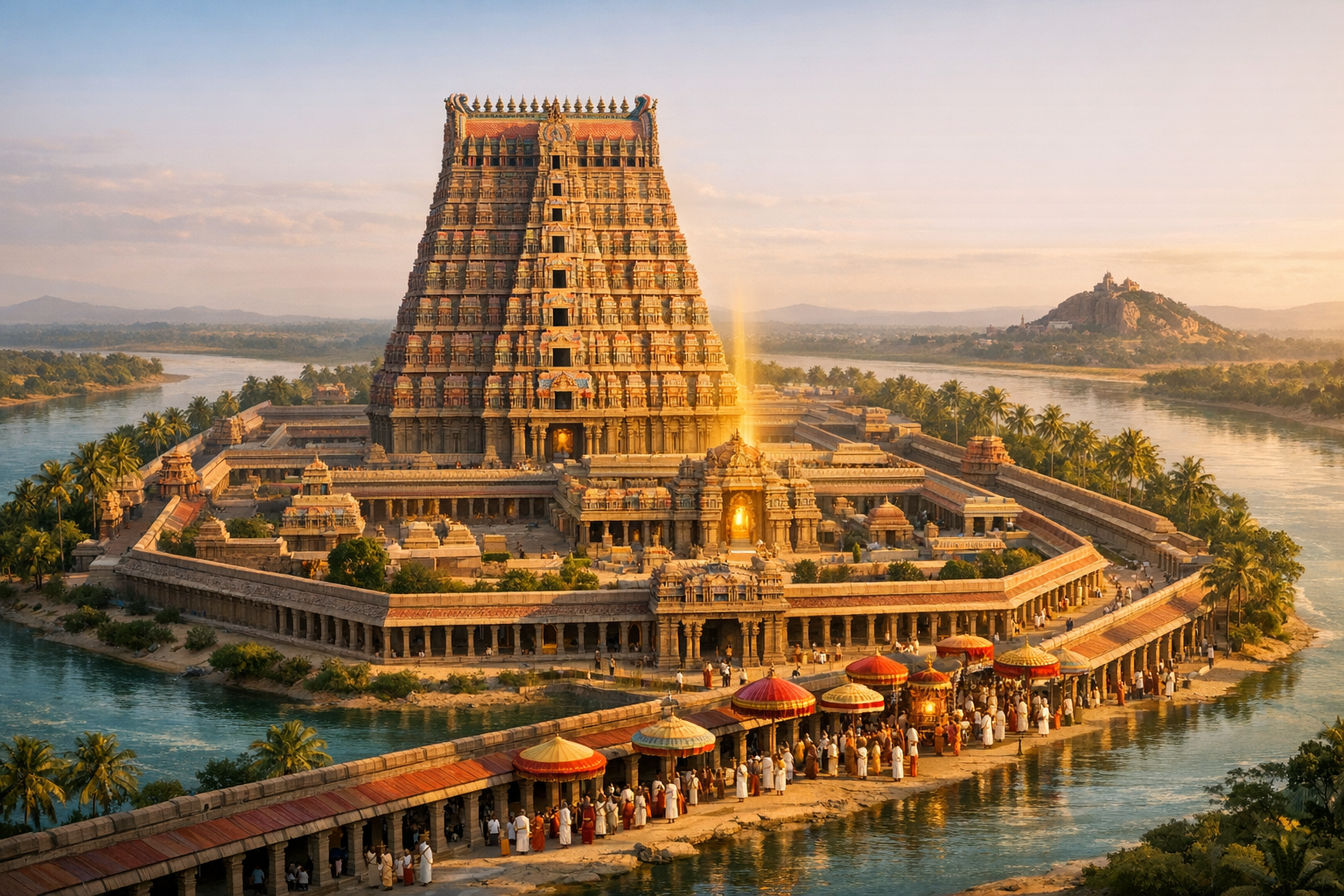
Set on the sacred island between the Kaveri and Kollidam rivers in Tamil Nadu, the Sri Ranganathaswamy Temple at Srirangam stands as Bhooloka Vaikuntham, the earthly Vaikuntha. As the largest functioning Hindu temple complex and a foremost Divya Desam of Sri Vaishnavism, it preserves a living continuum of worship, scholarship, and architecture centered on Lord Ranganatha in His reclining Ananta Sayana form.
The Srirangam Temple Storyoften summarized as the divine plan guiding Lord Ranganatha to Kaveriinterweaves theology, sacred geography, and cultural memory. The narrative mirrors a broader dharmic understanding that places and deities converge by cosmic intent, linking devotees to a larger order in which rivers, temples, texts, and communities serve a single principle of dharma.
According to temple chronicle traditions and the Sriranga Mahatmyam of the Skanda Purana, the Ranganatha murti emerged from Vaikuntha to Brahma, passed into the Ikshvaku lineage of Ayodhya, and was later entrusted by Sri Rama to Vibhishana after the Ramayana war. On returning toward Lanka, Vibhishana paused on the Kaveri’s banks. The deity was placed briefly on the groundan act that, in sacred telling, anchored the Lord permanently to Srirangam by divine will. This single moment defines the temple’s identity as a chosen abode rather than a merely constructed shrine.
Local tradition links this episode to Ucchi Pillayar at the Trichy Rockfort: Ganesha, appearing as a playful boy, is said to have facilitated the Lord’s settling at Srirangam, then fled to the hilltop when pursued. In keeping with Vibhishana’s devotion, the main sanctum at Srirangam faces southuncommon in Dravidian temple orientationso that Lord Ranganatha perpetually offers His darshan toward Lanka, affirming the inclusive grace that transcends boundaries.
The temple’s scriptural and devotional pedigree is deep and precise. The Sriranga Mahatmyam praises the kshetra’s sanctity; the Nalayira Divya Prabandham, especially the hymns of Nammalvar, Periyalvar, and Tirumangai Alvar, celebrate Srirangam as Koilthe temple par excellence in Sri Vaishnava idiom. Koil Olugu, the temple’s historical chronicle, preserves institutional memory across centuries of endowments, rituals, restorations, and community life.
Srirangam’s urbanism is an embodied cosmology. Seven concentric prakaras, monumental gateways, and axial corridors map theological ideas of protection, ascent, and proximity to the divine. The temple enshrines over twenty gopurams; the Rajagopuram rises to about 72 meters, and the complex spreads across roughly 156 acres. A thousand-pillared hall from the Vijayanagara period exemplifies the integration of ritual, aesthetics, and acoustics, hosting pageantry and performance rooted in devotional liturgy.
Ritual practice at Srirangam follows the Pancharatra tradition, with a full cycle of nitya (daily), naimittika (occasional), and utsava (festival) observances. Devotees encounter a carefully sequenced darshan: moolavar (immovable deity) Ranganatha presides in eternal repose, while the utsava murti, Namperumal, embodies the Lord’s gracious accessibility through processions along the veedhis. The rite Koil Alwar Thirumanjanam purifies the precincts seasonally; the calendar culminates in Vaikuntha Ekadashi, when the Paramapada Vasal opens as a symbolic threshold to the Lord’s abode.
The temple is also a conservatory of sacred arts. Ariyar Sevaian enactment through recitation and abhinaya of Divya Prabandham hymnsbridges text and devotion. The sonic landscape of Nalayira Divya Prabandham in Tamil, coexisting with Sanskrit Vedic chant, exemplifies the Sri Vaishnava synthesis of bhakti, ritual precision, and philosophical clarity.
Historically, Srirangam’s continuity required resilience. Inscriptions attest to Chola, Pandya, and later Vijayanagara patronage that expanded and stabilized the institution. Temple chronicles recount the 14th-century disruptions when invasions forced the itinerancy of Namperumal for decades across South India, until a ceremonious return under Vijayanagara protection around 1371 CE. This restoration reaffirmed Srirangam’s role as a liturgical and cultural nerve center where devotion, governance, and economy converged.
Doctrinally, the temple anchors the Vishishtadvaita tradition. Ramanujacharya’s long association with Srirangam shapes the temple’s liturgical order and community ethos: inclusivity through prapatti (surrender), scriptural exegesis in Sanskrit and Tamil, and disciplined temple management that serves both spiritual and social welfare. Successive acharyas, including Pillai Lokacharya, Vedanta Desika, and Manavala Mamunigal, further codified practice and pedagogy, ensuring that scholarship and seva reinforced one another.
As a riverine shrine, Srirangam participates in the Pancharanga Kshetrams along the Kaveri, together with Adi Ranga at Srirangapatna, Madhya Ranga at Shivanasamudra, Parimala Ranganatha at Mayiladuthurai, and Appala Ranganathar at Koviladi. This longitudinal pilgrimage articulates a theology of sacred flow: the Kaveri is not merely a landscape feature but a sentient presence in the narrative of grace. Across dharmic traditions, rivers serve as teachersBuddhism, Jainism, Sikhism, and Hinduism all revere water as purifier and connectorunderscoring a shared civilizational grammar of gratitude and stewardship.
The Srirangam complex continues to adapt with exemplary conservation. In 2017, the temple received the UNESCO Asia-Pacific Award of Merit for Cultural Heritage Conservation, recognizing sensitive restoration that balanced structural integrity, ritual functionality, and community participation. Current documentation projects, improved hydrological management on the island, and skilled craftsmanship training sustain both tangible and intangible heritage for future generations.
Visitors frequently describe an enveloping calm while moving from outer bazaars through the prakaras to the sanctum. The progression is not only spatial but existentialcrossing thresholds that invite attention, humility, and wonder. Many find that hearing Divya Prabandham recitations while beholding Namperumal in procession clarifies the core promise of the Srirangam Temple Story: divine accessibility is immediate, compassionate, and continuous.
Academically, Srirangam may be read as a complete ecosystem: a canonical narrative (Skanda Purana’s Sriranga Mahatmyam), a philosophical framework (Vishishtadvaita), a ritual technology (Pancharatra agama), an urban-cosmological blueprint (seven prakaras), and a social institution (endowments, education, and arts). Devotion and design co-produce meaning; the temple’s south-facing sanctum, its riverine siting, and its liturgical calendar together express an intentional, intelligible sacred order.
Taken as a whole, the divine plan that led Lord Ranganatha to the Kaveri does not exclude but embraces. The temple’s message resonates across Hinduism, Buddhism, Jainism, and Sikhism in its affirmation of compassion, ethical living, and reverence for nature. By honoring diverse paths within a shared quest for truth, Srirangam models a dharmic unity that remains urgently relevant in contemporary life.
Inspired by this post on Hindu Blog.










