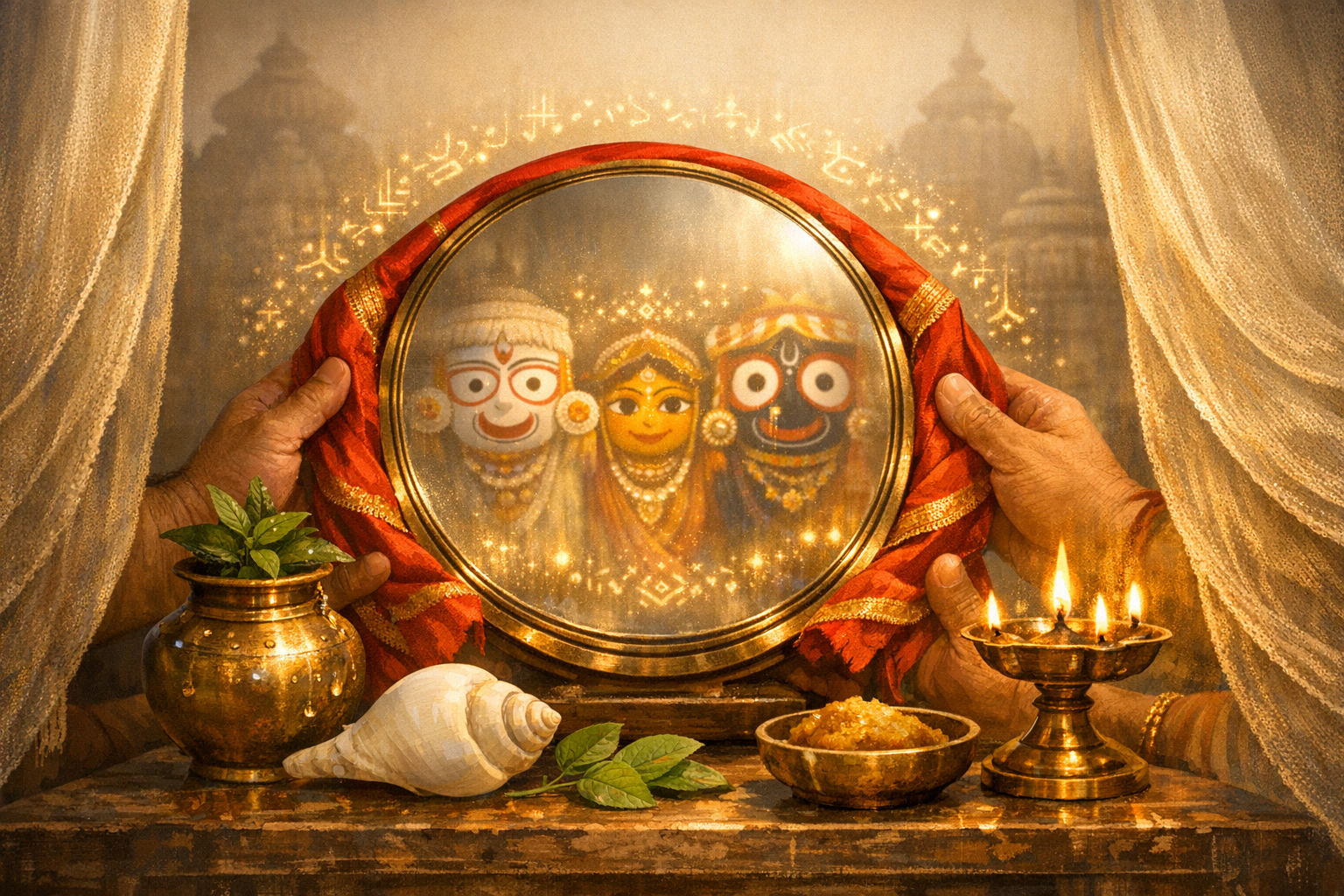
At the Jagannath Temple in Puri, Odisharevered as Puri Srimandirdaily worship unfolds through an intricate sequence of nitis (ritual protocols) preserved within Agamic and paddhati traditions. Among these, the Snan Darpan, or “bathing by the sacred mirror,” stands out for its rare union of ritual engineering, theological subtlety, and conservation wisdom.
Snan Darpan is a rite in which a consecrated mirror (darpana) becomes the proximate recipient of ablutionary mantras and offerings. Through this reflective medium, Mahaprabhu Jagannath, along with Balabhadra and Subhadra, receives the daily bath without direct and repeated contact with water. The mirror, treated as an auxiliary murti for the purpose of the rite, “carries” the essence of the abhiṣeka to the deities through their reflection.
Within the day’s overall orderMangala Arati, Mailam, Abakasha, Sakala Dhupa, Madhyanna Dhupa, Sandhya Dhupa, and Bada SingharaSnan Darpan is observed in the Abakasha segment, with precise timing adjusted by the Srimandir’s festival calendar and the prescriptions of its ritual manuals.
Ritual specialists describe the darpana used in Puri as a carefully handled, highly polished metal mirror, commonly fashioned from bell-metal (kansa) or a panchaloha alloy. Its edges are often wrapped for safe handling, it is veiled when moved, and it is stored in a controlled manner to protect the surface from abrasion and moisture. The mirror is not a casual implement; it is a sanctified instrument in the temple’s liturgical toolkit.
Before use, the mirror undergoes samskara appropriate to an upachara-bimba: purification, mantra nyasa, and placement in the correct ritual orientation. While mantras and substances (such as water or seasonally appropriate offerings) are directed to the mirror, the reflection of the deities upon the mirror’s luminous surface completes the logic of the snana. The rite is thereby both a physical procedure and a theological statement.
Agamic precedents undergird this practice. Across Vaishnava Pancharatra traditions and temple paddhatis, auxiliary or substitute foci (pratinidhi)including flags, yantras, and mirrorsare permitted for specific phases of worship, especially where the primary murti is delicate or where canonical norms advise limited direct contact. In this broader ritual grammar, darpana-seva is an accepted and meaningful modality.
The material rationale is compelling. As daru-brahma, the Jagannath triad is carved from wood and adorned with organic pigments and binders. Repeated daily ablutions would accelerate surface wear, pigment loss, and bio-deterioration. Snan Darpan, by redirecting the bath to a consecrated reflective surface, upholds the Agamic integrity of the upachara while safeguarding the living images for posterity.
The rite opens a window onto enduring philosophical themes. In classical Indian thought, bimba–pratibimba (original–reflection) has been a fertile metaphor for articulating presence and participation. The mirror’s reflection is not the deity, yet it is not other than the deity’s form as seen. Snan Darpan situates this insight in action, communicating how presence can be conveyed without physical saturation.
It also resonates with the Vaishnava intuition of achintya-bhedabhedasimultaneous, inconceivable oneness and difference. The mirror is distinct from Jagannath and yet, during the rite, becomes a medium that is not separate from the upachara directed to Him. The devotee’s understanding is refined: the Divine exceeds, yet intimately includes, material instruments of worship.
For many pilgrims, the experience is quietly transformative. The guarded movement of the mirror, the soft glint of its face, and the concentrated recitation of mantras evoke a palpable intimacy, as if the Lord and His devotees meet in the hush between sound and sight. The reflection, momentary and luminous, leaves a lasting impression of nearness.
Snan Darpan is not to be confused with the grand annual Snana Yatra (Dev Snan Purnima), when 108 ritual pots consecrate the deities with an expansive abhiṣeka that inaugurates the Anavasara period. The mirror rite is a daily observance that complements, rather than replaces, the public bathing festival.
Temple service (seva) is distributed among specialized sevayat lineages. Pujapanda priests lead the mantras and sequencing; attendants ensure alignment, lighting, and steadiness of the reflective surface; and access is regulated to maintain purity and concentration in the sanctum. The procedure is precise, the roles time-tested, and the intent singularly devotional.
From a ritual hermeneutic perspective, Snan Darpan translates dravyopachara (material offering) into tejobhuta (luminous, subtle offering). Through mantra (sound), gandha (fragrance), alankara (adornment), and pratibimba (reflection), the full spectrum of upacharas remains intact. The rite is thus complete in both form and essence.
Orientation and optics matter. The mirror is held steady and square to the deities’ gaze, with fabric screens used to prevent stray reflections. Light is moderated so that the reflection is soft yet legible, and the ritual team avoids any contact that could transmit oils or micro-scratches to the surface.
The sensorial field during Abakasha is intentionally coherent: the conch’s resonance, the faint coolness of sandal, the living sweetness of tulasi, and the cadence of Vishnu mantras together sustain a darshana that is inwardly clarifying even as it is outwardly simple.
At a wider dharmic level, the mirror functions as a symbol of inner clarity shared across India’s spiritual traditions. Gaudiya Vaishnavism sings of ceto-darpaṇa-mārjanamcleansing the mirror of the heart. Buddhist literature often likens a trained mind to a polished mirror that reflects things as they are. Jain thought praises the spotless cognition that shines without residue, while Sikh teachings speak to realizing the inner jot that illumines all. This shared mirror-metaphor deepens interrelated insights into attention, purity, and compassion.
Puri’s living tradition has long woven together diverse streamstribal Daita lineages and Vaidika archakas serve side by side, the Gajapati Maharaja acts as the Adya Sevaka, and countless pilgrims find a place in the Lord’s gaze. In this setting, the mirror is not only an instrument of snana but a sign of inclusivity: every face that gathers at Srimandir is, in some sense, gathered into the Divine reflection.
Custodial practice treats the mirror as a heritage object. It is handled with designated cloths, protected from dust and fingerprints, and returned to storage in a controlled manner. Regular inspection ensures that the reflective quality remains high and that the surface is free from corrosion or pitting, in harmony with Srimandir protocols.
In many shrines, mirrors are used during alankara to verify the symmetry of tilaka and netra-lanjana; at Puri, this practical function coexists with a profound liturgical role. Snan Darpan thus sits at the intersection of iconographic correctness and theological depth.
For first-time visitors who expect a visibly wet abhisheka, the mirror bath can seem understated. Yet its understatement is its power: what is preserved is not spectacle but sanctity, not saturation but presence. The realization that ritual completeness does not demand material excess becomes intuitively clear.
From the vantage of heritage studies, Snan Darpan represents a mature synthesis of doctrine and conservation. It refutes any simplistic opposition between faith and preservation, showing instead how ritual theory can guide responsible guardianship of sacred art in situ.
There is an ecological ethic here as well. By reducing daily water usage on the wooden murtis while retaining the bath’s liturgical substance, the rite models resource care that aligns with dharmic stewardship without compromising ritual authenticity.
Comparable usages of darpana-seva are attested in parts of Odisha and in select Vaishnava temples across India where wooden or particularly sensitive murtis are installed. Puri Srimandir’s practice, however, remains the most discussed exemplar and a reference point in conversations about “ritual technology.”
Devotees often note that the mirror’s serenity encourages their own. As a reflective surface must be free of dust to render a faithful image, so the heart benefits from quieting agitation to receive darshan. Snan Darpan becomes both worship and wordless teaching.
Two clarifications help frame the rite. First, Snan Darpan affirms, rather than diminishes, the reality of the murtis: it is a disciplined way of honoring their sanctity and material nature. Second, while daily contact with water is limited, canonical calendars still prescribe grand ablutionsmost notably during Dev Snan Purnimawithin a comprehensive ritual ecology.
In sum, Snan Darpan is ritual, philosophy, conservation, and pedagogy in one coherent act. It preserves the daru-brahma forms of Jagannath even as it reveals a perennial insight shared across dharmic traditions: in the clear mirror of consciousness, the Divine bathes the world, and the world bathes in the Divine.
Inspired by this post on Hindu Blog.