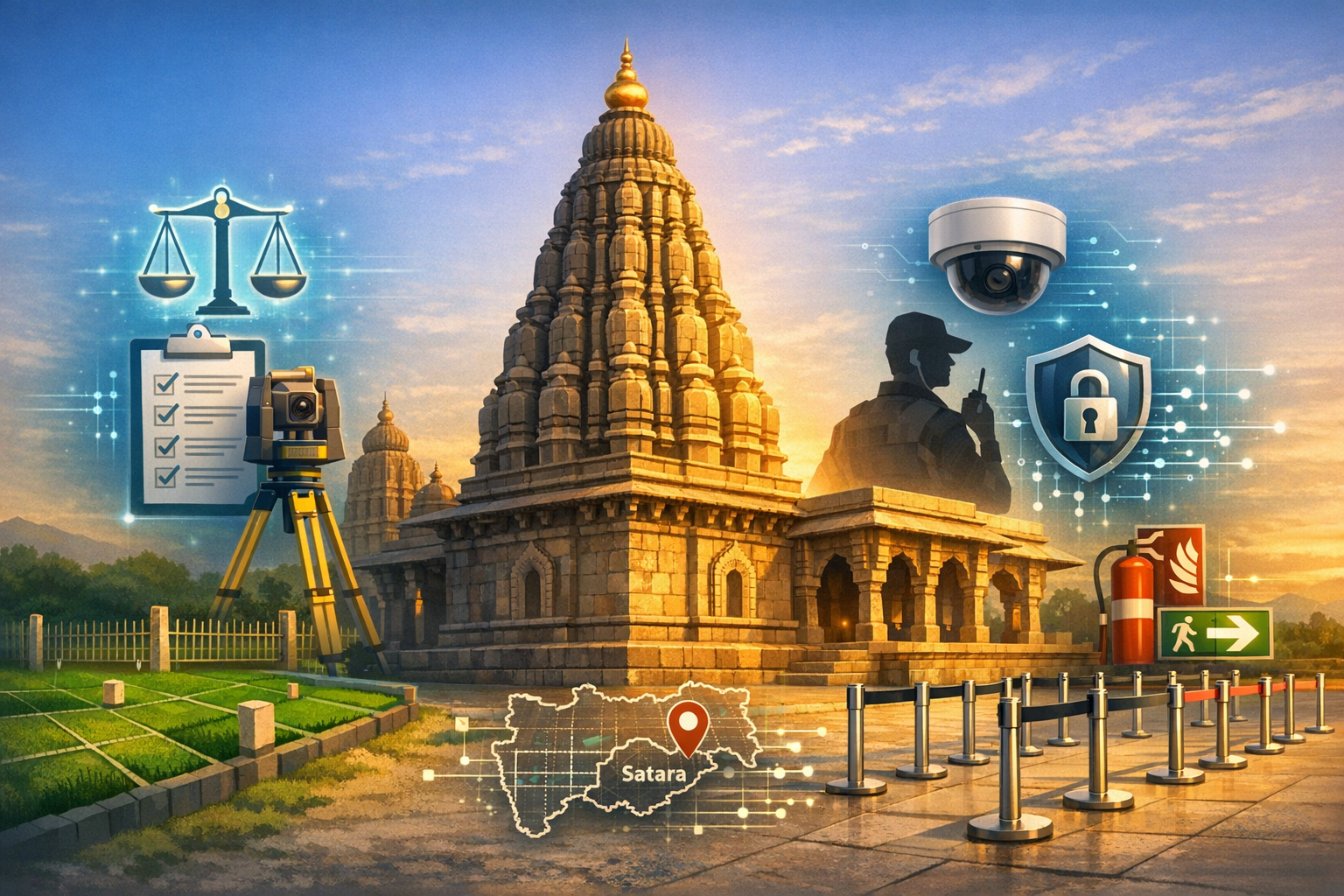
On 22 March, more than 1,000 trustees and representatives of mandirs from across Maharashtra will convene in Satara for the Maharashtra Mandir Nyas Parishad, a statewide temple conference where the central themes are expected to include governance reform, security modernisation, and land-management challenges, including disputes commonly described as waqf-related encroachments. The gathering signals a substantive shift from reactive issue-handling to structured, system-wide solutions that can strengthen dharmic institutions and serve devotees with greater transparency, safety, and dignity.
Temple governance sits at the heart of institutional credibility. In Maharashtra, most mandirs functioning as public charitable trusts are guided by the Bombay Public Trusts Act, 1950 (often referred to as the Maharashtra Public Trusts Act), overseen by the Charity Commissioner. The Parishad provides a platform to consolidate best practices for board composition, trustee duties, conflict-of-interest disclosures, internal controls, and regular, high-quality audits. Beyond legal compliance, governance today is also about timeliness of decisions, clarity in roles, transparency in finances, and measurable outcomes in community service.
Financial stewardship and regulatory compliance are likely to feature prominently. Trusts benefit from ensuring valid registrations and exemptions under the Income Tax framework (including contemporary provisions such as 12AB and 80G), and by adopting robust documentation for all donations and grants. Where foreign contributions are relevant, adherence to the Foreign Contribution (Regulation) Act (FCRA) remains non-negotiable. Establishing standard operating procedures for procurement, multi-quote or e-procurement mechanisms, maker–checker controls, and an independent audit committee helps reduce leakages and enhances public confidence. Clear donor communication, timely publication of audited statements, and grievance redress systems further anchor public trust.
Digital transformation is reshaping temple administration. With online donations, e-darshan queues, and volunteer databases, data responsibility is a governance duty. The Digital Personal Data Protection Act, 2023 (DPDP Act) frames obligations around purpose limitation, data minimisation, and breach response. Trustees can consider encrypting donor data in transit and at rest, rigorous access controls, periodic vulnerability assessments, and vendor due diligence for payment gateways compliant with RBI and NPCI norms. Publishing concise privacy notices, instituting consent logs, and establishing retention and deletion schedules translate legal requirements into everyday practice.
Security modernisation now demands an integrated approach spanning physical, crowd, fire, structural, and cyber dimensions. Multi-layered access control, trained private security under the Private Security Agencies (Regulation) Act, 2005 (PSARA), radio communications, and CCTV with standard retention policies are foundational. A risk register aligned to festivals and peak-footfall days enables preventive staffing and equipment readiness. Tighter integration between trustees, local police, district administration, and fire services ensures real-time coordination during high-density events and processions.
Crowd management merits special attention in any Satara temple conference agenda. The National Disaster Management Authority (NDMA) guidelines on crowd safety provide a mature framework for ingress–egress planning, micro-zoning of premises, bottleneck reduction, emergency corridors, clear signage, and public announcements. Queue design based on actual flow rates rather than notional capacities, shade and hydration points, and pre-event tabletop exercises with all stakeholders substantially reduce stampede risks. Crowd intelligence, including manual counts and sensor-based estimates during peak hours, improves decision-making on entry throttling and route diversions.
Fire and structural safety are non-negotiable commitments. Compliance with the National Building Code (NBC) 2016, the Maharashtra Fire Prevention and Life Safety Measures Act, and periodic structural audits are integral, particularly for heritage structures with wooden elements, oil lamps, and dense decorative materials. Fire detection and suppression systems must be checked and logged; emergency lighting, illuminated exit pathways, and trained evacuation marshals should be in place. Regular mock drills, vendor fire-safety clauses for stalls and kitchens, and strict control over temporary electrical loads help prevent incidents at scale.
Cybersecurity intersects increasingly with physical security. Phishing-resistant authentication for administrative consoles, segregation of donor systems from public Wi-Fi, continuous logging and anomaly detection, and incident response runbooks can contain breaches early. When integrated with physical controlssuch as tamper-evident kiosks, surveillance over cash-handling points, and reconciliation analyticscyber-physical convergence reduces the overall attack surface. A concise communication plan for cyber incidents, including template notifications and helpline escalation trees, sustains stakeholder trust in challenging moments.
Land stewardship and dispute resolution will likely form one of the most consequential strands of discussion. Trustees across Maharashtra benefit from meticulous land records management: securing updated 7/12 extracts and property cards, ensuring mutation entries after legacy transfers, fencing and boundary markers, periodic drone or total-station surveys, and GIS-enabled cadastral overlays under the Digital India Land Records Modernization Programme (DILRMP). Title audits that compile chain-of-title documents, old sanads, and court orders in a single, indexed repository can dramatically improve litigation readiness and negotiation outcomes.
Encroachment issues, including those linked to waqf-related claims, must be handled firmly yet lawfully, with an ethos of civic harmony. The Waqf Act, 1995 provides a statutory architecture for surveys, registration, and adjudication through Waqf Tribunals. Where overlaps in records arisewhether due to historical documentation gaps, transcription errors, or boundary ambiguitiesthe prudent course is evidence-led engagement: authenticated land extracts, survey maps, and court-recognised documents, followed by recourse to the competent civil courts or statutory tribunals as jurisdictionally appropriate. District administrations play a facilitative role in demarcation and enforcement. Public communication should be factual, rights-based, and de-escalatory, reaffirming that disputes are resolved by due process and not by rhetoric.
Heritage-sensitive approaches strengthen the case for protection and responsible use. Where a temple precinct is proximate to archaeologically protected structures or historically significant sites, alignment with the Archaeological Survey of India (ASI) and state heritage authorities prevents inadvertent non-compliance and opens access to conservation expertise. Conservation management plans that map rituals, footfall patterns, and structural stresses help balance living worship traditions with long-term fabric stability.
Unified learning across dharmic institutionsHindu mandirs, Buddhist viharas, Jain derasars, and Sikh gurdwarascan accelerate progress. Despite distinct liturgical needs, these institutions face similar governance, security, and property-management questions. Cross-institutional workshops on trustee responsibilities, whistleblower protections, volunteer training, child-safety protocols, food hygiene for prasad and langar, and documentation standards can create a common vocabulary of care. Such collaboration fosters social cohesion and models unity in diversity, reflecting a shared commitment to ethical stewardship and service.
Institution–state coordination is indispensable. The Charity Commissioner sets compliance expectations for public trusts; police and district administration support crowd and route management; municipal and state fire services enforce safety norms; and disaster management authorities strengthen preparedness. Joint pre-event reviews, standard checklists, and single-window escalation contacts cut response times. Periodic multi-agency drills around major utsavs can institutionalise learning and make safety culture part of the annual calendar.
Operational excellence is achievable through practical templates. Trusts can develop board charters with role clarity; publish annual reports highlighting key risks and mitigations; conduct vendor diligence covering legal standing, insurance, and safety compliance; and implement transparent donation workflows with automated receipts and monthly reconciliations. On the security side, site-specific threat assessments, layered checkpoints, child-identification protocols for reunification, first-aid stations with AEDs, and a clear lost-and-found process demonstrate care for devotees and volunteers alike.
Measuring what matters ensures momentum. Trustees can track compliance status under the Maharashtra Public Trusts framework, audit closure timeliness, incident rates per 100,000 visitors, resolution times for property cases, volunteer training coverage, fire drill frequency, and cyber incident mean-time-to-detect and -respond. Publishing such indicators annually invites constructive scrutiny, encourages knowledge exchange, and builds durable credibility with devotees, regulators, and civil society.
The Satara temple conference, by congregating a large and diverse trustee cohort, is positioned to catalyse a step-change in Maharashtra’s temple governance and safety standards. Anchoring discussions in law, engineering, risk science, and ethicsnot merely in episodic grievancesenables institutions to protect sacred spaces, uplift service quality, and maintain social harmony. By foregrounding unity across dharmic traditions and a commitment to due process in resolving land and encroachment disputes, the Parishad can chart a replicable model for other states. The ultimate beneficiary is the devotee, who experiences secure, transparent, and dignified worship in institutions worthy of the trust they inspire.
Inspired by this post on Hindu Jagruti Samiti.