Gurdwara Pathar Sahib, situated along the Srinagar–Leh corridor in Ladakh, stands as a resonant testament to compassion and forgiveness in the Sikh tradition while harmoniously engaging with the broader dharmic landscape of the Himalaya. Revered in the collective memory of Guru Nanak’s travels, the site weaves together sacred narrative, living practice, and interfaith rapport, offering a compelling case study in how ethics become embedded in place, ritual, and community life.
Geographically, the gurdwara lies approximately 25 kilometers west of Leh on the route toward Kargil, near the popular landmark known as Magnetic Hill and the Indus valley. At an elevation of roughly 3,500–3,600 meters, the sanctuary is maintained with exemplary care, with the Indian Army’s presence contributing to its upkeep and accessibility. This unique custodianship has made Pathar Sahib not only a site of Sikh pilgrimage but also a frequent stop for travelers and Ladakhi residents of diverse faiths.
Historically, the narrative of Pathar Sahib is situated in the context of Guru Nanak’s udāsīs (itinerant journeys) across the subcontinent and into the trans-Himalayan world. In Ladakh and adjacent regions, local remembrance often refers to Guru Nanak as “Nanak Lama,” reflecting a respectful, cross-cultural recognition that aligns with the plural religious milieu of the Silk Road. The setting underscores a longstanding interface between Sikh memory and Buddhist cultural geographies across the high Himalaya.
The primary sources that carry this memory forward are the Janamsakhi traditionshagiographic narratives compiled and transmitted from the 16th–17th centuries onwardand associated oral histories among local communities. While Janamsakhis present sacred biography rather than linear historiography, their durable presence in local practice and ritual indicates how ethical meanings and exemplars, such as forgiveness, are internalized and enacted within communities over generations.
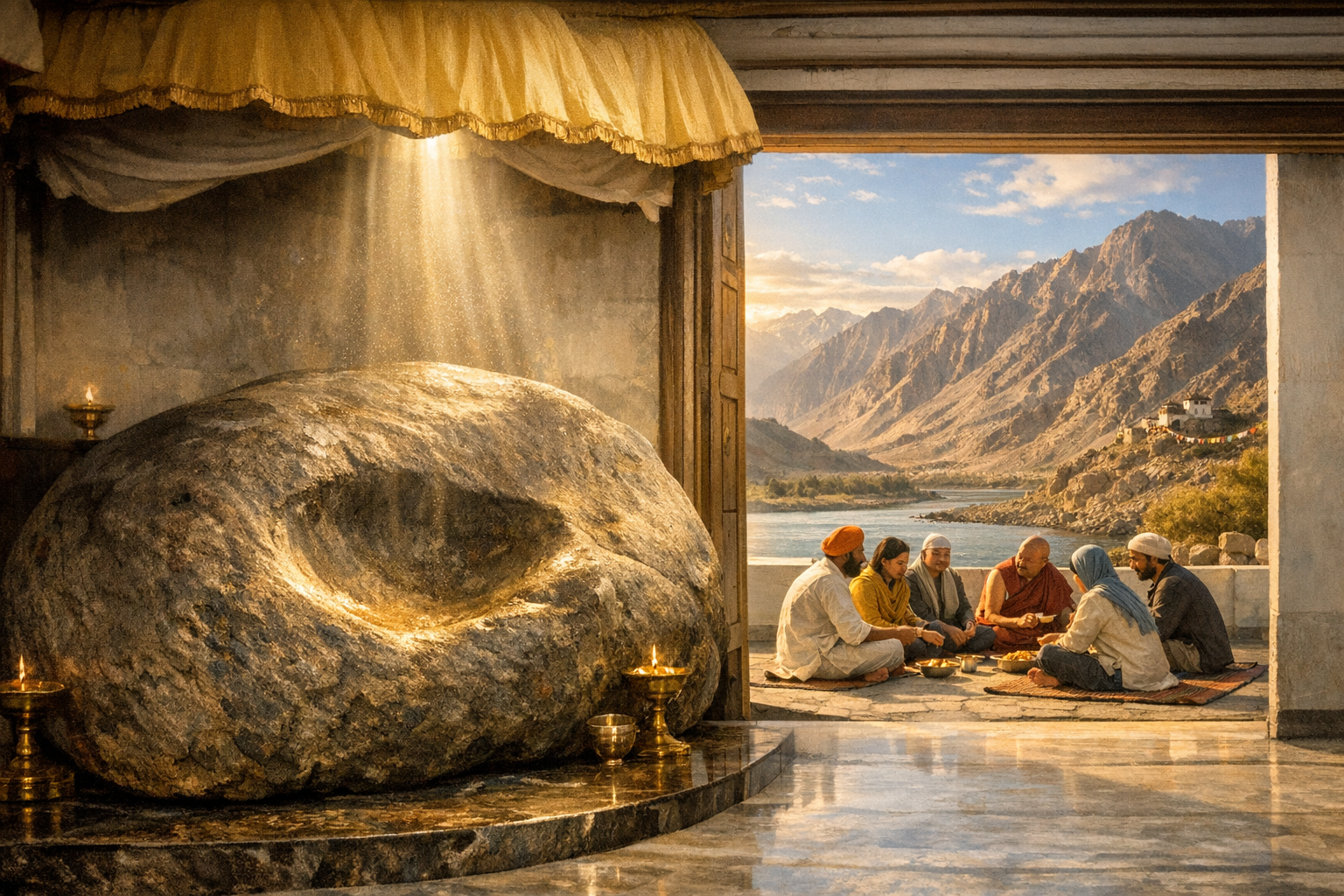
The widely recounted legend describes a malevolent being hurling a massive boulder (pathar) at the meditating Guru Nanak. According to the tradition, the rock softened on contact, retaining the impression of the Guru’s form and leaving the aggressor subdued and remorseful. Rather than punishment, forgiveness followed: the aggressor is said to have reformed through the Guru’s compassion. In theological terms, the narrative elevates the victory of karuṇā (compassion) and kṣamā (forbearance/forgiveness) over aggression, aligning closely with Sikh ethics and broader dharmic ideals.
From the vantage of Sikh thought, Pathar Sahib is frequently interpreted through the lens of “Nirbhau, Nirvair” (without fear, without enmity) proclaimed in the Mool Mantar and reflected throughout the Japji Sahib. The story’s moral axis sits at the junction of daya (compassion), nirvair (absence of hostility), and kirpa (grace), demonstrating how spiritual authority is embodied not through force but through transformative love and non-resentment. Pathar Sahib’s appeal thus rests in both the narrative itself and the resonance it continues to evoke in lived practice.
Materially, the sanctuary preserves a venerated boulder with an impression that devotees associate with Guru Nanak’s form. As with many sacred objects, interpretation ranges across a spectrumfrom devotional certainty to academic curiosityyet even a critical assessment recognizes that the stone has become a catalyst for ethical reflection and interfaith gathering. The stone’s significance, irrespective of questions of geological provenance or antiquity, lies in the enduring behaviors it inspires: humility, service, and reconciliation.
In terms of site development, local remembrance credits Buddhist attention to the location in earlier centuries, while the present gurdwara complex owes much to late-20th-century consolidation and care under the aegis of the Indian Army in partnership with the Sikh community. This layered custodianship, spanning monastic attention, local reverence, and national stewardship, reflects the site’s integrative characterreligious, cultural, and civic.
The daily rhythm at Pathar Sahib follows Sikh maryada. Kirtan, paath, and ardas provide a liturgical cadence, while langar (the community kitchen) embodies sarbat da bhalathe aspiration for the welfare of all. Visitors from varied backgrounds participate in this egalitarian meal, experiencing firsthand how Sikh practices cultivate equality, dignity, and fellowship. For many travelers navigating the altitude and distances of Leh–Ladakh, the gurdwara’s hospitality provides physical respite and a spiritual anchor.
Interfaith presence at Pathar Sahib is more than incidental; it is continuous and visible. Ladakhi Buddhists, Hindu pilgrims, and spiritual seekers routinely visit, drawn as much by the ethical teaching as by the site’s serenity. In the broader landscape, monasteries such as Spituk, Likir, and Alchi lie along related travel corridors, and their proximity underscores the region’s centuries-old habit of shared sacred geographies. Pathar Sahib thereby becomes a natural forum for gentle encounter and mutual learning among dharmic traditions.
Thematically, the site’s message resonates widely within the dharmic family. In Buddhism, karuṇā (compassion) is a central brahmavihāra; in Hindu thought, kṣamā is celebrated as a cardinal virtue; in Jain dharma, ahiṁsā (non-violence) and kṣamā (forgiveness) shape rigorous ethical disciplines. Pathar Sahib’s narrative and practice unify these strands by demonstrating how compassion transforms harm into harmony and converts fear into trust.
Comparatively, Sikh scriptural emphasis on daya and nirvair finds close conceptual neighbors in texts such as the Dhammapada’s teachings on non-hatred, the Mahabharata’s esteem for kṣamā, and the Jain Tattvārtha Sūtra’s call to harmlessness and restraint. While doctrinal vocabularies differ, the practical outworkingsservice, restraint, empathy, hospitalitycohere into a shared dharmic ethos. Pathar Sahib effectively turns these ideals into lived, accessible experiences for visitors and devotees alike.
Ladakh’s strategic and cultural position further heightens the site’s significance. At the confluence of high-altitude ecology and historic trade routes, the region encourages a self-reliant, community-oriented ethicvalues mirrored in the gurdwara’s langar, cleanliness, and volunteer-led seva. The Indian Army’s engagement at Pathar Sahib also reflects a practical embodiment of service that transcends sectarian lines, reinforcing the sanctuary’s role as a civic as well as spiritual landmark.
From the perspective of heritage studies, Pathar Sahib exemplifies how intangible heritageoral narrative, ritual, ethical memoryinteracts with tangible heritagestone, sanctum, langar hallto produce a holistic cultural asset. The “evidence of compassion and forgiveness” is not only the stone or the story but also the continuous enactment of seva and shared food, the attentive silence during kirtan, and the unassuming welcome extended to strangers at 3,500 meters above sea level.
Visitors often remark on an immediate sense of calm on entering the complexa calm made legible through small gestures: the offering of tea, the simple warmth of langar, a volunteer helping newcomers cover their heads, or an army jawan guiding a family along the pathway. These experiences, while modest in form, communicate a profound ethic of equality and care that many carry with them long after they leave the Indus valley.
For respectful visitation, simple observances are encouraged: cover the head, remove shoes, dress modestly, maintain decorum during paath or kirtan, and partake of langar with gratitude. Given the altitude, acclimatization, hydration, and unhurried movement are prudent. Environmental sensitivity is vital in Ladakh’s fragile cold-desert ecosystem; waste minimization and mindful use of resources align with the dharmic values the site upholds.
A critical, academic reading acknowledges that the interpretive status of the boulder’s impression will vary among observers. Yet the social facts are clear: the narrative binds community, sanctifies service, and promotes interfaith understanding. In heritage terms, Pathar Sahib demonstrates how sacred memory, irrespective of empirical certainty about a single artifact, can sustain a durable culture of humility, hospitality, and moral courage.
Taken together, these dimensionstextual memory, ethical practice, interfaith hospitality, civic stewardship, and environmental mindfulnessestablish Pathar Sahib as a paradigm of dharmic unity in contemporary India. Here, a Sikh sanctuary in the Himalaya becomes a common ground where Buddhists, Hindus, Jains, Sikhs, and global travelers encounter a single, luminous principle: compassion without enmity, forgiveness without condition.
In this light, Pathar Sahib is best understood as an embodied teaching. It makes the abstract concrete and the ideal practical, inviting all who arrivepilgrim, soldier, monastic, or touristto participate in seva, savor the solace of kirtan, and leave with an enlarged horizon of empathy. That enduring invitation, more than any single artifact, is the site’s truest evidence of compassion and forgiveness.
Inspired by this post on SikhNet – News.