
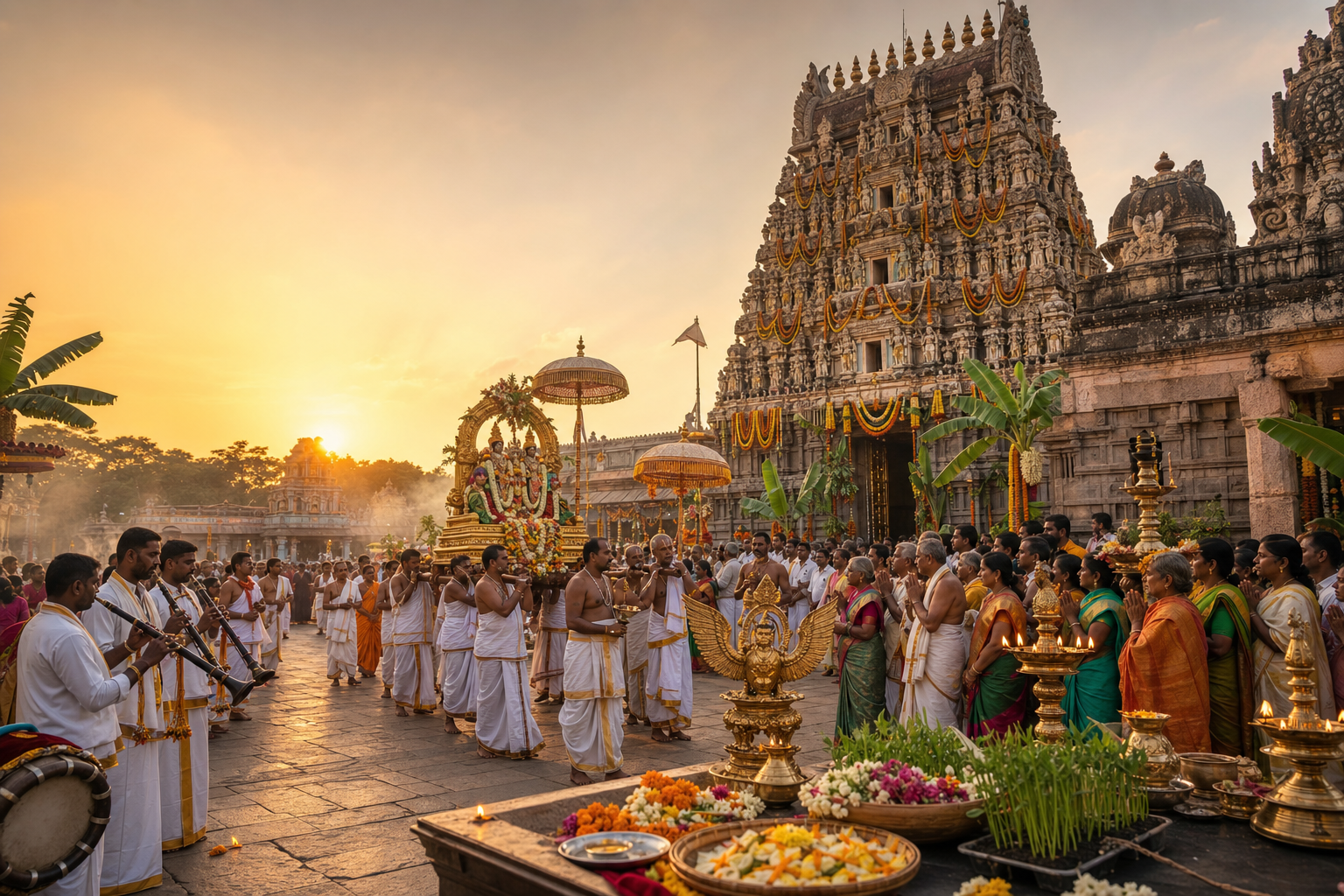
The Narayanavanam Kalyana Venkateshwara Swamy Temple Brahmotsavam 2026 is scheduled to be observed from May 28 to June 5, 2026, at Sri Kalyana Venkateswara Swamy Temple in Narayanavanam, Tirupati district, Andhra Pradesh. The annual Brahmotsavams are expected to bring together devotees, local temple traditions, TTD ritual discipline, and the living memory of a sacred Vaishnava kshetra closely associated with the divine marriage of Sri Venkateswara Swamy and Goddess Padmavati Devi.
The festival calendar begins before the formal Brahmotsavam dates. Koil Alwar Tirumanjanam will be observed on May 24, 2026, and Ankurarpanam will be performed on May 27, 2026. The main annual Brahmotsavams will then proceed from May 28 to June 5, 2026, with Garuda Seva on June 1, 2026, and Kalyanotsavam on June 4, 2026, standing out as especially important observances for pilgrims.
Narayanavanam occupies a distinctive place in the sacred geography of the Tirupati region. The temple is dedicated to Sri Kalyana Venkateswara Swamy, a form of Lord Vishnu worshipped in the auspicious context of marriage, harmony, dharma, prosperity, and family well-being. The sthala tradition connects Narayanavanam with King Akasaraja, father of Padmavati Devi, and preserves the belief that the celestial wedding of Sri Venkateswara Swamy and Padmavati Devi took place in this region before the Lord proceeded toward Tirumala.
This association gives the Narayanavanam Brahmotsavam a deeply emotional and theological character. The festival is not merely a public celebration; it is a ritual re-enactment of divine presence, cosmic order, and devotional memory. For many families, especially newly married couples and devotees praying for marital harmony, Sri Kalyana Venkateswara Swamy represents the grace that sanctifies household life and turns ordinary family aspirations into dharmic commitments.
The temple is generally understood to have been established in the sixteenth century, with 1541 AD often cited in traditional accounts, and it is administered by Tirumala Tirupati Devasthanam (TTD). Its ritual life follows the Vaikhanasa Agama tradition, one of the major Vaishnava temple worship systems. This matters because Brahmotsavam is not a casual festival format; it is structured through precise liturgical sequencing, priestly discipline, icon processions, purification rites, offerings, music, and community participation.
Koil Alwar Tirumanjanam, scheduled for May 24, 2026, is one of the most meaningful preparatory rituals. In TTD temple tradition, this observance involves the ceremonial cleansing and sanctification of the temple space. The word “Koil” refers to the temple, while “Alwar” carries the devotional sense of one immersed in divine experience. The ritual therefore functions both as physical purification and as theological preparation, reminding devotees that sacred celebration begins with inner and outer cleanliness.
Ankurarpanam on May 27, 2026, marks another important preparatory moment. Literally associated with the sowing of seeds, Ankurarpanam symbolizes fertility, auspicious growth, renewal, and divine blessing. Within the Brahmotsavam framework, it expresses the hope that the entire festival will unfold with spiritual abundance, social harmony, and ritual completeness. The act of sowing becomes a sacred metaphor: devotion, when planted with sincerity, matures into discipline, humility, and grace.
The nine-day Brahmotsavam period from May 28 to June 5, 2026, will form the central public celebration. Brahmotsavam, traditionally understood as a “grand festival,” is associated with the idea that Lord Brahma himself first performed such an utsavam in honor of Lord Vishnu. In temple practice, the festival allows the processional deity to come closer to the community, often through vahana sevas, ceremonial processions, Vedic chanting, devotional music, and collective darshan.
Garuda Seva on June 1, 2026, is expected to be one of the most attended and spiritually charged events of the Brahmotsavam. Garuda, the divine vehicle of Lord Vishnu, represents strength, surrender, speed, and the power of Vedic knowledge. In Vaishnava worship, the sight of the Lord mounted on Garuda is treated as especially meritorious, and devotees often experience this seva as a moment of intense bhakti, where theology becomes visible through procession, ornamentation, sound, and shared reverence.
Kalyanotsavam on June 4, 2026, carries special significance at Narayanavanam because the temple itself is tied to the sacred marriage tradition of Sri Venkateswara Swamy and Padmavati Devi. The ritual celebration of divine wedding is not only symbolic; it expresses the Hindu understanding that marriage, when rooted in dharma, is a sacred partnership. It honors companionship, responsibility, mutual respect, prosperity, and the stability of family life.
The emotional appeal of the Narayanavanam Kalyanotsavam lies in its accessibility. A devotee witnessing the ceremony may see more than a ritual event. The decorated deities, Vedic mantras, temple music, sacred offerings, and disciplined priestly movements create a bridge between personal longing and collective worship. In that setting, prayers for peace at home, healing in relationships, and continuity of family traditions become part of a larger dharmic rhythm.
From a cultural perspective, the Narayanavanam Brahmotsavam also demonstrates how Hindu temples function as centers of memory, art, community organization, and spiritual education. The festival gathers priests, temple staff, musicians, volunteers, pilgrims, local residents, and families into a shared sacred calendar. Such events help transmit ritual vocabulary, temple etiquette, regional history, and devotional identity across generations.
The role of TTD is significant in maintaining this continuity. Tirumala Tirupati Devasthanam is widely associated with the administration of Tirumala and several connected temples, and its involvement brings procedural order to festivals such as Brahmotsavam. Crowd management, ritual scheduling, temple maintenance, and adherence to agama-based practice all shape the pilgrim experience, especially during days such as Garuda Seva and Kalyanotsavam when attendance may increase.
For pilgrims planning to attend the 2026 Brahmotsavams, the key dates to remember are May 24 for Koil Alwar Tirumanjanam, May 27 for Ankurarpanam, May 28 to June 5 for the annual Brahmotsavams, June 1 for Garuda Seva, and June 4 for Kalyanotsavam. Since temple schedules can include detailed daily sevas, timings, and crowd-control arrangements, devotees should confirm the latest practical instructions through official TTD communication channels closer to the festival dates.
Narayanavanam is located near Puttur and within reach of Tirupati, making it meaningful for pilgrims who wish to understand the wider sacred landscape associated with Lord Venkateswara. The pilgrimage can be viewed not only as a visit to one temple but as an encounter with a network of Vaishnava memory: Tirumala, Tiruchanur, Srinivasa Mangapuram, Narayanavanam, and other nearby kshetras together preserve different dimensions of the Venkateswara tradition.
The Narayanavanam Kalyana Venkateshwara Swamy Temple Brahmotsavam 2026 therefore deserves attention not only as a festival notice but as a window into Hindu ritual culture. It brings together sacred history, Vaikhanasa Agama practice, TTD temple administration, Garuda Seva devotion, Kalyanotsavam symbolism, and the enduring belief that divine grace is experienced most deeply when worship is joined with discipline, humility, and community harmony.
Inspired by this post on Hindu Pad.










Leave a Reply
You must be logged in to post a comment.