
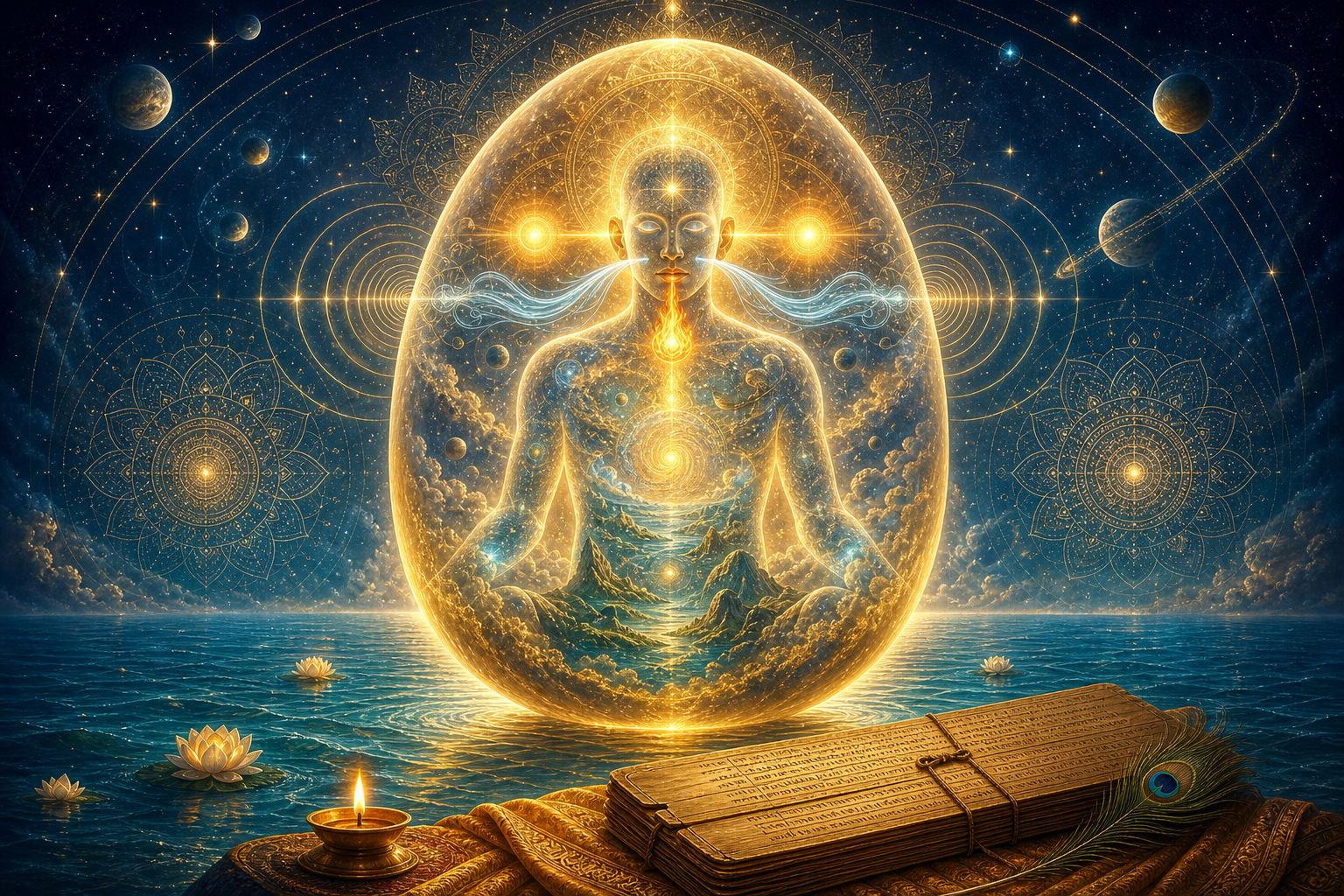
Śrīmad-Bhāgavatam 3.26.53-55 offers a concentrated philosophical vision of creation, embodiment, perception, and divine order. In these verses from Canto 3, Chapter 26, the teachings of Lord Kapila to Devahūti move from abstract metaphysics into a vivid cosmological image: the virāṭ-puruṣa, the universal form, enters the golden cosmic egg and the differentiated structure of the universe begins to unfold. The passage is brief, yet it carries a vast theological and technical framework that links the senses, their objects, their presiding deities, and the living experience of embodied consciousness.
The chapter is titled “Fundamental Principles of Material Nature,” and that title is essential for understanding the context. Kapila’s teaching is not merely a poetic description of cosmic origins. It is a systematic account of tattva, or ontological categories, in which prakṛti, time, karma, the guṇas, the senses, the elements, and divine supervision are all placed into a coherent order. The verses under discussion appear after the description of the universal egg, whose coverings and inner structure represent the layered nature of material manifestation.
The Sanskrit of Śrīmad-Bhāgavatam 3.26.53 begins: “hiraṇmayād aṇḍa-kośād utthāya salile śayāt tam āviśya mahā-devo bahudhā nirbibheda kham.” The image is striking. The golden cosmic egg rests upon the causal waters, and the Supreme Lord enters it as the virāṭ-puruṣa. Once present within it, He divides it into many departments. This division is not chaotic fragmentation; it is meaningful differentiation. The universe becomes intelligible because it is organized by consciousness, purpose, and divine presence.
The phrase virāṭ-puruṣa is especially important in Hindu scriptures and Vedic philosophy. It refers to the cosmic person, the universal form through which the many functions of creation can be contemplated as parts of one integrated whole. The universe is not presented as a dead mechanism operating without inner meaning. It is presented as a living, ordered field in which every faculty, element, and direction has a place within the body of the Supreme.
In Śrīmad-Bhāgavatam 3.26.54, the first specific manifestation described is the mouth. From the mouth comes speech, and with speech comes fire, the presiding deity of that organ. Then the nostrils appear, and within them arise the olfactory sense and prāṇa, the vital air. The sequence is precise: organ, faculty, deity, function. The body is therefore not understood as merely biological. It is a meeting point of matter, consciousness, energy, and cosmic governance.
This is one of the distinctive insights of the Bhagavata Purana: the senses are never isolated instruments. Speech is not only a physical capacity produced by the mouth and vocal system. It is also linked with agni, or fire, because speech carries transformative power. Words illuminate, digest experience, burn impurities, and sometimes wound when misused. A traditional practitioner hearing this passage is naturally drawn toward self-reflection: if speech is connected with sacred fire, then speech must be treated with restraint, truthfulness, and reverence.
The connection between vāṇī and vahni also has practical ethical implications. In daily life, speech often becomes casual, reactive, or careless. The verse invites a more disciplined understanding. Speech can become yajña when it is used for truth, śāstra, prayer, kīrtana, teaching, reconciliation, and compassionate correction. It can also become a source of bondage when driven by anger, vanity, gossip, or contempt. The cosmology of the virāṭ-puruṣa therefore becomes a moral psychology of communication.
The next movement in the verse is toward the nostrils, smell, and prāṇa. Prāṇa is not merely air in the mechanical sense; it is the vital principle that animates embodied life. Breath is the immediate sign that the living body is functioning. Across dharmic traditions, including Hinduism, Buddhism, Jainism, and Sikh contemplative practice, awareness of breath has often served as a doorway into discipline, humility, and presence. The verse does not collapse these traditions into one system, but it does affirm a shared intuition: life is sustained by a subtle order deeper than ordinary perception.
Śrīmad-Bhāgavatam 3.26.55 continues the unfolding. From the olfactory sense comes Vāyu, the wind-god who presides over that sense. Then the eyes appear, and in them the faculty of sight. From that faculty comes Sūrya, the sun-god, who presides over vision. Finally, the ears appear, along with hearing, and then the Dig-devatās, the deities of the directions. The pattern continues to show that perception is not treated as a private possession of the individual ego. Seeing, hearing, smelling, speaking, and breathing are possible because the individual participates in a cosmic arrangement.
The appearance of the eyes and Sūrya is one of the most powerful images in this passage. The sun is not merely an astronomical object in this theological frame; it is the cosmic condition that makes sight meaningful. In a simple experiential sense, this is immediately relatable. The eye may be healthy, but without light, sight cannot function. The verse deepens that observation into metaphysics: the faculty of vision, the external light, and the divine order behind perception are interdependent.
Traditional commentaries often connect this idea with the broader Vedic statement that the sun is the eye of the Supreme. The point is not to reduce the sun to a metaphor, nor to deny its physical reality. Rather, the sun’s physical luminosity is understood as part of a sacred order. The cosmos is readable because it is illumined, and illumination itself becomes a theological category. To see is not only to receive light; it is to be granted access to form, distinction, beauty, responsibility, and knowledge.
The ears and the Dig-devatās add another layer. Hearing depends on space and direction. Sound arrives from somewhere, and orientation matters. In Vedic culture, hearing is central to spiritual learning because śravaṇa, attentive listening, is the beginning of transformation. The Śrīmad-Bhāgavatam itself is a text meant to be heard. Its wisdom flows through dialogue: Kapila speaks to Devahūti, Sūta speaks to the sages, Śukadeva speaks to Parīkṣit. Hearing is therefore not passive reception; it is disciplined participation in sacred knowledge.
This passage also clarifies why the senses require training. If each sense belongs to a larger cosmic order, then sense enjoyment cannot be the highest goal of human life. The senses are instruments for knowledge, service, refinement, and liberation. The mouth is meant for truthful and sacred speech. The breath is meant to sustain life and aid self-mastery. The eyes are meant to perceive reality without envy or exploitation. The ears are meant to receive wisdom rather than merely noise. The body becomes a temple of responsibility rather than a tool for unchecked desire.
From a philosophical standpoint, these verses challenge strictly reductionist accounts of human experience. Modern thought often explains perception through physiology alone: eyes process light, ears process sound, nostrils process odor, and the nervous system organizes signals. The Bhāgavata does not reject functional description, but it expands the frame. It asks a deeper question: why is there an ordered correspondence between sense organs, sense objects, natural forces, and consciousness at all? Its answer is that material nature operates under divine supervision and within a purposeful cosmic order.
This does not require hostility toward science. A mature reading of Hindu scriptures can appreciate empirical study while recognizing that śāstra addresses questions of meaning, purpose, hierarchy, and liberation. The technical language of the Bhāgavata is not laboratory language, yet it is rigorous within its own metaphysical framework. It maps relationships between gross elements, subtle elements, sense faculties, presiding deities, and consciousness. Such a map is valuable because it prevents the human being from mistaking functional knowledge for ultimate knowledge.
The verses also carry an important lesson for unity among dharmic traditions. Hindu, Buddhist, Jain, and Sikh paths differ in theology, metaphysics, discipline, and scriptural authority. Yet all place serious emphasis on mastery of speech, ethical conduct, sensory restraint, awareness, and liberation from egocentric living. A passage like Śrīmad-Bhāgavatam 3.26.53-55 can therefore be studied not as a sectarian boundary marker, but as a dharmic reflection on how embodied life must be sanctified. Speech, breath, sight, and hearing are universal human experiences; dharma asks how they should be purified.
The image of the golden cosmic egg also has contemplative force. The universe begins as a potential whole, but it becomes meaningful only when entered and ordered by the Supreme. Similarly, a human life may contain talent, energy, education, and opportunity, yet remain internally uncoordinated until guided by a higher principle. Without dharma, faculties scatter. With dharma, the same faculties become aligned. The macrocosm and microcosm mirror one another: cosmic order and personal discipline are linked.
The sequence of manifestation also teaches humility. The individual does not independently create the power to speak, breathe, smell, see, or hear. These are received capacities. They arrive before personal achievement and remain dependent on conditions beyond personal control. This recognition softens arrogance. It turns ordinary embodiment into gratitude. Every breath becomes evidence of dependence; every sight becomes a gift of light; every meaningful word becomes a responsibility before truth.
H.G. Sikhi Mahiti Das’s chosen subject, Śrīmad-Bhāgavatam 3.26.53-55, therefore sits at the intersection of cosmology and practice. The verses are not merely about what happened at the beginning of creation. They are about how the created order still functions within every person. The mouth, nostrils, eyes, and ears are daily reminders of the virāṭ-puruṣa. The body is small, but it reflects a vast arrangement. The senses are intimate, but they are connected with cosmic powers.
The reference to presiding deities should also be understood carefully. In the Bhāgavata worldview, devas are not independent rivals to the Supreme. They are empowered administrators within the cosmic order. Agni, Vāyu, Sūrya, and the Dig-devatās represent intelligent governance over specific functions of the universe. Their presence in the text reinforces a layered understanding of reality: the Supreme Lord is ultimate, material nature supplies the field, devas administer functions, and living beings act within that system according to karma and consciousness.
This layered model avoids two extremes. It does not flatten the universe into impersonal matter, and it does not make the individual ego the center of existence. Instead, it locates the person within a sacred ecology of dependence. The human being acts, but not alone. The senses function, but not independently. Nature produces, but under supervision. The Supreme remains both immanent and transcendent, present within the universal body while never limited by it.
For contemporary readers, the most immediate application may be sensory discipline. A culture of constant stimulation trains the eyes to consume, the ears to chase distraction, the tongue to react, and the breath to become shallow under anxiety. The Bhāgavata offers a different orientation. It encourages reverence toward the faculties themselves. To see sacredly, hear attentively, speak truthfully, and breathe consciously is to begin restoring the senses to their rightful purpose.
The spiritual insight of these verses is therefore both cosmic and deeply personal. The same Lord who enters the golden cosmic egg also sustains the inner order by which perception becomes possible. The same universe that contains planetary systems, elements, and presiding deities is reflected in the living body. This is why dharmic practice often begins with simple disciplines: controlled speech, mindful breathing, sacred hearing, and purified vision. The path to transcendence does not despise embodiment; it educates embodiment.
Śrīmad-Bhāgavatam 3.26.53-55 ultimately presents creation as an ordered revelation rather than an accident. The virāṭ-puruṣa divides the cosmic field into meaningful departments, and from that order emerge speech, fire, breath, smell, wind, sight, sun, hearing, and direction. The message is intellectually rich and spiritually demanding: human faculties are sacred trusts. When they are aligned with dharma, they become instruments of knowledge, devotion, unity, and liberation.
Inspired by this post on Dandavats.
