Nandprayag, set at approximately 1,358 metres above sea level in the Chamoli district of Uttarakhand, is the hallowed junction where the glacier-fed Alaknanda meets the lucid Nandakini. Counted among the Panch Prayag, this sacred confluence is both a spiritual axis and a geographic landmark in the Himalaya, anchoring the rhythms of pilgrimage and the continuum of river reverence in northern India.
Within the classical Panch Prayag sequence along the AlaknandaVishnuprayag (with Dhauliganga), Nandprayag (with Nandakini), Karnaprayag (with Pindar), Rudraprayag (with Mandakini), and Devprayag (with Bhagirathi)Nandprayag occupies the second position from the source. Together, these nodes ceremonially preface the naming of the Ganga at Devprayag and encode a living map of sacred geography across Uttarakhand.
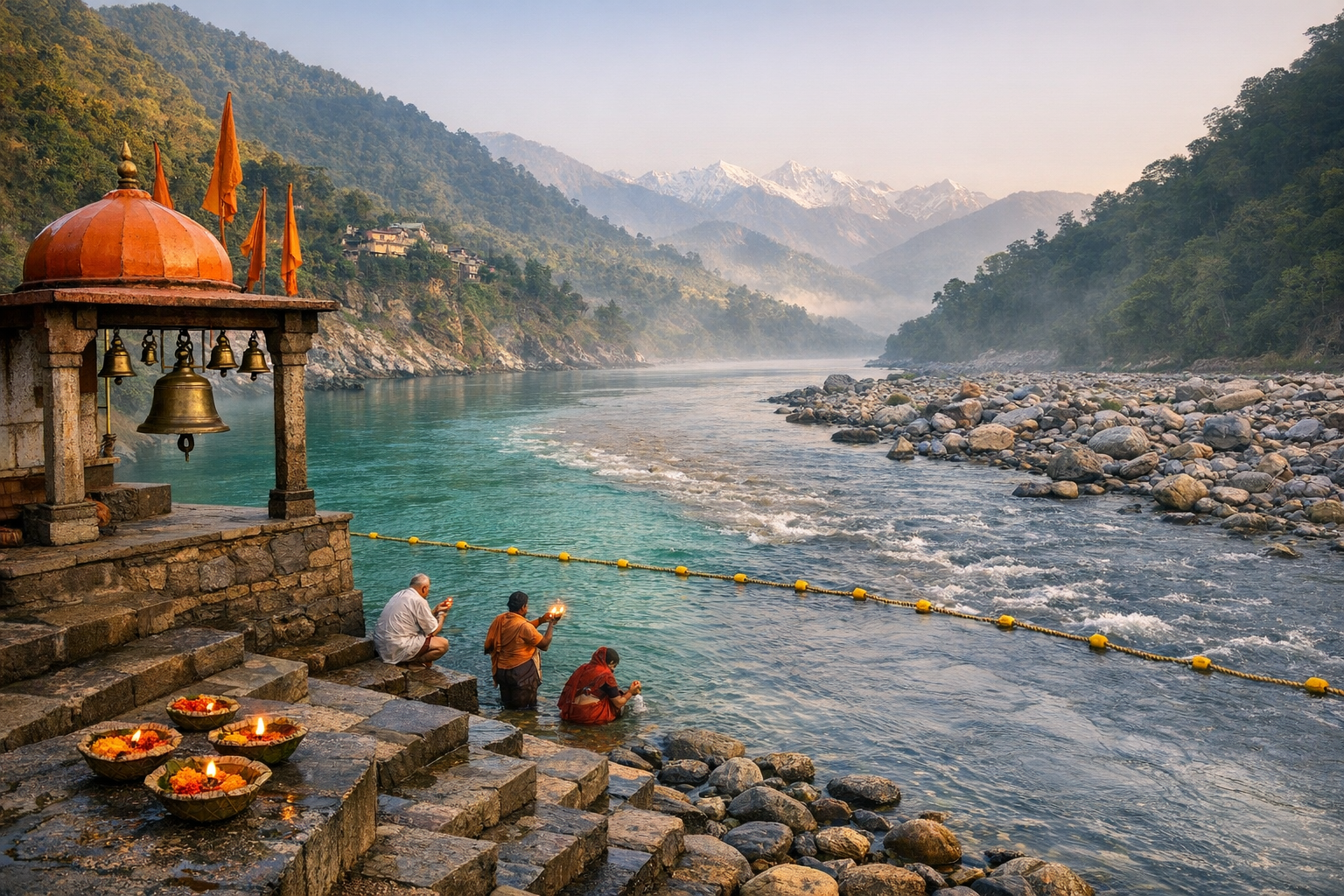
Hydrologically, the Nandakini rises from snowfields and small glaciers on the western flanks of the Nanda Devi–Nanda Ghunti–Trishul massif, descending through the Nandakini Valley via Ghat before turning north to meet the Alaknanda at Nandprayag. During the monsoon, the confluence presents a vivid two-tone palette: the relatively clear, emerald Nandakini folds into the more silt-laden, steel-grey Alaknanda, a chromatic gradient that remains visible from the stepped ghats.
The site also illustrates Himalayan fluvial geomorphology in motion: seasonally higher discharges generate short reaches of braiding, lateral bar formation on inside bends, exposure of older terrace deposits, and audible coarse-bedload transport over a bedrock mosaic of gneiss and schist typical of the Lesser Himalaya. These features offer an open-air classroom for students of river science and mountain hazards.
In local memory, the name evokes both King Nanda and the goddess Nanda Devi, whose cultic presence unites Kumaon and Garhwal through festivals, songs, and itinerant rites. Oral narratives recall yajnas performed on these banks and link the confluence to the broader Nanda Devi Raj Jaat ethos, wherein cyclical pilgrimage consecrates the mountains as living divinity and community commons.
Ritual practice at Nandprayag centres on tirtha-snan at dawn, sandhya aarti on the ghats, and offerings for pitri-tarpan. Auspicious observancessuch as Kartika Purnima, Makar Sankranti, and Mauni Amavasyasee heightened pilgrim presence, while daily worship sustains continuity between festival moments and the quieter cadence of the year.
The sanctity of confluences is a shared civilizational intuition across dharmic traditionsHindu, Buddhist, Jain, and Sikheach venerating water as purifier, witness, and sustainer of life. The ethos guiding ablutions and seva at Nandprayag resonates with the discipline of Buddhist and Jain tirtha-yatras and with Sikh devotion in Himalayan sanctuaries such as Hemkunt Sahib, affirming unity in spiritual diversity and a common ethic of reverence for nature.
Nandprayag sits on National Highway 7 (Rishikesh–Badrinath), between Karnaprayag and Chamoli, and serves as a natural pause on the Char Dham Yatra toward Badrinath. Approximate road distances are Rishikesh 190 km, Rudraprayag 55 km, Karnaprayag 22 km, Chamoli 17 km, and Badrinath 108 km. Public buses and shared taxis ply the corridor; the nearest railhead is Yog Nagri Rishikesh and the nearest airport is Dehradun’s Jolly Grant.
The optimal window for pilgrimage and study visits spans late April to June and September to November, with clear visibility and relatively stable mountain roads. The July–August monsoon brings elevated discharge and landslide risk, while December–February remains cold with occasional snowfall and reduced services. Each season, however, offers a distinct experiential registerfrom crystalline skies to austere winter quietude.
Safety and responsible practice are integral to the yatra. Currents intensify near mid-channel in the Alaknanda, so bathing is best limited to roped, designated areas under local guidance. Disciplines such as avoiding single-use plastics, using biodegradable offerings, and refraining from detergents in the river honour the Ganga river system and help mitigate cumulative downstream impacts.
For many visitors, the first sight of the gentler-hued Nandakini merging with the vigorous Alaknanda evokes a calm expansivenessan encounter with movement and stillness held together. The soundscape of water on rock, temple bells, and low-voiced mantras imprints a memory of serenity that lingers long after the journey resumes.
Scholars and learners will find in Nandprayag a compact field-site where ritual, ecology, mobility, and hospitality converge. Observation of ghat maintenance, seasonal fairs, oral lore, and the everyday economies of pilgrimage reveals how collective care and repeated practice build resilient sacred commons over generations.
As part of a wider circuit, Nandprayag aligns naturally with visits to the other Panch PrayagVishnuprayag near Joshimath, Karnaprayag on the Pindar, Rudraprayag on the Mandakini, and Devprayag where the Ganga is namedwhile proximate destinations such as Auli, Joshimath, and the Valley of Flowers extend engagement with the Himalaya’s cultural and ecological textures.
As both confluence and community, Nandprayag demonstrates that Himalayan rivers are not only hydrological systems but also repositories of meaning. Approached with humility, accuracy, and care, the site invites pilgrims and researchers alike to participate in the living heritage of Uttarakhand’s sacred geography.
Within the Panch Prayag schema, clarity in nomenclature sustains local knowledge: the Mandakini meets the Alaknanda at Rudraprayag, while the Nandakini unites with the Alaknanda at Nandprayag. Maintaining this distinction respects tradition, aids orientation for travellers, and highlights the distinctive character of each confluence.
Inspired by this post on Hindu Blog.