Mudgara Ayudhaliterally, the hammer or mallet-like implementholds a distinctive position in Hindu sacred art and weapon symbolism. Unlike the elegant curvature of the sword or the iconic profile of the trident, the mudgara is compact, weighty, and purpose-built: a broad striking head mounted on a short or medium-length shaft. In Hindu iconography and temple sculpture, it embodies a paradox central to dharmic thoughtthe union of sacred destruction and protective guardianship. Where it appears, the mudgara signals decisive force marshaled to uphold order (dharma), dispel obstacles, and secure thresholds, while also evoking the creative labor of forging and consecrating the cosmos.
Philologically, classical Sanskrit dictionaries gloss mudgara as a hammer or mallet, differentiating it from the gada (mace), musala (pestle), and vajra (thunderbolt). In form, the mudgara’s head is typically blocky or barrel-shaped with a flat or gently rounded face designed for impact; its haft is comparatively short to allow controlled, close-quarters blows. In sculptural programs, the implement is rendered with minimal flourishoften a rectangular or drum-like headvisually announcing utility over ornament. This blunt clarity is essential to its meaning: the mudgara is the instrument that breaks, tests, and fixes what must be reset in the service of cosmic and social order.
Texts on warfare and artisanship in the broader Sanskritic tradition attest to hammers among the standard tools and weapons of the premodern world. While literary canons celebrate more famous ayudhas, the hammer’s presence is implicit wherever smithing, temple building, or defensive architecture flourished. The Shilpa Shastras codify extensive canons for tools and measurements used by sculptors and metalworkers; although these treatises focus on proportion and ritual purity rather than cataloging battlefield inventories, the hammer is fundamental to the sacred craft that midwifed India’s bronze icons and stone reliefs. In this sense, mudgara belongs both to the armory and to the atelier, bridging protection and creation.
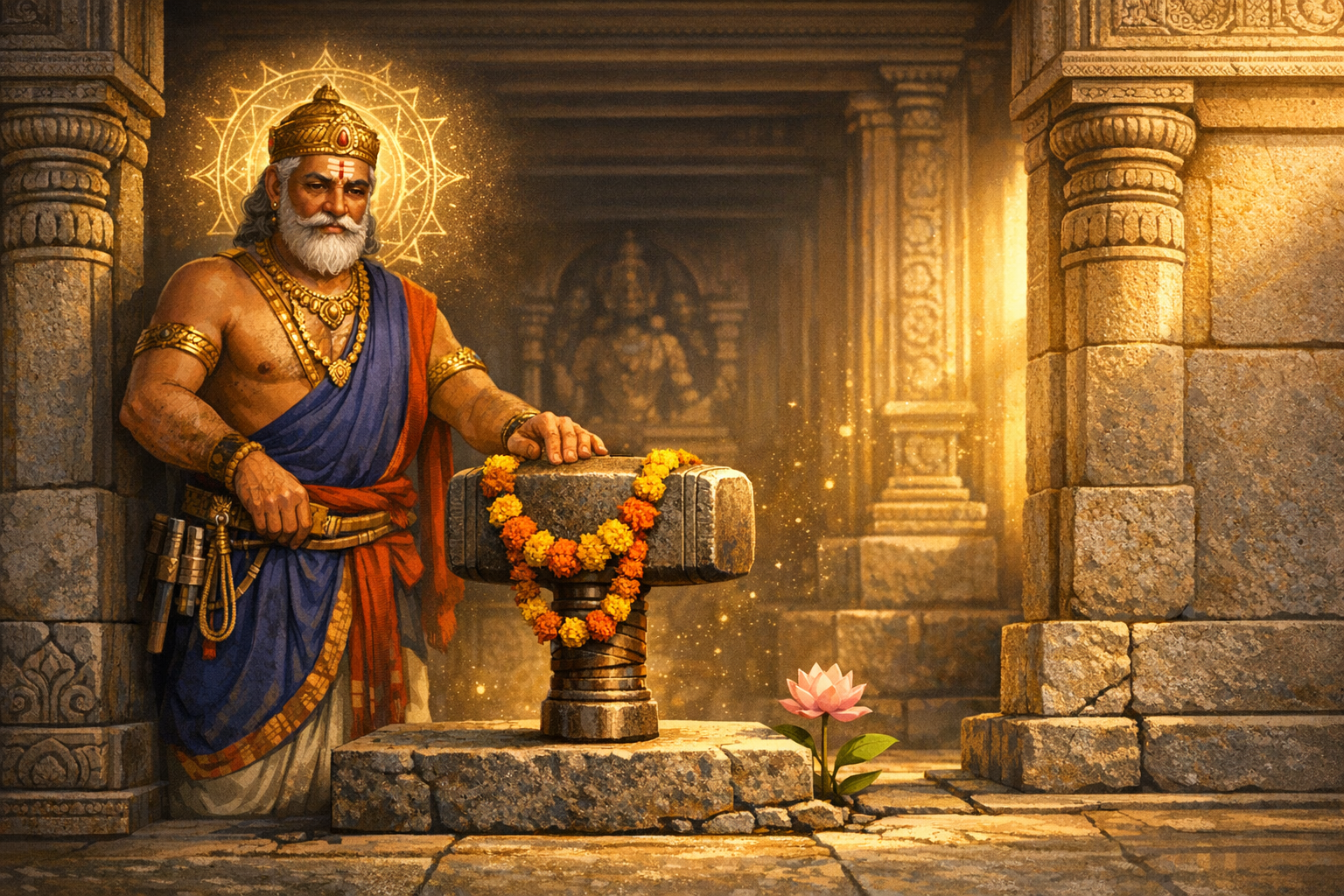
In Hindu iconography, mudgara appears less frequently than mainstream emblems of gods and goddesses, yet where it does occur its placement is telling. Guardians of thresholds (dvarapalas) and yaksha attendants are sometimes shown with mallet-like implements rather than bulbous maces, emphasizing their pragmatic custodial role: to bar the unworthy, to quell disorder, and to stabilize the sacred precinct. Equally, the divine craftsman Vishvakarma is commonly depicted with a hammer among his tools, a visual theology that entwines shaping, repairing, and occasionally unmaking as necessary phases of cosmic maintenance.
Vishvakarma’s association with the hammer offers a key to the mudgara’s layered meaning in Hindu sacred art. As architect of divine weaponry and palatial abodes, Vishvakarma wields the hammer not to wreak indiscriminate havoc but to refine, calibrate, and enforce fit. The same blow that sets a temple stone true or closes a joint tight becomes, by extension, a cosmological act: rectification through carefully bounded force. This hermeneuticforce as precision, not excessinvites viewers to read mallet-bearing figures as embodiments of order-restoring intelligence.
Within Shaiva and Shakta visual cultures, the mudgara does not displace emblematic attributes such as the trident, drum, or sword; rather, it appears occasionally with attendant guardians or fierce subsidiary figures who operationalize the deity’s mandate. The hammer’s presence in these contexts stresses not spectacle but efficacy: tamas (inertia, obstruction) is not merely banished but physically “broken up” into workable fragmentsan image of inner work as much as outer defense. Such scenes resonate with temple ritual life, where rectification, repair, and consecration are continuous cycles.
Vaishnava and Ganapatya traditions, with their expansive iconographic repertoires, sometimes include implements that can be misread as hammers in multi-armed forms. Discerning viewers and researchers therefore benefit from a few practical heuristics: the gada typically swells to a rounded or pear-shaped head, musala reads as a long, uniform pestle, ankusa is a hooked goad with a compact profile, and vajra presents as a symmetric thunderbolt motif. By contrast, mudgara will usually display a broad, blunt face and a stocky shaft, signaling utility over flourish.
Symbolically, the mudgara’s “sacred destruction” targets what Hindu philosophy identifies as the real adversaries of freedom: avidya (ignorance), granthi (karmic knots), and vighna (obstructions). As a weapon, it communicates an ethical use of forcedecisive but boundedapplied to the hard shell of entrenched patterns that deny harmony. This is not wanton violence; it is surgical unmaking, akin to removing a flawed rivet before a bridge can bear weight, or breaking a calcified clump so a field may take root anew.
Complementing this destructive-rectifying function is the mudgara’s protective power. In temple iconography, guardians armed with mallets emphasize the responsibility to hold space: to steward thresholds between the everyday and the sacred, to stabilize the ritual environment, and to defend the vulnerable. The hammer’s short reach suggests proximity and accountability; it is the implement of those who stand near the door and answer for what crosses the line.
Equally potent is the mudgara’s creative valence. In the hands of Vishvakarma and by extension the community of shilpins (sacred artisans), the hammer becomes a consecrating instrumentbringing metal and stone to canonical form, striking out impurities, and sealing joints that must endure monsoon, procession, and centuries of worship. Festivals like Ayudha Puja honor such tools explicitly, acknowledging that implements of work and defense participate in dharma when sanctified by right intent and right use.
Technical reading of the mudgara in sculpture benefits from attention to fabrication logic. In bronze icons, a hammer’s face may be subtly flattened or undercut, its haft wrapped or collared where hand meets tool; in stone reliefs, the head often reduces to a rectangular prism with beveled edges. Because hafts are prone to breakage, restorations sometimes shorten the implement; this can make a gada look like a mallet or vice versa. Field documentation therefore relies on corroborating cues: figure type (guardian, artisan, attendant), posture (resting the head on the ground is common for mallets), and contextual attributes (tool belts, measuring cords, or other craftsman’s emblems near Vishvakarma).
Differentiation from cognate ayudhas clarifies interpretation. The gada’s head is generally globular and often ornamented; the vajra is axially symmetric with pronged finials; the musala appears rod-like and longer than the mudgara; the ankusa terminates in a hook and knob. The mudgara’s profile remains intentionally blunt and businesslikeits “aesthetics” underline functionso misidentifications often resolve once head geometry and grip are examined closely.
Distributionally, mallet-bearing figures are attested in South Asian temple traditions, with noteworthy occurrences among guardians and artisan-deities in both northern and southern idioms. Across South and Southeast Asia’s Hindu-influenced visual cultures, similar implements appear in workshops and threshold scenes, reflecting a shared material vocabulary of building and safeguarding sacred space. Chronologically, their presence aligns with periods of vigorous construction and metallurgical refinement, echoing the growth of bronze casting and stone templar architectures.
Comparative dharmic perspectives deepen the mudgara’s message of unity. In Buddhist iconography, the vajrathough not a hammerfunctions analogously as the indestructible force that shatters ignorance, paired with the ghanta (bell) to balance skillful means and wisdom. In Jain traditions, Tirthankaras remain non-violent and attribute-free, yet guardian yakshas and yakshinis occasionally carry clubs or mallet-like implements as emblems of wardship, reframing protection as custodianship of non-violent space. In the Sikh tradition, the saint-soldier ideal (miri-piri) elevates the ethical use of strength to defend justice; while the khanda and kirpan are central, the broader symbolism honors the forge and the discipline behind every bladewhere hammers are indispensable. Across these traditions, the core principle converges: strength is sanctified when it protects life, dispels delusion, and serves the common good.
Material-culture studies further underscore the hammer’s centrality. Indian metallurgists perfected high-carbon wootz steels and panchaloha alloys for sacred bronzes; both demanded controlled hammer work for shaping, chasing, and finishing. Stone carvers relied on coordinated hammer-and-chisel systems to achieve the crisp planes and delicate reliefs visible in Hindu sculptures. The mudgara, then, is not merely represented in art; it is the means by which much of that art exists. This reflexivity makes the hammer a fitting emblem of sacred pragmatismdoing what must be done so that vision becomes durable form.
Ritually, Ayudha Puja and Vishvakarma Jayanti foreground the ethical sanctification of tools and weapons. Households and workshops place hammers alongside books, instruments, and implements of trade before deities, seeking blessings for safe, conscientious use. Observers often note a palpable humility in these ceremonies: power is acknowledged, dedicated, and bound to responsibility. This ritual framing mirrors the iconographic onethe mudgara is potent precisely because it is constrained by dharma.
Museum-goers and temple pilgrims frequently report a subtle emotional register where mallet-bearing guardians are concerned: a sense of steadiness, of quiet resolve rather than flamboyance. The short-hafted hammer looks close to the ground, weighted and real, evoking relatable experiences of repair, making, and care. This resonance invites an inward reading: just as artisans tap a joint until it aligns, spiritual practice incrementally corrects misalignments in conduct and perception. In both, gentle precision alternates with decisive strikes.
For students of Hindu iconography and sacred art, the mudgara offers a valuable interpretive key. It asks viewers to track not only what is destroyed, but what is made possible after the break; not only who is barred at the threshold, but what stability their barring protects. It binds battlefield, workshop, and shrine into a single economy of care, where strength, skill, and sanctity cooperate. Read this way, the mudgara ayudha clarifies a signature insight of the dharmic traditions: renewal requires the courage to unmake what cannot hold, and the compassion to make well what must endure.
In sum, the divine hammer’s appearance in Hindu sculpturesespecially with Vishvakarma, guardians, and attendant figuresembodies sacred destruction and protective power held in ethical balance. Its blunt geometry, practical handling, and deep ties to artisanal labor distinguish it from other ayudhas and align it with the enduring themes of Hindu iconography: the defense of dharma, the dispelling of ignorance, and the patient craftsmanship of renewal. In concert with parallel ideals across Buddhism, Jainism, and Sikhism, the mudgara invites a unifying reflection: when force is married to wisdom and compassion, both temples and communities stand firm.
Inspired by this post on Hindu Blog.