
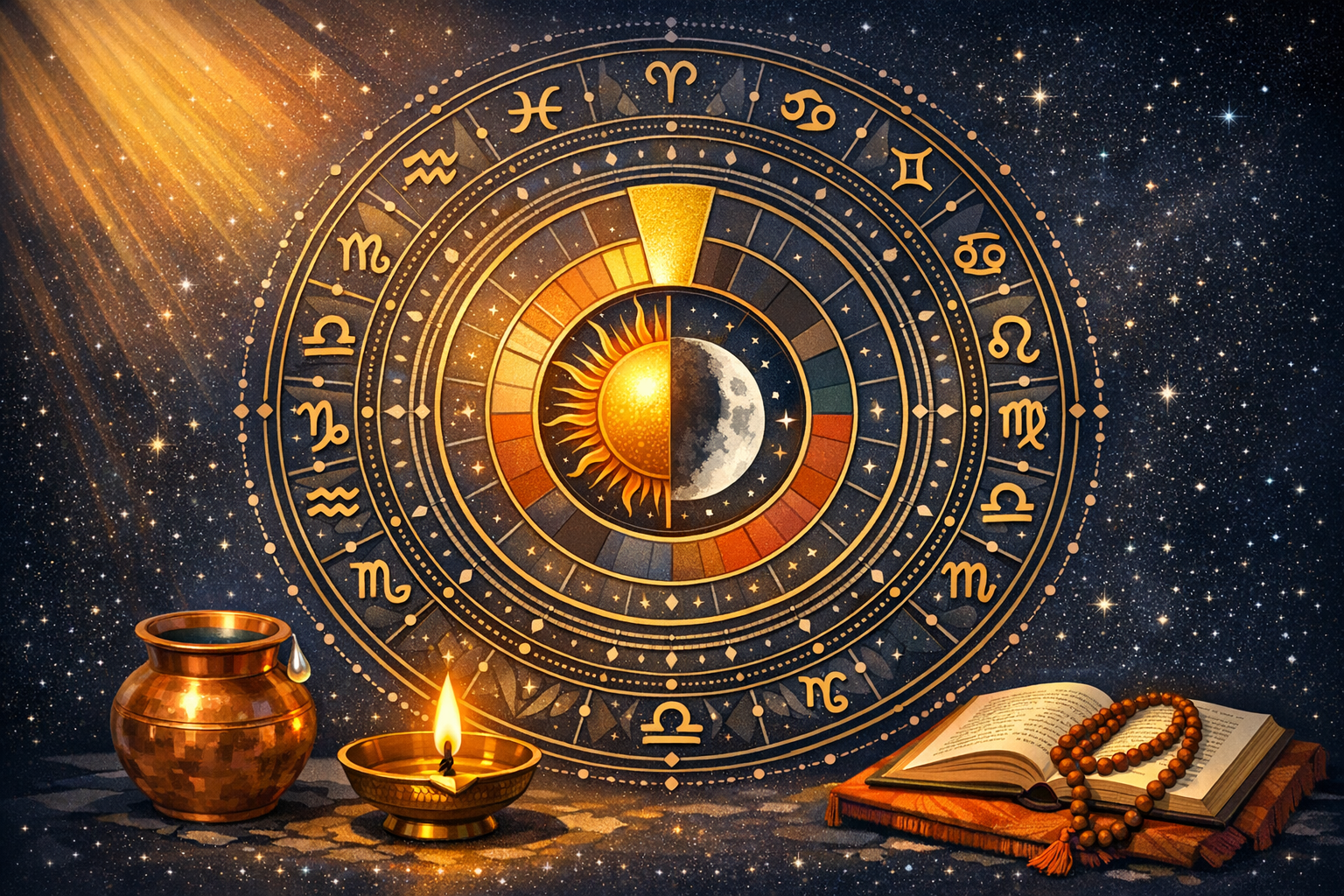
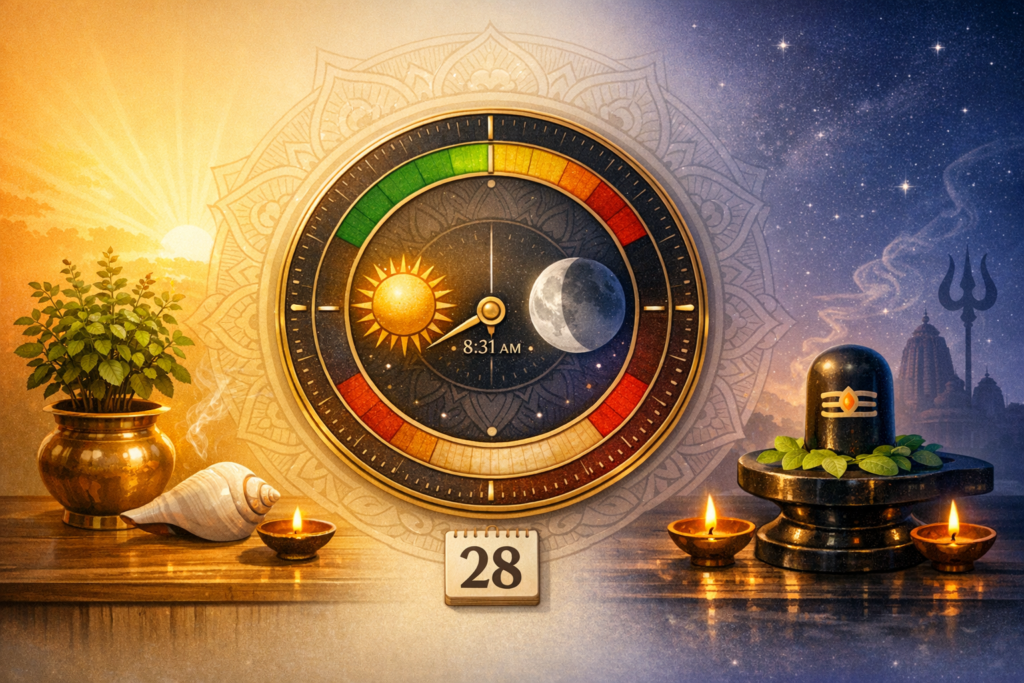
Sunday, May 24, 2026, in the Hindu calendar (Panchang) marks Shukla Paksha Ashtami—the eighth lunar day of the waxing phase—until 8:52 AM (IST). From 8:52 AM onward, the day transitions to Shukla Paksha Navami. As with all Panchang computations, local sunrise, longitude, and latitude can shift the exact boundaries slightly; therefore, regional panchangam references should be consulted for precision.
Shukla Paksha denotes the bright fortnight when the Moon’s illumination increases each night. In dharmic traditions, this ascending light is symbolically linked with growth, clarity, and sattva, making it a favored period for study, devotion, and constructive works—tempered, however, by the specific tithi’s intrinsic quality.
Technically, a tithi is defined by the longitudinal separation between the Sun and the Moon, increasing in steps of 12°. Ashtami spans when the Moon’s elongation from the Sun lies between 84° and 96°, and Navami from 96° to 108°. Because the Sun–Moon angular rate is not constant with respect to civil time, tithis begin and end at varying clock times and do not align neatly with sunrise or midnight.
In classical muhurta frameworks (e.g., Muhurta Chintāmaṇi), Ashtami is categorized as a Jaya tithi—a “victory” day. It is considered effective for tasks requiring resolve, protection, and cutting through obstacles, and for invoking Shakti through Devi upāsanā. It is generally not prioritized for major life ceremonies (vivāha, griha-praveśa), but it can be aligned with vrata, mantra-japa, and sankalpas related to courage and discipline.
From 8:52 AM (IST), the day becomes Navami, a Rikta tithi (“hollow” or “unfilled”) traditionally approached with restraint for auspicious inaugurals. Navami is well-suited for austerities, scriptural study, internal purification, seva, and remedial or protective rituals. Households planning significant beginnings often defer them or time them within benevolent muhurta segments while avoiding inauspicious intervals.
Practically, the Ashtami-to-Navami transition encourages a two-part rhythm for the day: utilize the Ashtami window for focused spiritual effort and decisive clearing of backlog or protective sankalpas; pivot after 8:52 AM to quieter disciplines—contemplation, anusthāna, svādhyāya, and inner alignment—consistent with Navami’s Rikta character.
Good Time (Shubh Muhurat) planning on this Sunday benefits from universal timing principles that are independent of local nakshatra/lagna specifics. The Abhijit Muhurta—centered around local solar noon—offers a broadly auspicious window (approximately 24 minutes before to 24 minutes after true noon). Because true noon varies by longitude and the equation of time, local adjustment is essential; nevertheless, Abhijit remains a reliable daily anchor for moderate initiations, prayers, and sankalpas.
It is equally important to avoid the day’s inauspicious segments. Traditional electional astrology flags Rahu Kaal, Yamaganda, and Gulika as times to sidestep for new undertakings. The daylight period from sunrise to sunset is divided into eight equal parts; on Sundays, the mapping is: Rahu Kaal = 8th segment, Yamaganda = 5th segment, Gulika = 7th segment. To compute local clock times, divide the day’s sunrise–sunset interval by eight and assign these segments in order. For major rites demanding exactitude, a local panchang or competent jyotiṣi should be consulted.
Many regions also use Choghadiya for quick decision-making. Daytime on Sundays starts with Udveg at sunrise, followed by Char, Labh, Amrit, Kaal, Shubh, Rog, and cycles onward in this order. Choghadiya slots are proportional to the local day/night length; Shubh, Labh, and Amrit are generally favored, while Kaal, Rog, and Udveg are typically avoided for initiations.
Nakshatra and Chandra Rashi (Moon’s sign) refine the day’s quality. The nakshatra is determined by the Moon’s position within the 27 lunar mansions; the Moon’s rashi (Chandra Rashi) is its zodiacal sign (each spanning 30°). Both can change during the day. Because these depend on exact lunar longitude at a given place and time, authoritative local panchang data should be used. As a working principle, actions are aligned with the temperament of the nakshatra at sunrise, adjusting if a mid-day change occurs.
While precise nakshatra and rashi for May 24, 2026, vary by location and clock time, this framework supports responsible planning: favor benevolent nakshatras (e.g., Rohini, Mrigashira, Pushya, Anuradha, Uttarāṣāḍhā) for initiations and avoid fierce ones (e.g., Mūla in certain contexts) unless the task explicitly benefits from their transformative energy. Similarly, note the Moon’s rashi for emotional tenor and community interactions; a watery rashi often amplifies receptivity, a fiery rashi dynamism, an airy rashi networking, and an earthy rashi practicality.
Yoga and Karana—two additional Panchang limbs—further nuance outcomes. Yoga (27 in number) is computed from the sum of solar and lunar longitudes; Karanas (11 repeating divisions of half-tithis) color the immediate actionability of a time block. Because both are highly time-sensitive, responsible use relies on local calculations; yet, the principle remains consistent: align high-stakes tasks with harmonizing yogas and stable karanas when possible.
Vāra (weekday) also matters. Sunday (Ravivāra) is governed by Surya and is associated with leadership, clarity, health, and illumination. When harmonized with Jaya Ashtami during the early part of the day, it can support resolute sankalpas and protective worship; once Navami begins, the same solar steadiness pairs well with reflective practice, humility, and self-regulation.
Calendar traditions vary. Most regions in India today will observe the same tithi sequence noted above, but Amānta vs. Pūrṇimānta month reckonings and local sunrise may affect festival assignments. Time zones and daylight saving in the global diaspora can further shift boundaries. Hence, the phrasing “in most regions” remains essential for accuracy and respect for regional paramparā.
Suggested home observances for households include a simple dawn deepa and jal-arpaṇa, followed by brief mantra-japa (e.g., Gāyatrī-japa, or Devi stotras during Ashtami hours). After the Navami transition, quiet svādhyāya (e.g., Bhagavad-Gītā, Dhammapada, Āgamas, Ādi Granth excerpts as per tradition) and a focus on compassion (dāna, anna-dāna, or seva) honor the Rikta tithi’s reflective nature.
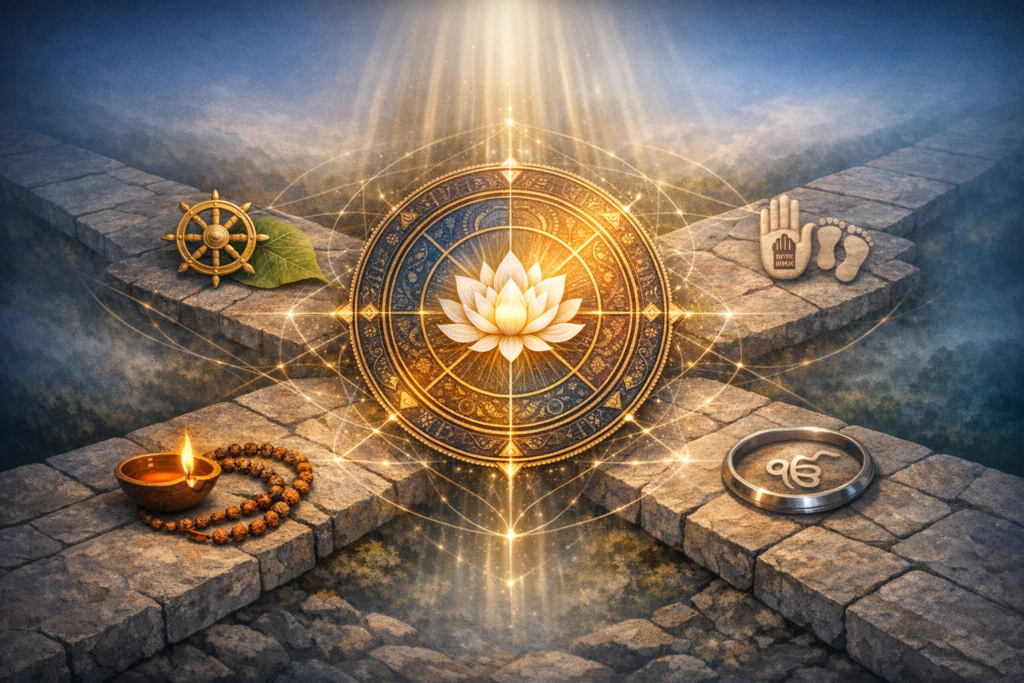
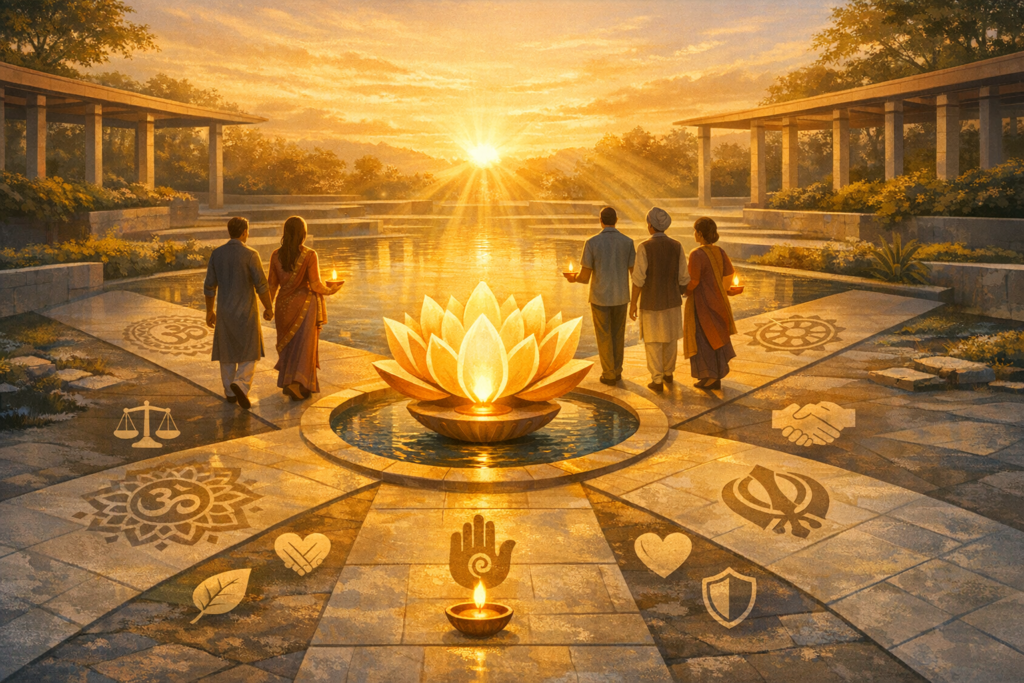
In the spirit of unity among dharmic traditions, this lunar cadence can be appreciated across paths. Hindus may emphasize Devi upāsanā and japa; Buddhists may integrate mindful sitting and mettā (loving-kindness) practices; Jains may adopt samayik and pratikraman for inner purification; Sikhs may strengthen the day through Nitnem, kirtan, and seva. The shared lunar rhythm invites mutual respect and a harmonious ethos: multiple paths, one aspiration toward inner clarity and collective well-being.
For spiritual planners, a balanced day-plan is: complete any essential initiations within safe windows (e.g., Abhijit, favorable Choghadiya) during Ashtami; after Navami begins, favor maintenance, learning, harmonization, and remedial worship. Avoid Rahu Kaal, Yamaganda, and Gulika for fresh undertakings, and if a critical rite must be performed, seek a precise, location-specific muhurta.
Finally, a methodological reminder enhances accuracy: determine local sunrise and sunset; compute segment-based intervals (for Rahu Kaal, etc.); retrieve nakshatra, rashi, yoga, and karana for the specific place and moment; and cross-check with a trusted regional panchang. This disciplined approach preserves the scientific intent of the Panchang while honoring tradition.
Key takeaways for Sunday, May 24, 2026 (IST): Shukla Paksha Ashtami prevails until 8:52 AM, then Shukla Paksha Navami. Use the early Jaya tithi span for protective, disciplined efforts; shift to contemplative, service-oriented, and remedial practices after the Navami onset. Anchor moderate initiations around Abhijit Muhurta and steer clear of Rahu Kaal, Yamaganda, and Gulika for new beginnings. Validate nakshatra and rashi locally to fine-tune decisions with care and respect across all dharmic traditions.
Inspired by this post on Hindu Blog.




Leave a Reply
You must be logged in to post a comment.