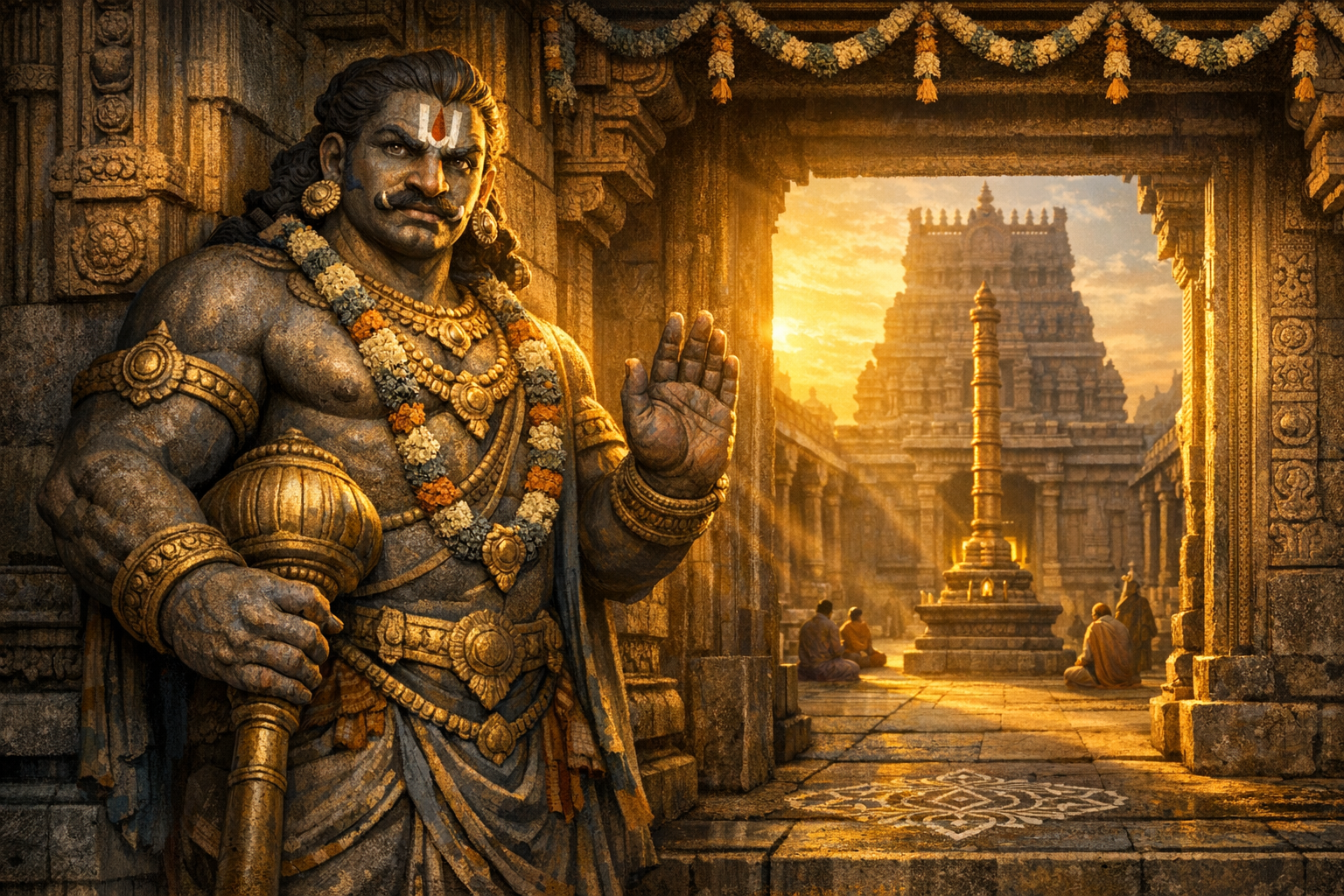
Across the sacred geographies of Hindu temples, guardians at the threshold embody a profound theology of protection, purity, and passage. Within the Vaishnava tradition, these divine doorkeepers (dvarapalas) mark the liminal moment when a devotee transitions from the ordinary to the consecrated. Among the many guardians who flank gateways and sanctums, Chanda is venerated in several kshetras as the fierce sentinel of the eastern entrance, a living symbol of vigilance aligned with the rising light of Surya and the auspicious promise of dawn.
Temple architecture encodes this vision in stone. From the outer prakara and towering gopura to the mahadvara, dvajasthambha, balipeetha, and the intimate antarala before the garbhagriha, every threshold articulates the movement from worldliness to sanctity. Dvarapalas serve as both visual and ritual anchors to these thresholds, affirming that entry into Bhagavan Vishnu’s presence is at once a spatial act and a moral undertaking: a decision to quieten agitation, align intention, and honor dharma.
The name Chanda, derived from Sanskrit caṇḍa (fierce, impetuous, unyielding), connotes disciplined intensity harnessed for protection. It should not be confused with chandas (Vedic meter), though both derive from cognate roots. In the temple context, Chanda’s ferocity is not rage; it is a controlled kshatra-energy, transfigured into guardianship so devotees may enter untroubled by distraction, fear, or malice.
Directionality matters in Indic cosmology. The east is the cardinal of emergence, illumination, and right-beginning. Many Vaishnava temples privilege their eastern gate for processions, first darshan, and ceremonial ingress. Within such spatial theologies, Chanda’s placement at the eastern entrance functions as a doctrinal and architectural cue: the devotee steps into light under the watch of a sentinel who keeps the precinct ritually clean while inwardly urging restraint, clarity, and reverence.
Local sthala-puranas and oral priestly traditions (archaka-parampara) often pair Chanda with Prachanda, amplifying the icon’s protective tenor. In Vaishnava shrines where the Ugra resonance of Narasimha is thematically important, this pairing becomes especially intelligible: Chanda–Prachanda serve as the tamed perimeter of a greater, divinely governed fierceness that destroys adharma yet shelters bhaktas. Nomenclature varies regionally, and temples may emphasize different guardian names; nonetheless, the protective semantics of Chanda remain consistent.
Iconographically, Vaishnava dvarapalas reveal a shared grammar across time and polity. Chanda is typically rendered as a robust, broad-shouldered guardian with emphatic gaze, sometimes with slightly protruding canines to signal deterrence without demonic overtones. Common attributes include the gada (mace), khadga (sword), or a palm positioned in a restraining, warning mudra. Vaishnava markers such as vanamala motifs, conch or chakra ornaments, and subtle tilaka cues on the brow may be present depending on the period and workshop.
Stylistic idioms reflect dynastic ateliers. Chola and Vijayanagara guardians tend toward muscular volumes and assertive stance; Hoysala carvings favor intricate jewelry, patterned textiles, and scrollwork; Nayaka-era figures may heighten theatricality through dynamic torsion and expressive eyes. Regardless of period, the dvarapala’s essential task persists: to stabilize the temple’s moral-ritual perimeter.
The Agamic foundations that inform this practice are robust. Pancharatra and Vaikhanasa paddhatisalongside shilpa-shastra compendia such as Mayamata and Manasaraprescribe dvara-devata installation, orientation, and worship as part of the larger consecratory system of the temple. While textual lists of named guardians differ, the underlying principle is uniform: threshold deities absorb and neutralize disruptive influences so that the energy within the garbhagriha remains sattvic and serene for darshan.
Accordingly, many temples integrate offerings (bali) and salutations (namaskara) to dvara-devatas in daily and festival liturgies. Priests often circumambulate the balipeetha and honor directional and threshold guardians before entering the sanctum for nitya-archana. This sequence signals the community’s acknowledgment that sacred order is maintained from the precinct outward to the cosmic perimetera choreography in which Chanda’s station at the east holds special resonance.
Devotees frequently mirror this ritual courtesy in personal practice. Before stepping through the eastern gate, many pause, lower their gaze, and silently salute the guardians. For some, this gesture becomes a psychological pivot: agitation is set down, the mind reorients to compassion and truthfulness, and the heart prepares to receive Bhagavan’s anugraha without inner noise. In that sense, Chanda’s guardianship powerfully complements bhakti; fierceness at the doorway protects gentleness at the heart.
Theologically, Chanda embodies kshatra in seva. Within Vaishnavism, the protective function is not external to devotion; it is devotion operationalized. Just as Vishvaksena personifies the cosmic order that administers Vaikuntha, the dvarapalas enact order at the temple’s margins. They are not antithetical to Vishnu’s auspiciousness; they safeguard it.
Regional art and priestly speech continue to preserve Chanda’s name in numerous Vishnu and Narasimha kshetras across Andhra Pradesh, Telangana, Tamil Nadu, and Karnataka. In certain shrines, inscriptions, name plaques, or temple guides explicitly identify the flanking guardians; in others, the names persist through oral transmission and festival recitation. Such variability is characteristic of India’s temple culture, where canonical, regional, and local strands braid together to form a living tradition.
Scholarly caution is prudent: not every eastern dvarapala is formally named Chanda in all Vaishnava temples, and textual lists of gatekeepers (e.g., Jaya–Vijaya and others) differ across Puranic and Agamic corpora. Yet the recurrent attribution of the eastern sentinel as Chanda in several locales justifies speaking of a recognizable, if regionally textured, Vaishnava convention. Where precise epigraphs are absent, the name functions as a meaningful devotional label, not an arbitrary flourish.
The idea of threshold guardians is shared across the wider dharmic family. Buddhist monasteries and shrines feature dvarapala-like yaksha figures and dharmapalas who defend the Dharma and delineate sacred precincts. Jain temples greet visitors with kshetrapala and attendant yakshas who uphold the vows of purity and non-violence within the mandapa. Though Sikh gurdwaras avoid anthropomorphic gate sentinels, the marked etiquette of entryremoval of shoes, head covering, and reverent bowplays an analogous role, establishing a protected moral field at the threshold.
This common grammar of sanctified entry underscores unity among Hindu, Buddhist, Jain, and Sikh traditions. All affirm that a sacred interior requires a mindful boundaryand that guardianship, whether imaged in stone or enacted as disciplined etiquette, is a compassionate service to all seekers. In this shared horizon, Chanda’s fierceness is neither sectarian nor exclusionary; it is inclusively protective, making room for many spiritual paths to approach the Divine without hindrance.
Puranic literature enriches this vision with accounts of Vaikuntha’s multiple gates and renowned doorkeepersmost famously Jaya and Vijaya. Local Vaishnava communities often supplement these classical names with regionally cherished guardians such as Chanda, integrating textual memory with lived practice. The result is not contradiction but complementarity: canonical archetypes and regional embodiments working in tandem to preserve the sanctity and accessibility of the temple.
Chanda’s semantics also invite a subtle reading of fierce compassion. The same resolute energy that stands guard without compromise is, in devotional logic, what makes compassion possible within. Fierceness is thus not opposed to love; it is love’s perimeter. By policing distraction and malice at the doorway, Chanda ensures that within, the bhakta may experience Vishnu’s grace in undistorted clarity.
Festival cycles make this vivid. During Brahmotsavams and other utsavas, processions cross thresholds that are ritually acknowledged and blessed. Priests may offer flowers, lamps, and mantras to the guardians as the utsava-murti passes, signaling gratitude for their ceaseless watch. The choreography of exit and returncrossing out into the community and back into the sanctumunfolds under the steady eyes of the dvarapalas, with Chanda’s post at the east setting the day’s auspicious arc.
There is a psychological depth here as well. Every spiritual life has thresholdsmoments that demand courage, clarity, and a decisive turn toward truth. In that interior journey, Chanda’s figure becomes a mirror: what stands at the door of the heart must be both firm and compassionate. Devotees often find that a brief mental salutation to the guardians before darshan fosters exactly that inner stance.
Daily life offers resonant analogies. Households across India draw kolam or rangoli at the doorway, hang toranas, and observe etiquette of entry to honor the home’s sanctitymicrocosmic echoes of the temple’s guarded thresholds. The message is consistent: purity begins at the boundary, and mindful entry dignifies what lies within.
Conservationists, art historians, and temple authorities play a vital role in preserving guardian sculptures, inscriptions, and ritual knowledge linked to dvara-devatas. Detailed documentation of local names such as Chanda, careful epigraphic recording, and support for priestly transmission sustain the living weave of Agama, Purana, and regional memory. Preservation here is not merely archaeological; it is theological and communal.
For visitors, a simple practice aligns with this heritage: pause at the eastern gate, lower the gaze, and silently honor the guardians. This is not superstition but pedagogy. The moment teaches discrimination (viveka) and reverence (shraddha), preparing the mind for darshan. Many pilgrims speak of a tangible stillness that followsan experiential assurance that one is being invited, not merely admitted.
In sum, Chanda at Vishnu’s eastern gate concentrates a wide constellation of meaningsAgamic architecture, Puranic memory, regional devotion, and inner disciplineinto a single, powerful image. As a fierce yet compassionate dvarapala, Chanda safeguards the sanctity of Vaishnava spaces so that devotees of every dharmic path may approach Bhagavan in peace. Guarded thresholds, it turns out, do not narrow the way; they keep it open, clear, and radiant.
Inspired by this post on Hindu Blog.