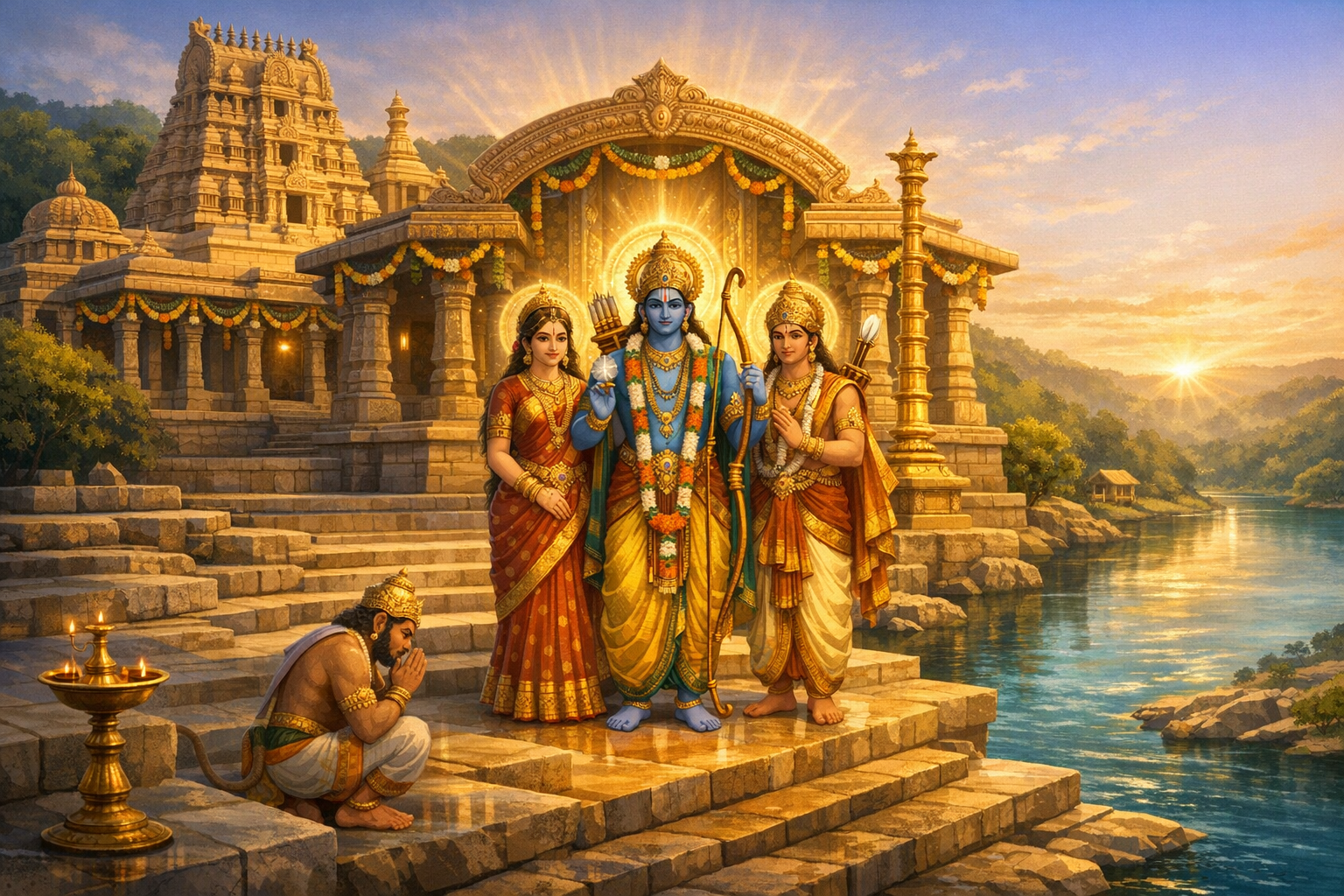
Bhadrachalam Sita Ramachandra Swamy Temple, set along the forested banks of the Godavari in present-day Bhadradri Kothagudem district of Telangana, is among the most venerated Hindu temples in the Telugu-speaking world. The kshetra’s Sthala Puranam integrates Valmiki’s Ramayana, sacred geography, and verified historical memory to present a compelling narrative of Sri Rama’s presence in Dandakaranya during vanavasa. In the cultural imagination of Sanatana Dharma, Bhadrachalam epitomizes the seamless continuity between scripture, place, and living practice.
According to the epic framework narrated by Sri Valmiki, the Tretayuga saga of Sri Rama begins in Ayodhya, capital of Kosala, where the righteous heir apparent accepts exile on King Dasaratha’s command. Sri Rama departs with Seetha and Lakshmana, traversing the ancient forests of central and southern India. The Dandakaranya segment of this journey maps onto the Godavari basin, situating present-day Bhadrachalam and its environs within the lived landscape of the Ramayana.
Local tradition holds that the very name Bhadradri (Bhadrachalam) memorializes a penance performed by Bhadraunderstood in the puranic imagination as a mountain-personage devoted to Sri Rama. In this reading, Bhadra’s long tapas culminated in a boon: the Lord would manifest on this hill and sanctify it perpetually. The Sthala Puranam thus treats the hill not merely as terrain but as a conscious participant in dharma, aligning the site with enduring Vaishnava theologies of divine presence in sacred space.
Within the regional Ramayana cartography, nearby Parnasala embodies the forest hermitage where Seetha and Lakshmana dwelt with Sri Rama during vanavasa, and where the ruse of the golden deer unfolded prior to Seetha’s abduction. Oral histories and pilgrimage circuits around Bhadrachalam preserve episodes linked to Jatayu’s valor and to the Godavari’s role as a lifeline through which the narrative of dharma moves from ordeal to restoration. While textual criticism distinguishes between pan-Indic Ramayana recensions, the devotional consensus across the Telugu country accepts this geography as a living mnemonic of Valmiki’s account.
A significant episode in the kshetra’s local memory concerns Pokala Dammakka, a devotee who, guided by a dream vision, is said to have discovered the moola vigrahas of Sri Rama, Seetha, and Lakshmana within an anthill on Bhadradri. Dammakka’s simple worship with forest offerings and her effort to draw the community to the site established an early rhythm of seva that linked the forest economy with temple ritual. The account exemplifies a recurrent motif in Indian temple originswhere divine manifestation emerges through the devoted attention of those living closest to the land.
The temple’s attested historical development accelerates in the 17th century with Kancherla Gopannarevered as Bhadrachala Ramadasuwho served as a local tahsildar under the Qutb Shahi administration. Tradition maintains that, moved by intense bhakti, he undertook major reconstruction and endowments for Sita Ramachandra Swamy Temple. Subsequent legend narrates his imprisonment by Sultan Tana Shah for diverting revenue, followed by an extraordinary royal change of heart, release, and patronage allegedly prompted by the Lord’s grace. While historians parse documentary elements from hagiographic embellishment, the consensus recognizes Ramadasu’s seminal role in institutionalizing worship at Bhadrachalam and in composing kirtanas that seeded a robust Bhakti Tradition centered on Sri Rama.
Iconographically, the moola murti of Bhadrachalam is renowned as Vaikuntha Rama. In a striking departure from strictly human-armed depictions, Sri Rama here bears four arms: the upper hands hold shankha and chakra while the lower hands hold kodanda and arrow, signifying the confluence of maryada-purushottama and the transcendent Vaikuntha iconography of Vishnu. Seetha stands to the Lord’s left and Lakshmana to the right, forming a triad that fuses royal dharma, conjugal fidelity, and fraternal devotion into a single vision. Separate shrines for Anjaneya and other deities complement the main sanctum, shaping a complete pilgrimage experience.
The temple’s architectural profile reflects Dravidian influences adapted to a hill-shrine topology. Gopurams and mandapas frame the ascent, while the Godavari itself functions as a living tirtha. The dwajasthambha and procession routes enable utsavas that integrate the town’s civic layout with ritual cartographies. Inscriptions, later donor plaques, and liturgical schedules chronicle the temple’s gradual expansion, revealing a pattern typical of South Indian temples where community, crown, and commerce convene to sustain sacred institutions.
The ritual calendar at Bhadrachalam balances nitya-seva (daily worship) with grand utsavas. Archana, abhishekam, and deepa aradhana anchor the daily cycle. During weekly and monthly observances aligned with tithis and nakshatras, the temple accentuates specific aspects of Sri Rama’s grace, harmonizing domestic piety with public darshan. The liturgical grammar here is classical yet accessible, allowing both seasoned sadhakas and first-time pilgrims to enter the stream of devotion without impediment.
Sri Rama Navami constitutes the kshetra’s crown jewel. On this day, the celestial wedding (Kalyanam) of Sri Rama and Seetha is performed with precise adherence to Vedic and Agamic injunctions, while remaining deeply participatory. The next day typically commemorates Sri Rama Pattabhishekam, the coronation that symbolically restores righteous order. Pilgrims describe the Kalyanam as a living synthesis of scripture, music, and communitywhere Ramadasu’s kirtanas, Telugu ritual aesthetics, and Sanatana Dharma’s universality cohere into a singular rasa of devotion.
Vaikuntha Ekadashi is another highlight, when the Vaikuntha Dwaram is ceremonially opened and devotees seek mukti-darshan. Seasonal Godavari-centered observances draw additional pilgrims, underscoring how river and temple interpenetrate in a mutually sustaining cycle. Such festivals reiterate a civilizational principle: time itself becomes sacred when aligned with dharma, and space becomes sacred when consecrated by worship and ethical conduct.
In the realm of music and literature, Bhadrachalam radiates far beyond its hilltop precinct. The compositions attributed to Bhadrachala Ramadasu, woven into the broader tapestry of Carnatic and bhajana traditions, amplify the temple’s spiritual reach. These kirtanas translate sophisticated theologyranging from surrender (sharanagati) to ethical kingshipinto accessible song, allowing the Ramayana’s ideals to be internalized through melody and collective remembrance.
From an interdisciplinary perspectivespanning history, philology, and anthropologythe Sthala Puranam of Bhadrachalam illustrates how epic narrative, regional ecology, and political history combine to shape Hindu Temples as living institutions. The presence of administrative records from the Qutb Shahi period alongside resilient oral traditions demonstrates that temple histories in India are both textually grounded and communally curated, resistant to reductive single-source explanations.
Bhadrachalam also provides a meaningful locus for inter-dharmic reflection. The Ramayana has resonant retellings in Buddhist, Jain, and later Sikh narrative worlds, each illuminating dharmic values such as compassion, courage, and restraint. Seen in this light, the kshetra’s messagerooted in Sanatana Dharma yet welcoming of diverse seekerssupports unity among Hindu, Buddhist, Jain, and Sikh traditions. The ethical arc of Sri Rama’s life serves as a shared civilizational touchstone, encouraging mutual respect and a commitment to collective well-being.
For pilgrims, the praxis of yatra to Bhadrachalam harmonizes external travel with inner cultivation. Bathing in the Godavari with reverence, hearing kirtana, and witnessing Kalyanam or deepa aradhana become vehicles for aligning conduct (dharma), devotion (bhakti), and contemplative clarity (jnana). The kshetra thus sustains a comprehensive spiritual pedagogygrounded in scripture, embodied in ritual, and confirmed by ethical transformation in daily life.
Conservation and heritage stewardship are essential to this living tradition. Ensuring the structural integrity of the temple, safeguarding ritual continuity, and preserving the Godavari’s ecological health are complementary responsibilities. Community participationthrough transparent governance, responsible pilgrimage, and support for traditional artsenables Bhadrachalam to thrive as a site of worship and as a beacon of Cultural Heritage for future generations.
In summary, the Sthala Puranam of Bhadrachalam Sita Ramachandra Swamy Temple presents an integrated, academically coherent narrative: a Tretayuga epic spatially anchored in the Godavari region; a sacred hill named for Bhadra’s tapas; a historical renaissance under Bhadrachala Ramadasu; and an ongoing ritual life whose festivals, music, and ethics continue to inspire. Through this synthesis, Bhadrachalam affirms a timeless truth of Sanatana Dharma: that the highest ideals of the Ramayanatruthfulness, compassion, courage, and just governanceare not distant memories but living possibilities.
Inspired by this post on Hindu Pad.