
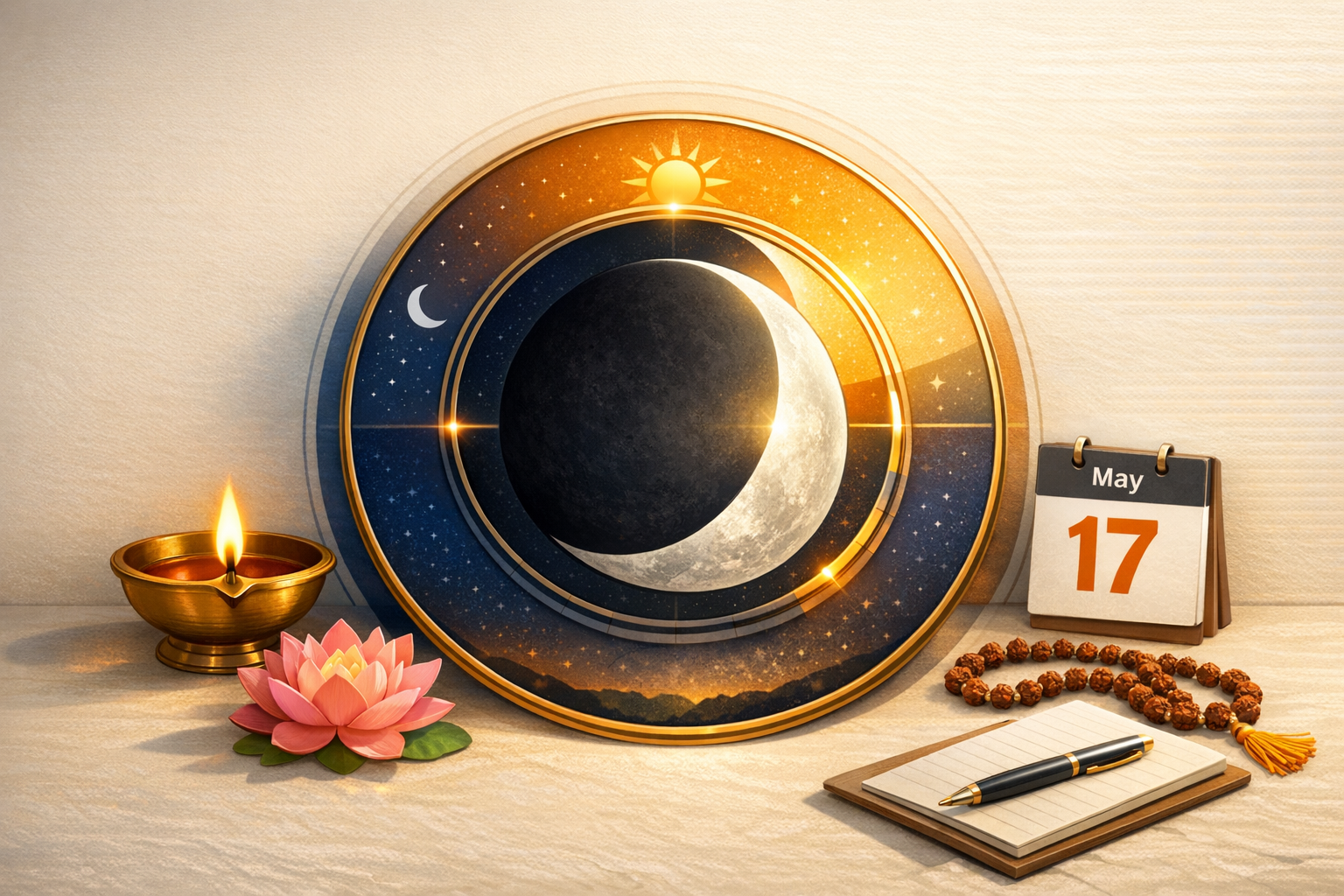
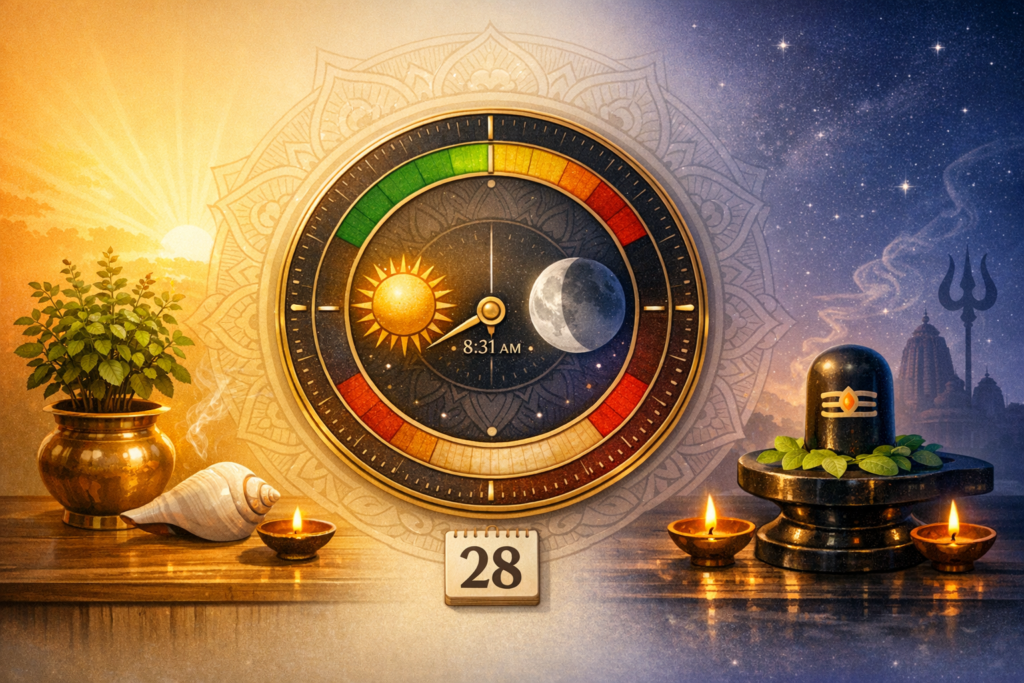
Sunday, 17 May 2026, in the Hindu calendar (Panchang) features a clear tithi transition that shapes observances and planning for the day. Amavasya tithi (new moon) continues until 1:37 AM on May 17. From 1:37 AM to 11:14 PM, Shukla Paksha Pratipada—the first tithi of the waxing fortnight—prevails; Shukla Paksha Dwitiya commences immediately thereafter. As with all Panchang data, minor regional variations are possible depending on location and calculation conventions.
In Jyotisha, tithi is defined by the angular separation between the Moon and the Sun. Each tithi spans 12 degrees of elongation, and due to the non-uniform motions of the luminaries, a tithi’s actual duration can vary (typically between roughly 19 and 26 hours). This is why a civil date can contain parts of two tithis, and why ritual timing follows the tithi rather than the Gregorian date.
The pre-dawn Amavasya segment until 1:37 AM is traditionally associated with quietude, introspection, and closure. Many families use this interval or the preceding Amavasya daytime—whenever the tithi prevails—to offer deepa-dana, perform japa, undertake sattvic austerities, and, where appropriate within family custom, conduct pitru-tarpana. The contemplative tenor of Amavasya resonates with broader dharmic sensibilities around stillness and renewal.
With the advent of Shukla Paksha Pratipada at 1:37 AM, the lunar month’s bright half begins. Pratipada carries an auspicious, initiating quality that many households recognize as conducive to sankalpa, study, and constructive undertakings. The long Pratipada window that runs through 11:14 PM makes most of the daytime on May 17 favorable for śubha-kārya in many traditions, subject to personal and regional guidance.
For “Good Time” or muhurat selection on this date, practical heuristics can refine planning. Because Pratipada occupies the active daylight period, it is generally preferred for inaugurating routine endeavors, setting spiritual resolutions, organizing study plans, and beginning modest projects. When a precise muhurat is required, users typically check Abhijit Muhurta (centered around local solar noon) and avoid Rahu Kaal, Yamaganda, and Gulika segments. On Sundays, Rahu Kaal falls in a fixed daytime segment determined by local sunrise-to-sunset division; exact windows must be computed for the observer’s location. The principle is to harmonize auspicious tithi support with favorable diurnal segments.
The Panchang’s other limbs—Nakshatra, Yoga, and Karana, along with Vara (weekday)—further nuance the day. Nakshatra indicates the Moon’s residence among the 27 stellar asterisms, shaping the qualitative tenor of activities; Yoga reflects combined Sun–Moon dynamics; Karana refines action-specific suitability. While the present entry focuses on tithi, practitioners who wish to select the most refined muhurta for May 17 should obtain the day’s Nakshatra and Chandra Rashi from a location-specific Panchang and consider Tara Bala, Chandra Bala, and relevant dasha–transit factors.
Nakshatra and Rashi details can be determined accurately using a trusted regional Panchang or a Jyotisha almanac configured for local coordinates and time zone. As a rule of thumb, Chandra Rashi highlights the Moon’s sign-based disposition for the individual, while Nakshatra adds a lunar mansion–based flavor to the day’s activities. For personal rituals or life events, alignment with one’s Janma Nakshatra and Chandra Rashi considerations is commonplace.
Amavasya’s concluding interval lends itself to practices of completion and purification—disposal of stale impressions, gentle vrata, or charity with a reflective spirit. Once Shukla Paksha Pratipada begins, families often clean their shrine spaces, light a fresh lamp, and offer simple worship to Ganesha, Vishnu, Shiva, Devi, or the Kula Devata, according to lineage. Acts of dana, study of scriptural passages, and beginning a new sadhana routine fit the initiating energy of Pratipada.
Across India, calendar conventions differ. In the amanta system (common in much of the South and West), Shukla Paksha Pratipada marks the start of a new lunar month. In the purnimanta system (common in much of the North), it marks the bright fortnight of the ongoing month name. The underlying tithi timing remains the same, and the day’s practical and spiritual import is preserved across these systems.
These lunar rhythms also echo across the broader dharmic family. Hindu Panchang observances, Jain recognition of bright and dark fortnights for vrata, and Buddhist uposatha cycles share a respect for lunar cadence that supports inner clarity, ethics, and compassion. While Sikh tradition follows a solar Nanakshahi framework and emphasizes timeless seva and simran rather than lunar muhurta, the shared values of reflection, service, restraint, and truthfulness link the traditions in a spirit of unity.
A practical planner for 17 May 2026 would therefore note: complete any Amavasya-aligned observance before 1:37 AM (or during the daylight of the preceding Amavasya if that tithi prevails). From sunrise up to 11:14 PM, the presence of Shukla Paksha Pratipada favors initiating wholesome tasks, study, and simple auspicious beginnings, while still applying standard cautions for Rahu Kaal and related intervals determined locally.
Technical note on accuracy: tithi start–end moments are astronomical and will shift by longitude, latitude, and daylight saving practices where applicable. When selecting a muhurat for a specific city, consult a reputable Panchang set to the precise location and time zone, verify sunrise–sunset times, and, if needed, obtain guidance from a competent Jyotisha practitioner to synchronize tithi with diurnal factors such as Abhijit Muhurta and avoidances like Rahu Kaal.
Key takeaway: on May 17, 2026, Amavasya tithi ends at 1:37 AM, Shukla Paksha Pratipada prevails until 11:14 PM, and the day’s daylight hours largely fall under an auspicious initiating tithi. Aligning activities with this structure—while integrating Nakshatra, Rashi, and local muhurta refinements—supports a day of clarity, renewal, and constructive action in harmony with the Panchang.
Inspired by this post on Hindu Blog.




Leave a Reply
You must be logged in to post a comment.