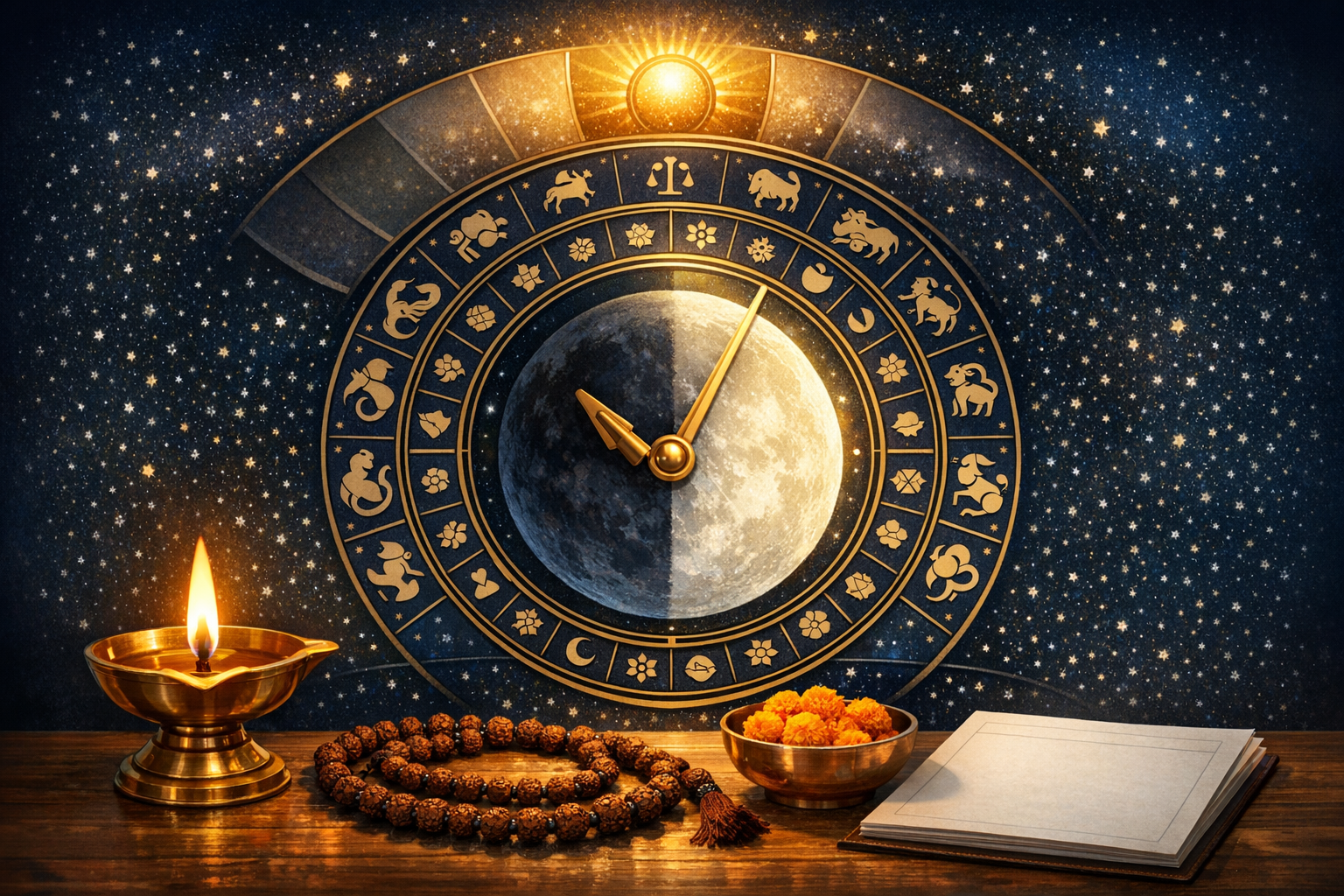
On Sunday, May 10, 2026, within the Daily Hindu Calendar (Panchang) framework, a tithi transition is observed: Krishna Paksha Ashtami (the eighth lunar day of the waning phase) prevails until 10:06 AM, after which Krishna Paksha Navami continues for the remainder of the day. This timing is typically referenced to Indian Standard Time and may vary slightly by location; most regional almanacs align with this span.
Krishna Paksha, the dark fortnight, traditionally invites introspection, restraint, and steady sādhana. Many households structure devotional routines to harmonize with the moon’s diminishing light, using the quieter ambience of the waning phase to deepen mantra-japa, scriptural reading, and reflective charity.
Krishna Paksha Ashtami carries particular importance in numerous lineages as Kala Ashtami, a day devoted to reverence for Bhairava. Common practices include simple fasting (upavāsa), lighting a deepa at dusk, reciting Bhairava-kavacha or names of Shiva, and extending kindnesssymbolically to a dog, Bhairava’s vahanathrough feeding or care. Observances are adapted by region and family tradition; the ethical core is ahimsa, remembrance, and self-discipline.
Because Ashtami concludes at 10:06 AM, those following vrata rules based on sunrise may complete Kala Ashtami practices in the early morning, then shift intention toward Navami after the tithi changes. When rituals are pegged to nighttime presence (nishita) of Ashtami, practitioners typically consult a local Panchang to confirm which civil date carries Ashtami at the required clock segment.
Krishna Paksha Navami, which follows, is often treated as a balanced day for continuing steady routines: serene recitation of Vishnu or Devi stotras, household seva, and measured study. Unlike Shukla Paksha Navami (the Navami of the bright fortnight), this Navami emphasizes inner composure over festivity, complementing the contemplative tone of the dark half of the month.
Shubh Muhurat on May 10 should be selected with reference to local sunrise and standard Panchang parameters. Abhijit Muhuratthe mid-day auspicious windowtypically straddles the exact middle of daylight and is useful for undertakings requiring clarity and resolve. Beyond Abhijit, astrologically sensitive planning also considers Tara-bala and Chandra-bala (strength from Nakshatra and the Moon’s sign) for personal alignment.
Conversely, Rahu Kalam, Yamaganda, and Gulika Kalam are commonly avoided for new initiatives. For Sundays, traditional schedule templates place Yamaganda around mid-day, Gulika in the mid-afternoon, and Rahu Kalam later in the afternoon toward sunset; each window is derived by dividing day length into eight equal parts from local sunrise. Actual clock times vary seasonally and by latitude, so a location-specific Panchang should be consulted before scheduling.
Technical overview of Panchang elements enhances accuracy. The five principal limbs are Tithi (lunar day), Vara (weekday), Nakshatra (lunar mansion), Yoga (sum-based luni-solar quality), and Karana (half-tithi segment). Together, they provide a robust temporal framework for ritual timing, meditation cycles, and daily decision-making.
Tithi is defined by the angular separation between the Moon and the Sun; each tithi spans 12° of this elongation. Ashtami occurs when the separation lies between 96° and 108°, and it ends the instant the separation reaches 108°, inaugurating Navami. Because the Moon’s motion is not uniform, tithi lengths vary, so end times like 10:06 AM are empirically computed from precise ephemerides.
Nakshatra divides the ecliptic into 27 sectors of 13°20′ each, anchored to the sidereal zodiac. The Moon’s instantaneous ecliptic longitude determines the operative Nakshatra, which, along with its lordship (nakshatra-adhipati), guides nuances such as mantra selection, tone of worship, and travel choices. Rashi indicates the Moon’s sidereal sign; most Indian almanacs adopt Lahiri ayanāṁśa for converting tropical longitudes to sidereal coordinates.
Yoga is computed from the sum of the Sun’s and Moon’s longitudes, mapped into 27 equal parts; it refines the day’s qualitative feel in many traditions. Karanahalf of a tithicycles through seven repeating Karanas and four fixed ones, providing finer-grained ritual markers, particularly for sankalpa phrasing and the start of specific karmakāṇḍa.
Regional calendar conventions also matter. In the Amanta system (followed widely in the Deccan), the lunar month concludes with Amavasya; in the Purnimanta system (common in North India), it concludes with Purnima. The same civil day can therefore be named differently (e.g., Vaishakha Krishna Ashtami versus a locally named equivalent), while the underlying tithi phenomenon remains identical.
Shared Dharmic resonance is evident across Hindu, Buddhist, Jain, and Sikh communities. The 8th tithi has long been a contemplative markerBuddhist Uposatha cycles often include the 8th day for intensified mindfulness; Jain practices around Ashtami emphasize tapas, svādhyāya, and dana; Sikh households frequently align significant tasks with sabad-centered reflection and seva rather than astrological determinism. Each path honors inner purification and compassion, affirming unity in diversity.
A practical, tithi-aware day plan for May 10 may flow as follows: conduct early-morning japa and light offerings while Ashtami prevails; complete any Kala Ashtami vrata commitments before 10:06 AM; after the tithi turns to Navami, favor tasks that require calm follow-through rather than fresh launches, reserving any new undertaking for Abhijit Muhurat or another confirmed auspicious window.
Those operating across time zones or at higher latitudes should always verify local ephemerides, since civil clock time for the tithi boundary can shift materially from Indian Standard Time. Reputable Panchang sources that specify location, daylight saving status, and ayanāṁśa will yield the most reliable results for muhurta and sankalpa.
In summary, May 10, 2026 unites precision and purpose: Krishna Paksha Ashtami, with its inward focus and Bhairava-oriented discipline, culminates at 10:06 AM; Krishna Paksha Navami supports steady, compassionate action thereafter. Read through the Panchang lensTithi, Nakshatra, Rashi, Yoga, and Karanathis day invites quiet strength, mindful service, and pan-Dharmic harmony.
Inspired by this post on Hindu Blog.