In Bengal’s sacred cultural landscape, the veneration of Hargauri Durga (Har-Gauri Durga) crystallizes a distinctive devotional mood: the Goddess as Uma, the tender daughter who returns to her maternal home in autumn, accompanied by Shiva. This homecoming narrative, cherished across centuries, complements rather than supersedes the more widely celebrated image of Mahishasura Mardini Durga. Where the latter emphasizes righteous valor and the subjugation of adharma, the Hargauri lens foregrounds familial warmth, purity, and the harmony of conjugal divinityHara (Shiva) and Gauri (Parvati)in a way that is both intimate and cosmically resonant.
Etymologically, “Hargauri” fuses two primordial names: Hara, an epithet of Shiva as the ascetic, and Gauri, “the radiant one,” a principal name of Parvati as the gentle and auspicious consort. In Bengal’s idiom of devotion, this pairing softens the vertical distance often felt in the Goddess’s fierce manifestations and draws attention to her horizontal nearnessas daughter (kumari), as mother (ambā), and as bride (gauri). Iconographically and ritually, the motif centers on sacred union and return, evoking the cyclical textures of season and society that Durga Puja encodes each year.
Bengal’s textual and ritual memory situates this tenderness within a broad Shakta framework. The Devi Mahatmya of the Markandeya Purana, foundational to Durga Puja, provides the theological basis of Shakti’s sovereignty across the cosmos. Medieval Bengali literatureespecially the Chandi-Mangal corpusdomesticates that sovereignty into household and village life, while popular narratives of akāl-bodhana (Rama’s autumnal invocation of the Goddess) affirm the autumn rites as scripturally consonant though seasonally exceptional. In this matrix, Hargauri Durga emerges as the devotional grammar of nearness, bringing Shiva into the familial tableau to underscore the fullness of auspicious union (saubhāgya).
Ritually, the Hargauri ethos unfolds across the arc of Devi Paksha, which begins on Mahalaya at the close of Pitru Paksha. From Mahashashthi through Vijayadashami, rites such as kalparambha, adhivāsa, and bodhana awaken the Goddess in her autumn seat. On Mahasaptami morning, the nava-patrikāa bound cluster of nine plants, colloquially the koḷā bouis bathed and installed as a living emblem of Durga’s vital power distributed through the natural world. In the Hargauri imagination, this organic invocation mirrors Uma’s return to the mother’s courtyard, carrying with her the fertility and well-being of fields, rivers, and hearths.
The emotional architecture of this tradition is carried by āgamani and bijoya songslyric genres that dramatize Menakā’s anticipation and Himāvan’s paternal joy as Uma arrives, and the tender ache as she leaves on Vijayadashami. These songs, embedded in Bengal’s seasonal rhythms, translate high theology into the lived grammar of family: the door swept clean, lamps lit at dusk, and a daughter’s laughter rediscovered in the ancestral home. Hargauri Durga thus renders metaphysics visible in domestic acts that devotees recognize as their own.
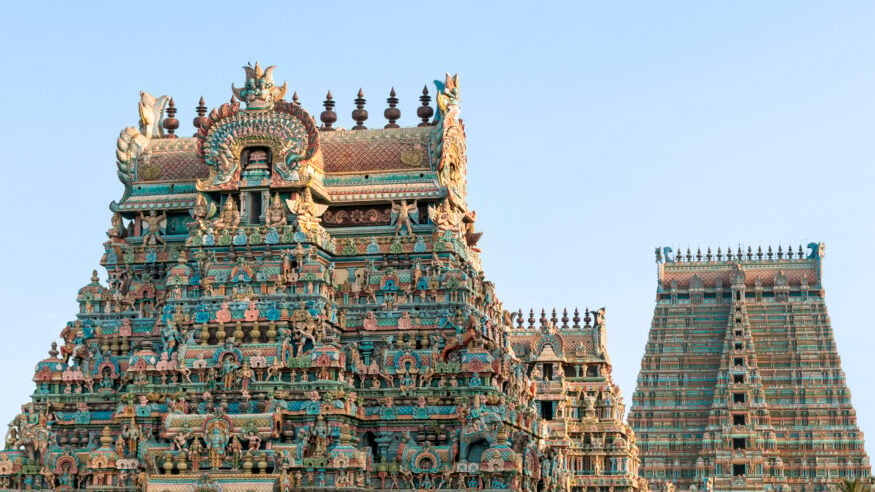
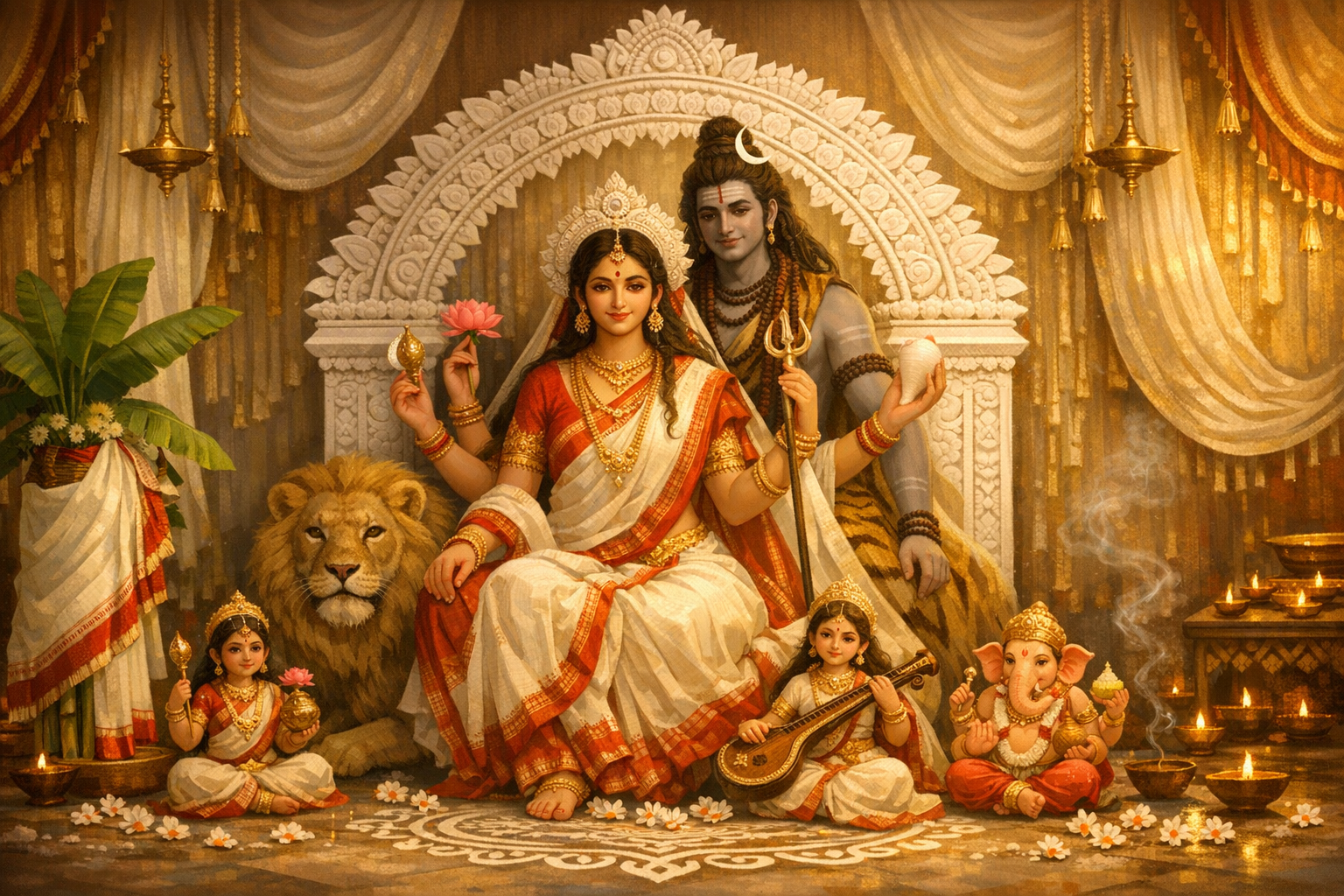
A hallmark of the Hargauri lens is the visible presence of Shiva near Durga’s pedestal. In many Bengali mandapas, Shiva appears as ascetic guardian (Bhairava) or as the calm, witnessing spouse. This placement invokes the Uma-Maheshvara (Hara-Gauri) archetype that Indian art history documents across regionsfrom early medieval reliefs in Bengal and Odisha to the Somaskanda compositions of Tamil temples. When Bengal’s autumnal Durga arrives “with Shiva,” the image encodes an ideal of conjugal dharma without subordinating the Goddess’s autonomy: Shakti’s sovereignty remains central, and Shiva’s presence affirms the inseparability of consciousness and power.
In sculptural and painted idioms, Hargauri Durga tends toward softer palettes and tranquil facial lines, counterpointing the kinetic energy of the Mahishasura Mardini tableau. She is flanked by her childrenLakshmi and Saraswati on either side, with Kartikeya and Ganesha completing the familial quaternitywhose symbolism (prosperity, learning, valor, auspicious beginnings) refracts the values a household aspires to embody. In certain pandals, the visual grammar draws explicitly on Somaskandathe familial triad with Shiva and Skandawhile retaining the Bengali canonical framing of the five deities (pañcha devatā) around the central Goddess.
Beyond aesthetics, Hargauri Durga articulates a synthesis of ascetic and householder ideals. Shiva’s quiet proximity figures the contemplative axis (nivṛtti), while Durga’s domestic nearness expresses the engaged, life-affirming axis (pravṛtti). Their union is not merely conjugal; it is metaphysicalthe conjoint of awareness (śiva-tattva) and energy (śakti-tattva). Bengal’s ritual calendar ties this synthesis to agricultural cycles: the retreat of monsoon, the ripening fields, and the communal renewal that Sharadiya Durga Puja orchestrates. The homecoming metaphor translates cosmology into seasonal praxis.
In the nine-fold Navadurga cycle, the name Mahāgauricognate with Gaurievokes clarity, purification, and a gentle luminosity. While Mahāgauri and Hargauri are distinct devotional cues, the shared resonance of “Gauri” reinforces the tender, auspicious valence that Bengal foregrounds in Uma’s autumnal return. For many households, this saumya mood provides a devotional counterbalance to the Goddess’s raudra force celebrated in Sandhi Puja at the Ashtami–Navami juncture.
Literature and music intensify the Hargauri sensibility. The devotional corpus associated with Ramprasad Sen and the broad stream of Śyāma-saṅgīt bring mother–child intimacy into potent relief. The āgamani–bijoya cycle has functioned as a social text for centuries, encoding memory, migration, and return. In many neighborhoods, these songs are the first signs of Devi Paksha; the community recognizes through melody that Uma is at the doorstep.
Ritual details further situate the Hargauri vision. Kumari Puja venerates the living embodiment of the Goddess in a young girl, mapping the theme of daughterly sanctity onto communal practice. Sindur Khela on Vijayadashamiwhere married women anoint Durga and one another with vermilionsymbolically preserves the auspicious thread of marital well-being (saubhāgya) even as the Goddess prepares to depart. Immersion (visarjan) then ritualizes leave-taking, and bijoya greetings bind social fabric through reconciliation and renewal.
The pan-Indic reach of the Hara–Gauri archetype illuminates Bengal’s place in a larger dharmic tapestry. In Maharashtra, Gauri-Ganesh observances insert a Gauri focus into the Ganeshotsav rhythm; in Karnataka, Gauri Habba precedes Ganesh Chaturthi; in Odisha, the Uma-Maheshvara pairing populates temple reliefs; and Tamil visual culture elaborates the Somaskanda motif with theological sophistication. Bengal’s Hargauri Durga belongs to this shared civilizational register while preserving its own autumnal poetics of homecoming.
The maternal persona that Hargauri centers also resonates across other dharmic traditions. In Buddhist art and narrative, protective mother figuressuch as Hārītī and the compassionate savioress Tārāreiterate the ethos of nurture and refuge. Jain traditions venerate Ambikā and Padmāvatī as guardian deities associated with protection and ethical flourishing. Sikh scriptural and literary memory contains robust celebrations of righteous power (vīr rasa), and the martial literature associated with Chandi narratives frames śakti as a force of justice. Read together, these currents affirm a common civilizational intuition: sacred femininity unites care and courage, tenderness and strength.
Shiva’s inclusion in the Bengali autumnal tableau answers a profound theological and social concern: how to reconcile interiority with relational duty, renunciation with responsibility. The Hargauri frame suggests that these are co-implicated rather than opposed. The ascetic’s stillness is not flight from the world but the ground from which ethical action and familial solidarity arise; the householder’s care is not worldliness but a practice of dharma that steadies society. In ritual space, this synthesis appears effortless: Shiva stands, serene; Gauri smiles, present; the household breathes as cosmos.
From a cultural-historical perspective, Hargauri Durga has also functioned as a medium of social cohesion. Community barowari pujas, household observances, and neighborhood āgamani processions invite cross-generational participation. The idiom of “daughter’s homecoming” bridges social strata: it offers a shared language in which tenderness is not private sentiment but public virtue. In diaspora contexts, this imagery has proven especially resilient, recreating familiarity and belonging far from ancestral neighborhoods along the Ganga–Brahmaputra.
Environmentally, the tradition encodes a sacral ecology. The nava-patrikā underscores plant life as a locus of divinity; river baths and organic materials recall older rhythms of reverence for water and earth. As communities renew immersion practices to protect aquatic ecosystems, the Hargauri emphasis on purity and care provides an inward grammar for outward sustainability.
Taken together, these strands clarify why “Durga arrives along with Shiva” carries such affective and philosophical force in Bengal. It is not a mere narrative flourish; it is a doctrinal and cultural statement that divinity is relational and complete. The warrior Goddess remains central in scriptural recitation and Sandhi Puja, yet the Hargauri focusher tender presence by the hearth, Shiva’s calm witness by her sidereveals the other half of sacred power: protection without domination, strength suffused with compassion, and victory that returns home to bless.
In conclusion, Hargauri Durga in Bengal offers a comprehensive hermeneutic for Sharadiya worship: a unifying lens through which ritual, iconography, music, and social ethics converge. By holding together Uma’s daughterly nearness and the cosmic union with Shiva, it articulates a dharmic vision in which tenderness is itself a mode of strength. This synthesis resonates across Hindu, Buddhist, Jain, and Sikh sensibilities, reinforcing a civilizational commitment to harmony, familial virtue, and the sanctity of compassionate power.
Inspired by this post on Hindu Blog.