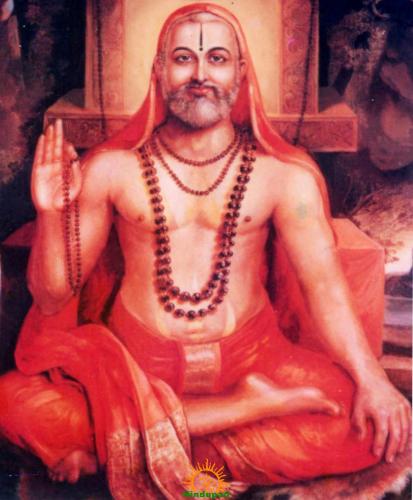
On April 12, 2026, in Lithuania, HH Niranjana Swami presented a rigorous exposition of Brihad Bhagavatamrita (Part One, Chapter Two, verses 37–49), clarifying how the tradition’s descriptions of cosmic luminariesBrahma, Indra, and othersserve a precise theological function. Rather than ending with these eminent figures, the narrative channels admiration toward the simple, spontaneous, and consummate devotion embodied by the residents of Gokula. The governing metaphor is crystalline: just as every river inevitably merges with the ocean, all strands of spiritual excellence converge in the devotion of Vraja.
Brihad Bhagavatamrita, attributed to Srila Sanatana Goswami, is a foundational text of Gaudiya Vaishnavism that systematizes the gradations of bhakti and the experiential horizons of the devotee. In the Purva-khanda (Part One), the text follows a discernible arc from reverence for cosmic administrators and sages to progressively more intimate tiers of loving service to Sri Krishna. Verses 1.2.37–49 present the pivot-point of this ascent: they praise various exalted personalities while simultaneously indicating that their glories point beyond themselves to the pinnacle of devotion found in Gokula and, in its eternal counterpart, Goloka.
These verses deploy a didactic strategy common to classical Sanskrit theology. Praise of illustrious figures functions not as a terminus but as a hermeneutic ladder. Each rung affirms the authenticity and power of devotion at that stage while gently orienting the reader toward a higher synthesis. The effect is cumulative: admiration is repeatedly redirected until it rests in the spontaneous, intimate love of the Vrajavasis, whose devotion is unselfconscious and free from the awe-laden distance that marks other realms.
The ocean-river metaphor offers both literary elegance and theological precision. “Rivers” signify differentiated excellencesknowledge, power, renunciation, devotion under majestic awareness (aisvarya-bhakti), and the heroic fidelity of devotees such as Hanuman and the Pandavas. The “ocean” represents the sweetness-centered devotion (madhurya) of Gokula, where relational immediacy eclipses formal grandeur. Technically, this does not diminish earlier excellences; rather, it reveals their telos, the consummation toward which all authentic devotion flows.
Indra’s role illustrates the pedagogy. As protector of the cosmic order, Indra commands reverence, yet Srimad-Bhagavatam’s Govardhana-lila (10.25) shows him humbled by Krishna’s effortless sheltering of Vraja. That episode, echoed in the evaluative framework of Brihad Bhagavatamrita, reframes power as subordinate to love. Listeners often recognize in this a practical lesson: professional success and social authority retain value, but their highest function is to be reenchanted by humility, gratitude, and service.
Brahma’s place is similarly clarifying. Brahma-vimohana (Srimad-Bhagavatam 10.13–14) depicts the architect of the universe realizing the limits of even the loftiest intellect before the childlike sweetness of Krishna’s exchanges with the cowherd boys. Within the hierarchy of devotion mapped by Brihad Bhagavatamrita, this vision does not discredit knowledge; it perfects it by aligning scholarship with love, replacing possessive certainty with wonder and affectionate surrender.
A crucial distinction in the tradition illuminates the text’s conclusions: Gokula refers to Krishna’s terrestrial Vraja-lila manifest within historical time, whereas Goloka denotes its eternal, transcendental locus beyond the Vaikuntha realms. Brihad Bhagavatamrita’s verses implicitly bind these togetherthe terrestrial revelation mirrors the transcendental prototype. In both, the essence is identical: love unmediated by regal distance, where Krishna is approached as friend, child, beloved, and protector in intimate immediacy.
From a technical standpoint, the hierarchy marks a movement from aisvarya (majestic awareness) toward madhurya (sweet intimacy). In aisvarya-dominant devotion, consciousness of God’s omnipotence shapes relationship; in madhurya, that omnipotence remains but withdraws from prominence to allow the rasa of intimacy to flourish. Srila Rupa Goswami’s conceptual vocabulary (e.g., Bhakti-rasamrita-sindhu) provides a complementary matrix for understanding how Brihad Bhagavatamrita places the Vraja-bhava at the apex without invalidating other modes of worship.
This apparent hierarchy can be misunderstood as sectarian triumphalism; Brihad Bhagavatamrita explicitly resists that reading. Each exemplary figure is honored as perfect within their own rasa and function. The “ascent” describes increasing intimacy, not comparative spiritual worth. The text’s rhetorical flow, as emphasized by HH Niranjana Swami, safeguards universal respect while guiding aspirants who seek the particular sweetness of Vraja-prema.
Such framing carries unifying implications across the broader family of dharmic traditions. The humility of Indra, the wonder of Brahma, and the affectionate reciprocity of Vraja resonate with Buddhist compassion (karuna) and loving-kindness (maitri), with Jain ideals of ahimsa and aparigraha, and with Sikh emphases on seva and prem-bhakti. Read this way, Brihad Bhagavatamrita models a pedagogy of reverence that honors diverse realizations while affirming a shared aspiration toward selfless love and service.
The text also speaks to contemporary practice. Core limbs of bhaktisravana (hearing), kirtana (chanting), and smarana (remembrance)operate not as sectarian markers but as disciplines that refine attention and intention. Many practitioners report that consistent kirtan tempers pride (as in the Indra paradigm), while reflective study harmonizes intellect with devotion (as in the Brahma paradigm). The outcome is ethical clarity and emotional resilience, indispensable for plural, modern societies.
Within Gaudiya Vaishnavism, this synthesis culminates in the Vrajavasis’ spontaneous devotion (raganuga-bhakti), wherein love is guided by the exemplary moods of Krishna’s associates. Yet the text’s didactic structure encourages humility: those content in other theistic forms or practices are neither belittled nor displaced. In this way, Brihad Bhagavatamrita exemplifies Sanatana Dharma’s commitment to unity in spiritual diversity.
Scripturally, Brihad Bhagavatamrita functions in productive dialogue with Srimad-Bhagavatam and the Bhagavad-Gita. Where the Gita universalizes devotion“bhaktya mam abhijanati”Brihad Bhagavatamrita articulates how that devotion variably manifests across personalities, realms, and rasas. The result is a layered cartography of devotion: comprehensive enough for scholars of Vedic literature, yet pastorally precise for communities such as ISKCON seeking applied, lived bhakti.
Sanatana Goswami’s method is pedagogically elegant: it affirms at every stage before redirecting. This prevents binary thinking and cultivates gratitude. By first honoring the devas and great devotees, the text subdues the impulse to dismiss other paths. Then, having built broad respect, it introduces the sweetness of Gokula as the integrative ocean into which all noble currents return.
For interreligious and intrareligious dialogue, this approach offers a constructive template. Rather than debating which practice is “supreme” in abstract terms, Brihad Bhagavatamrita encourages attending to what each devotion accomplishes ethically and emotionallyits capacity to generate compassion, truthfulness, self-restraint, humility, and care for all beings. In this evaluative light, the convergence in Gokula symbolizes the fulfillment of those virtues in intimate love.
In global contextssuch as the Lithuanian gathering where these verses were discussedthis message resonates as a lived ethic. Migrant and diasporic communities frequently navigate multiple identities and allegiances. The text’s insistence on honoring every authentic offering while moving toward deeper intimacy with the Divine becomes an instrument for social cohesion, not fragmentation, within the larger umbrella of Sanatana Dharma.
Ultimately, verses 1.2.37–49 of Brihad Bhagavatamrita do not merely rank devotions; they reveal a movement from the head to the heart without discarding the head. Knowledge is crowned by love; power is humbled by service; ritual is enlivened by relationship. The residents of Gokula personify this synthesis, and Goloka enshrines it eternally. The river meets the ocean, and nothing true in the river is lostonly fulfilled.
As HH Niranjana Swami underscored, the hierarchy of excellence is thus a hierarchy of intimacy. It educates, heals pride, deepens gratitude, and leads to seva-centered living. Read alongside Srimad-Bhagavatam and the Bhagavad-Gita, and in conversation with Buddhist, Jain, and Sikh wisdom on compassion and service, Brihad Bhagavatamrita 1.2.37–49 offers a comprehensive, unifying vision: many currents, one ocean; many excellences, one consummation in love.
Inspired by this post on Dandavats.