
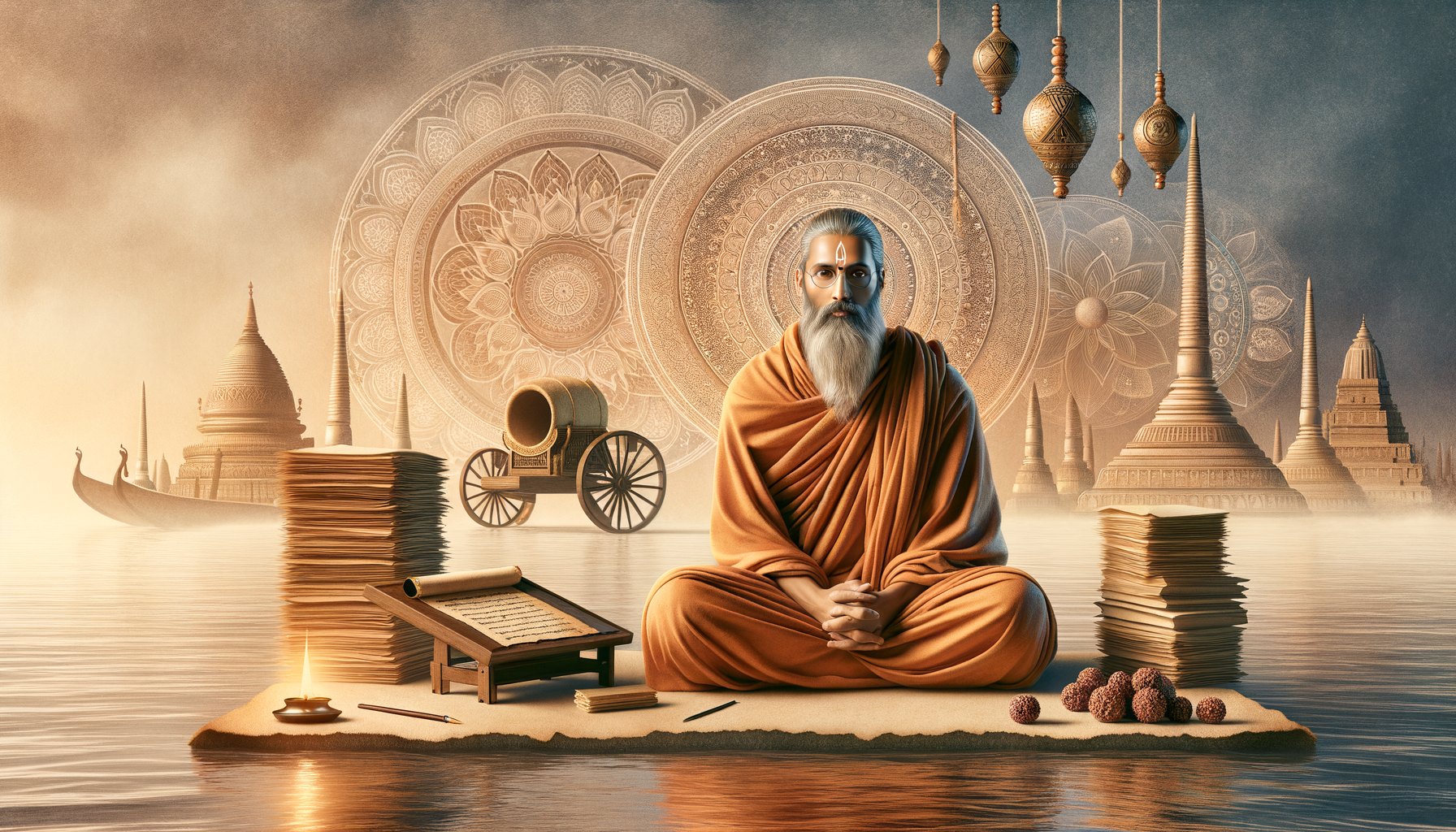
Veda Vyasa, revered as Krishna Dvaipayana Vyasa, stands as the supreme literary architect of Hindu Civilization, shaping its spiritual imagination and intellectual traditions across millennia. Tradition attributes to him the organization of the Vedas, the composition or redaction of the Mahabharata, and the dissemination of Vedic wisdom through Sanskrit narratives that continue to inform ethical life, ritual practice, and philosophical inquiry.
Known honorifically as Bhagavan Veda Vyasa and Maharshi Veda Vyasa, this sage is remembered for distilling vast oral traditions into an accessible corpus. By systematizing Vedic literature and articulating frameworks of dharma, he helped consolidate the foundations upon which subsequent schools of Indian philosophy would build. His influence spans texts, teachers, and temples, making him central to the living heritage of Sages of India.
The Mahabharatatraditionally ascribed to Vyasaserves as a monumental canvas of human duty, moral ambiguity, and divine counsel. Within it, the Bhagavad Gita presents a coherent philosophy of action, devotion, and knowledge that has guided seekers in diverse contexts. These Sanskrit works continue to animate conversations on ethics and public life, offering a shared vocabulary of dharma recognized across dharmic traditions.
Beyond epic narrative, the Puranas attributed to Vyasa preserve cultural memory, sacred geography, and devotional practices. They have informed temple traditions, festival calendars, and the pedagogy of oral storytelling. Through these texts, communities encounter the continuum between mythic time and historical experience, strengthening bonds of belonging across the Indian subcontinent.
Vyasa’s literary architecture advances a plural understanding of truth: one that invites rigorous inquiry while honoring multiple paths to realization. This ethos resonates with the unity-in-diversity at the heart of Hinduism, Buddhism, Jainism, and Sikhismtraditions that, though distinct, converge on values such as compassion, truthfulness, restraint, and service. The integrative vision attributed to Veda Vyasa thus supports interrelated spiritual journeys rather than a single prescriptive path.
In contemporary life, Vyasa’s ideas remain practical and illuminating. Readers encounter the Mahabharata’s dilemmas in leadership, family responsibility, and civic duty; the Bhagavad Gita’s counsel offers equanimity and purpose amidst rapid social change. Whether studied in classrooms, chanted in homes, or contemplated in meditation halls, these texts provide steady guidance for ethical decision-making and inner stability.
Academic study recognizes textual layering and historical redaction in these traditions, noting the interplay of oral transmission, regional recensions, and philosophical elaboration over time. Yet, through these evolving forms, the conceptual corea disciplined pursuit of dharma and liberationpersists with clarity. The enduring vitality of Vedic literature is, in no small measure, a testament to Vyasa’s synthesizing genius.
As the Supreme Literary Architect, Veda Vyasa unites memory, meaning, and method: memory through epic and Purana, meaning through the Bhagavad Gita’s vision of dharma, and method through traditions of commentary and debate. His legacy continues to invite readers into a humane, integrative, and dialogical understanding of the sacredone that strengthens unity among dharmic paths while deepening fidelity to each tradition’s wisdom.
Inspired by this post on Hindu Blog.










