Smriti Chandrika (Smṛticandrikā) stands among the most influential Dharmashastra digests (nibandhas) in South Asia, widely consulted across centuries for its systematic exposition of Hindu law, ritual, and social norms. Attributed to Devannabhattaalso referenced in sources as Devanna-Bhattopadhyaya, Devanna, Devananda, and Devagana, the son of Keshava Bhattopadhyayathe work is generally dated to the 12th century CE and associated with southern India. Its enduring significance lies in the clarity of organization, documentary rigor, and the deliberate restraint with which it curates earlier authorities.
While often grouped with early juridical texts of Hindu tradition, Smriti Chandrika is not a dharmasutra in the technical sense; it is a later compendium within the broader Dharmashastra corpus. As a nibandha, it consolidates, compares, and reconciles prescriptions from earlier smṛtis and allied literature, presenting determinations with minimal authorial intrusion. This careful method makes it a crucial bridge between classical sources and lived jurisprudence in medieval and early modern South India.
The compilation’s method is characteristically Dharmashastric: it cites foundational smṛtis (such as Manusmriti, Yājñavalkya-smṛti, Nārada-smṛti, and Parāśara-smṛti), engages with commentarial traditions (notably the Mitākṣarā school), and weighs ritual manuals (Gṛhya-sūtras) and customary law (sadācāra, deśācāra). Hermeneutical tools drawn from Mīmāṁsā and Nyāya undergird its approach, enabling the text to resolve apparent contradictions through context, hierarchy of authorities, and rules of interpretation.
Smriti Chandrika is renowned for compiling the opinions of multiple authorities without polemics. Where disputes appear among earlier texts, it presents the spectrum of views, carefully indicating prevailing practice, regional custom, or a reasoned reconciliation. This temperamentscholarly yet non-sectarianhas been consistently noted by legal historians (for example, in P. V. Kane’s assessments of Dharmashastra literature) as a major reason for the work’s acceptance across schools of practice.
The digest’s coverage is extensive. In Achāra (conduct), it treats daily duties (nitya and naimittika karmas), purity and impurity rules, varṇa-āśrama-dharma, food practices, and auspicious times. In Saṃskāra (life-cycle rites), it discusses the canonical series from garbhādhāna to antyeṣṭi, mapping textual prescriptions to actual observance. In Śrāddha and dāna, it delineates offerings for ancestors and normative charity. In Prāyaścitta (expiations), it categorizes penances with attention to intention, circumstance, and proportionalityhallmarks of Dharmashastra’s graded ethic.
A substantial portion addresses Vyavahāra (procedure and substantive law). Here, Smriti Chandrika follows the classical schema of legal suits and defenses, modes of proof (witness testimony, documents, possession, and, in older strata, ordeals), standards for judicial conduct, and remedies. The treatment is recognizably Mitākṣarā-oriented yet attentive to regional practice, preserving the coherence of the legal field while acknowledging the authority of custom as a source of dharma.
On family and property law, the digest offers detailed guidance on marriage (vivāha), partition and inheritance (dāya-vibhāga), women’s property (strīdhanā), adoption (dattaka), guardianship, and obligations among coparceners. Its pages are frequently consulted for the taxonomy of marriage forms, the validity conditions of ceremonies and consent, and the intricate shares accruing to sons, daughters (under specified conditions), and other heirs within Mitākṣarā doctrine. The sections on strīdhanā are especially notable for their granularity in classifying acquisitions and their disposition.
Smriti Chandrika’s influence radiated most strongly in the Drāviḍa school of Hindu law. In the Madras Presidency during the colonial period, courts commonly treated italongside allied digests and customsas an authoritative statement of local Hindu personal law, particularly in matters of partition, inheritance, adoption, and marriage. Its balanced collation of sources, coupled with attention to regional practice, made it a preferred reference in judicial reasoning and legal scholarship.
The text’s jurisprudential posture is marked by three features. First, it affirms the primacy of śruti-smṛti foundations while recognizing custom’s normative force when not in conflict with higher authorities. Second, it employs reasoned reconciliation rather than dogmatic preference, a method that strengthens internal coherence. Third, it exhibits a documentary culturemeticulous citation and careful categorizationthat anticipates later legal digest traditions across the subcontinent.
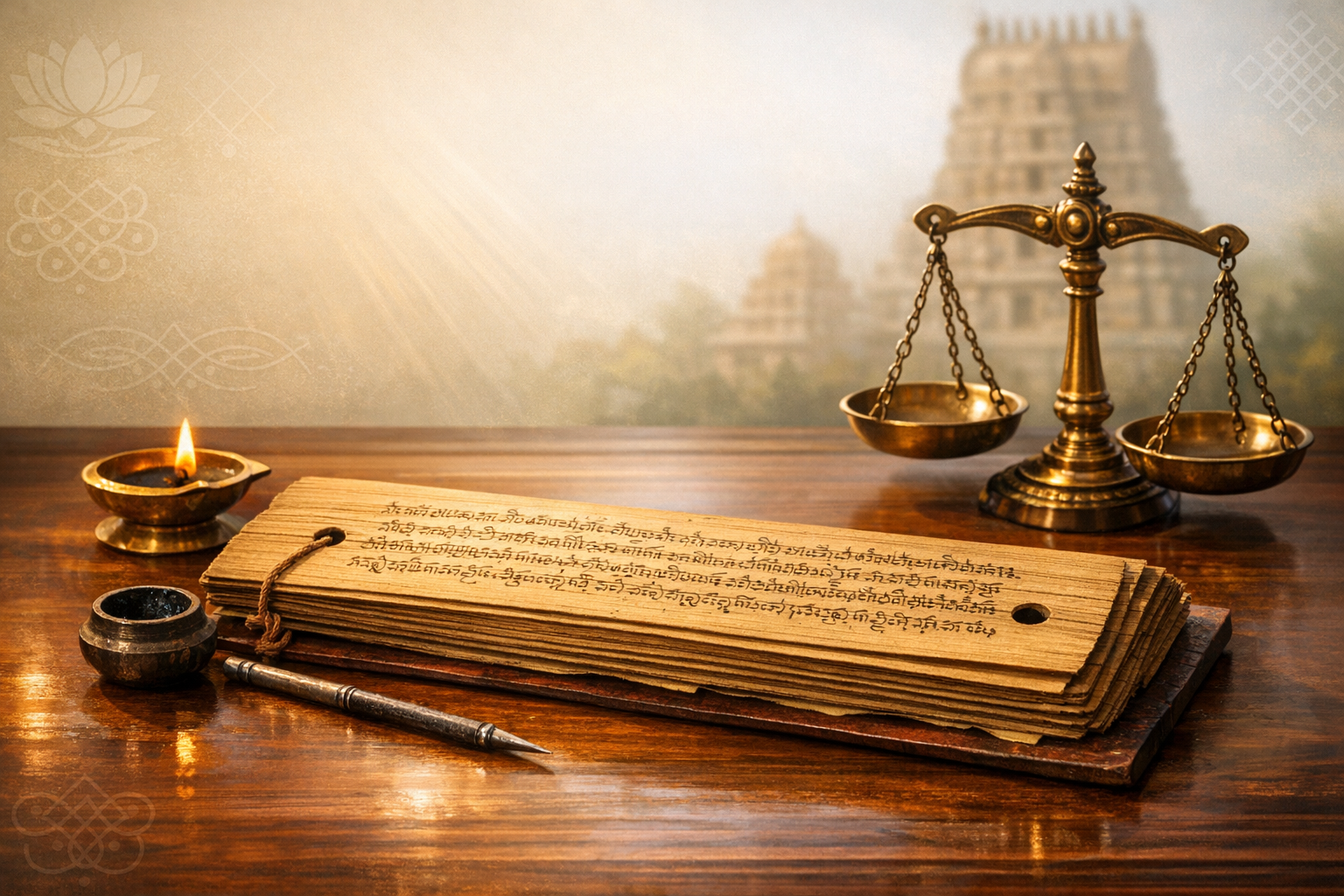
Manuscript and textual history indicate a wide circulation in South India, with copies preserved in Devanagari, Grantha, and Telugu-Kannada scripts. Nineteenth- and early twentieth-century print editions broadened its reach, enabling jurists, paṇḍitas, and scholars to cross-reference its determinations with other major digests such as the Viramitrodaya, Nirṇaya-sindhu, and Sarasvatī-vilāsa. This intertextual visibility reinforced Smriti Chandrika as a stable pillar within Dharmashastra studies.
Thematically, its handling of vyavahāra titlessuch as debts and pledges, boundary disputes, partnership and agency, property transfers, and injuryshows a pragmatic concern with social order. Although some older evidentiary forms (like ordeals) reflect their era, Smriti Chandrika’s persistent emphasis on truthfulness of testimony, documentary probity, and proportional remedies illustrates a maturing legal rationality oriented toward fairness and predictability.
In the domain of kinship and succession, the digest’s exposition of coparcenary, unobstructed and obstructed heritage, survivorship, and partition rules entered the common vocabulary of South Indian jurisprudence. Its systematic parsing of lineal and collateral claims, along with the priority rules among heirs, supplied courts and scholars with a dependable matrix for adjudication and commentary under the Mitākṣarā framework.
Equally noteworthy is the work’s attention to ritual propriety without losing ethical perspective. In Achāra and Saṃskāra, ritual detail is treated not as an end in itself but as a disciplined means to uphold social harmony, personal responsibility, and intergenerational continuityvalues resonant across dharmic traditions. This ethic of duty and care aligns with the broader civilizational ideal of dharma as both principle and practice.
Read comparatively, Smriti Chandrika’s plural and layered method mirrors a shared dharmic sensibility found in Buddhist Vinaya discussions on context-sensitive discipline, Jain Āgama and nibandha traditions that integrate scripture with conduct codes, and Sikh Rahit literature emphasizing truthfulness, justice, and communal responsibility. By honoring textual authority, reasoned deliberation, and living custom together, the digest models an inclusive legal-intellectual culture that strengthens unity among Hindu, Buddhist, Jain, and Sikh traditions.
From an intellectual-history perspective, Smriti Chandrika clarifies how Hindu law evolved through careful stewardship of earlier sources rather than abrupt innovation. Its influence on the Drāviḍa school, and later on colonial-era adjudication in the Madras Presidency, demonstrates how a well-organized digest can anchor legal practice across changing institutional settings. Even today, its discussions on inheritance, women’s property, and procedural norms help clarify the historical foundations of contemporary debates about personal law and reform.
Devannabhatta’s editorial restraint remains a defining strength. By foregrounding primary authorities and customs and minimizing personal assertion, Smriti Chandrika cultivates trust across communities of interpretation. That sensibilityscholarly, dialogical, and ethically groundedcontinues to serve as a model for inter-traditional discourse, encouraging respectful coexistence and shared problem-solving within the broader dharmic family.
In sum, Smriti Chandrika is a definitive 12th‑century Dharmashastra digest: methodical in its citations, comprehensive in scope, and formative for the Drāviḍa school of Hindu law. Its synthesis of scripture, reason, and custom offers a durable template for legal understanding and a living reminder that unity within diversity is a core strength of the dharmic traditions.
Inspired by this post on Hindu Blog.