Does Sita’s return to the Earth at the close of the Valmiki Ramayana imply an act of suicide? A careful, text-grounded, and tradition-aware reading indicates otherwise. In classical Hindu hermeneutics, this episode is framed not as self-harm but as a theologically charged, poetic, and symbolic homecoming: the daughter of the furrow (Sita) returns to the cosmic mother (Bhoomi Devi). Understanding the Ramayana as epic poetry (kavya)with layered meanings and aesthetic devicesclarifies why treating this scene as literal self-destruction misreads both the genre and the dharmic worldview it encodes.
Both the Ramayana and the Mahabharata are composed primarily in verse and belong to the category of itihasanarratives that preserve history, ethics, and spiritual insight through an aesthetic, mnemonic medium. Across ancient India, verse was an established vehicle for preserving knowledge, not only in sacred narratives but also in technical disciplines. Ayurveda is a notable example: core texts such as the Ashtangahridaya are metrical; many formulations, nighantus (lexicons), and procedural verses are set to familiar meters (often anuṣṭubh) to aid memorization and cross-generational transmission. The use of verse does not diminish factuality; rather, it encodes layered meaningsethical, spiritual, and culturalwithin a compact and memorable form.
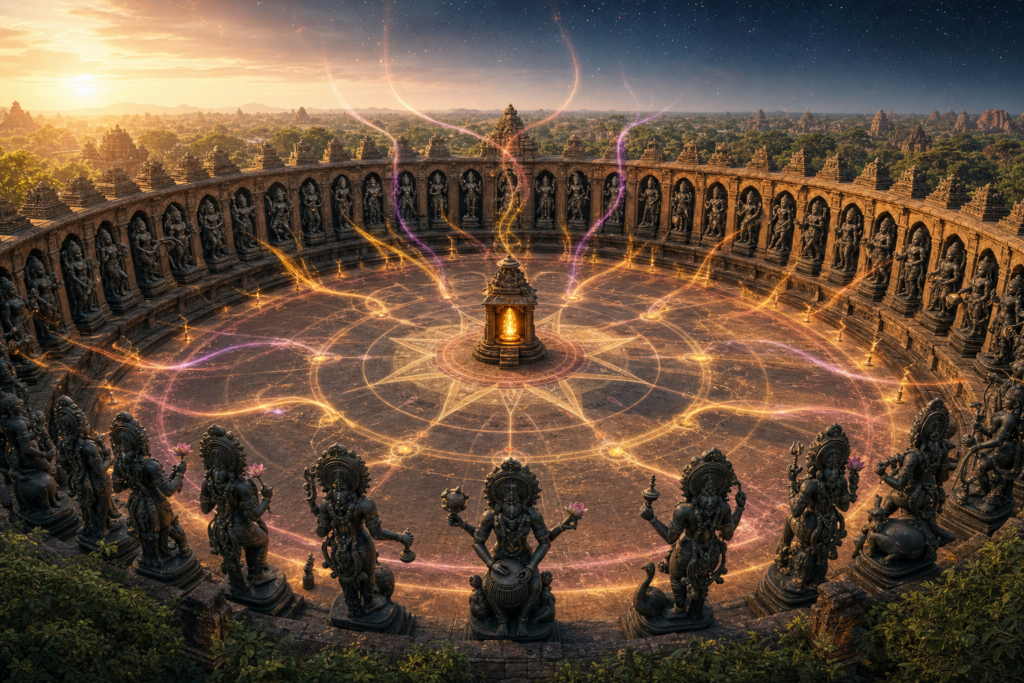
The textual locus of Sita’s departure lies in the Uttara Kanda of the Valmiki Ramayana. Invoking the Earth as witness to her lifelong fidelity and purity, Sita prays that if she has remained unsullied in thought and deed, Bhoomi Devi should receive her. The narrative describes the Earth parting, a golden throne manifesting, and the Earth goddess herself embracing Sita. The scene culminates in Sita’s disappearance from the human plane (a classic antardhana motif). Crucially, this is not narrated as self-destruction; it is depicted as a divinely sanctioned transitioninvocation, testimony, and receptionconsistent with the Ramayana’s recurring pattern of the gods and cosmic principles participating in human destinies.
Philologically, the name “Sita” derives from the Sanskrit root “sī,” relating to the furrow made by a plough. King Janaka discovers the infant Sita while ploughing; she is literally child of the field, daughter of the Earth. The denouement thus completes a narrative ring: born of the Earth, tested by fire, vindicated by truth, and ultimately reunited with Bhoomi Devi. This chiastic return is not merely poetic flourish; it is a structural signature that aligns character, origin, and destiny with cosmic order (ṛta). In terms of narrative architecture, it is pratisamharaa return that closes thematic loops established at the very beginning of the epic.
Classical Indian exegesis often reads sacred narratives through three interwoven lenses: adhibhautika (historical and human), adhidaivika (cosmic and divine), and adhyatmika (inner and spiritual). Read adhibhautikally, Sita’s act expresses moral agency: a refusal to prolong a public life in which her personhood has been unjustly scrutinized. Read adhidaivikally, it is the Goddessvariously identified in Vaishnava theology as Sri or equated with Bhoomi Devireuniting with her own cosmic domain. Read adhyatmikally, it is a serene renunciation, a movement from worldly turmoil to spiritual repose, a passage that resonates with the epic’s concern for dharma, dignity, and liberation (moksha). None of these lenses require, imply, or support the notion of suicide.
From the standpoint of Dharmaśāstra and allied ethical traditions, ātma-hatyā (self-killing) is unequivocally prohibited. The textual markers in the Ramayana do not indicate voluntary self-destruction; instead, they present an invocation anchored in truth-claim (satya-pratijñā) and a divine reception (daivī-pratigraha). Equally, Sita’s transition is not a form of prayopaveśa (the solemn fast unto death permitted under very specific, renunciate conditions), nor does it resemble any impulsive act of despair. The ramification is clear: the epic’s own categories, vocabulary, and dramatic cues locate Sita’s departure in a sacral and symbolic register, not in a clinical or legal one.
Motifs of sacred departure recur across the dharmic spectrum and are not reducible to modern categories of self-harm. In the Mahabharata, the Pandavas undertake mahāprasthānathe great departureculminating in Yudhishthira’s svargārohaṇa (ascent to heaven). In Vaishnava narratives, divine figures withdraw from the visible plane through antardhana. In Buddhist tradition, the Buddha’s parinirvāṇa marks a consummate spiritual passage, not self-destruction. In Jain dharma, the carefully regulated practice of sallekhana is distinguished from suicide by intention, context, discipline, and non-attachment. These examples differ in metaphysics and ritual grammar, yet they share a civilizational respect for conscious, sacred transitions. Sita’s return to the Earth aligns with this broader Indic grammar of departure, emphasizing dignity, truth, and transcendence rather than negation of life.
The feminine divine is central to the scene’s meaning. In Vaishnava theology, the Goddess is manifoldSri Devi (prosperity), Bhu Devi (the Earth), and Nila Deviarticulating complementary aspects of divine femininity. Sita, frequently identified with Sri, is simultaneously the child of Bhu; her final transition signifies a sovereignty that no courtly pronouncement can either grant or revoke. Poised between history and myth, she enacts a reclamation of dignity through reunion with the cosmic mother, thereby affirming the epic’s ethic that dharma and grace operate beyond royal sanction and social spectacle.
Poetically, the episode employs rasa and alaṅkāra to evoke layered response. The pathos of karuṇa rasa, the marvel of adbhuta, and ultimately the quietude of śānta converge as Earth opens and divinity intervenes. Hyperbolic suggestion (utprekṣā) intensifies the scene’s moral gravitas without insisting on prosaic literalism. Epic poetry in Sanskrit does not merely report events; it amplifies ethical and spiritual stakes through aesthetic form. To flatten such scenes into modern prose categories alone is to miss the kavya’s intended cognitive and emotional architecture.
Later retellings underscore the same symbolic logic. Tulsidas’s Ramcharitmanas renders Sita’s departure as a divine and dignified return, not a violent end. Kamban’s Iramavataram in Tamil poetry likewise frames the moment within bhakti aesthetics and divine agency. Commentarial traditionssuch as Govindaraja’sread the scene through the prisms of dharma, divine honor, and poetic necessity. Across regions and languages, the interpretive consensus treats Sita’s transition as theological closure rather than self-harm. That stability across centuries of reception matters for historical understanding and for responsible, cross-cultural reading today.
Methodologically, importing contemporary medico-legal definitions of “suicide” into an ancient epic moment risks anachronism. The Ramayana’s categories are dharmic and aesthetic, not clinical. Where the modern lens benefits is in attending to human dignity and psychological plausibility; yet the interpretive baseline must still be the epic’s indigenous hermeneutics. Once that baseline is honored, the scene coheres: Sita’s truth-claim is publicly vindicated not by human institutions but by the cosmic mother, and her departure reconfigures grief into grace, exile into return, and scandal into sacral testimony.
This interpretive approach also promotes unity across dharmic traditions. Hinduism, Buddhism, Jainism, and Sikhism honor, in distinct ways, the Earth and the ethical aspiration to truth, compassion, and freedom from attachment. The Ramayana’s Earth-as-witness motif resonates with broader Indic intuitions about nature as sacred partner in moral life. Reading Sita’s return through this shared civilizational lens fosters inter-traditional respect: it affirms that sacred narratives, while diverse, converge on the dignity of the person, the sanctity of truth, and the presence of transcendence in worldly trials.
In sum, Sita’s return to the Earth is a poetic-theological consummation, not suicide. The scene harmonizes philology (Sita as “furrow”), theology (Bhoomi Devi’s embrace), ethics (dharma beyond spectacle), aesthetics (rasa and alaṅkāra), and civilizational motifs of sacred departure. It participates in the broader Indic habit of encoding profound spiritual insights within epic poetry, just as Ayurveda often encodes technical knowledge in verse for durability and depth. When read on its own terms, the Ramayana offers not a narrative of despair but an enduring meditation on truth, honor, and liberation that continues to inspire across Hindu, Buddhist, Jain, and Sikh communities.
Inspired by this post on Hindu Pad.