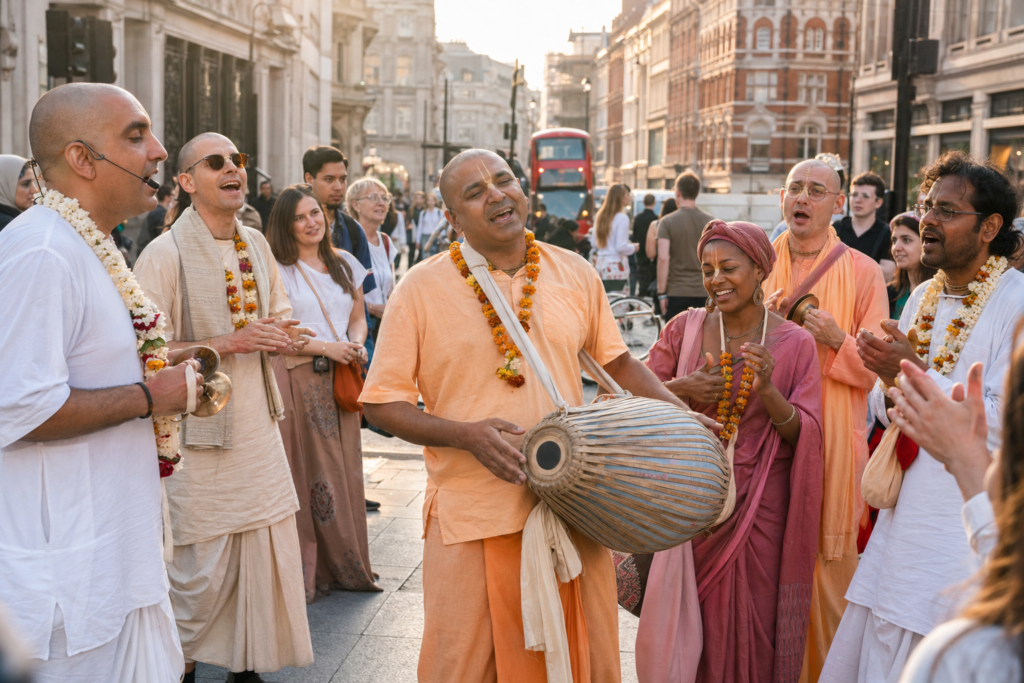
Every civilization treasures its ancient wisdom, and for the Indo-Aryan world, the Vedas stand as the foundational corpus of spiritual insight, ritual science, and philosophical reflection. Composed in Sanskrit and revealed to seers (rishis), this knowledge was transmitted word by word, note by note, through a rigorous oral tradition. Because the Vedas were passed down orally, there was constant pressure to preserve their pristine form. To meet this challenge, the tradition diversified into organized lineages and textual recensions known as shakhasstructured schools that safeguarded sound, meaning, and method with extraordinary precision.
A shakha is best understood as a living curriculum: a carefully maintained recension of a Vedic text set, taught within a disciplined lineage (guru–shishya parampara), and supported by auxiliary works that regulate pronunciation, ritual, and interpretation. Each shakha guarded its own Samhita (collection of mantras), Brahmana (ritual exegesis), Aranyaka (forest treatises), and Upanishads (philosophical teachings), often accompanied by Shrauta Sutras and Grihya Sutras that codified public and domestic rites. The result was a federated systemdiverse yet interoperabledesigned to transmit the Vedas intact across regions and centuries.
Two forces shaped the rise of shakhas: geographic expansion and fidelity of transmission. As communities spread across the subcontinent, regional instruction necessarily varied in accent, chant, and ritual emphasis. To prevent drift, each school instituted strict recensional rules, internal checking mechanisms, and a shared disciplinary scaffold. The goal was not innovation but continuity: to ensure that the same syllable, pitch, and cadence heard in one place resonated identically in another.
Classical sources preserve traditional counts for the number of shakhas per Vedafigures that attest to an earlier age of rich plurality. While enumerations vary by text and period, the broad picture is clear: far more recensions once thrived than survive today. Nonetheless, the lineages that remain continue to exemplify the original intent: unbroken transmission through rigorous pedagogy, daily practice, and communal responsibility.
The architecture of each shakha forms an integrated textual ecosystem. The Samhita provides mantras; the Brahmana explores ritual logic; the Aranyaka bridges ritual and contemplation; and the Upanishads articulate metaphysical insight. Around these cores orbit technical treatises: Pratisakhyas specify phonetics and accent, Anukramanis index seers, deities, and metres, and the VedangasShiksha (phonetics), Chhandas (metre), Vyakarana (grammar), Nirukta (etymology), Jyotisha (astronomy and calendrics), and Kalpa (ritual)enable mastery. Together, these texts operationalize a complete knowledge system, from how to utter a syllable to why a rite transforms the sacrificer.
The science of sound sits at the heart of this system. Vedic recitation encodes pitch accentsudatta (raised), anudatta (unraised), and svarita (falling)and recognizes temporal extension (pluta) and nasalization (anunasika). Multiple recitation modes (pathas) serve as internal error-correction: the pada-patha separates compound words; the krama-patha chains pairs sequentially; advanced vikriti recitations, such as jata-patha and ghana-patha, weave mantras in complex permutations that make corruption statistically improbable. This layered redundancy mirrors modern ideas of fault-tolerant transmission long before such terms existed.
Rigveda shakhas historically numbered more than a dozen, but the Shakala recension is the principal survivor in full oral form today. Its textual constellation includes the Aitareya Brahmana and Aitareya Upanishad, with associated ritual manuals such as the Asvalayana and Shankhayana Sutras used in different regions. The Kausitaki tradition, linked with the Kausitaki (or Sankhyayana) Brahmana and Upanishad, informs scholarly understanding of variant Rigvedic liturgical practice even where continuous recitation has lapsed.
Samaveda shakhas are inseparable from melodic performance. The Kauthuma and Rānāyanīya lineages remain widely represented, while the Jaiminīya (also called Talavakara) survives in select communities. Their textual repertoire includes the Chandogya Upanishad (Kauthuma) and the Kena Upanishad (traditionally tied to the Talavakara school). Beyond text, these schools preserve complex sāman chant traditionsGramageya and Aranyageya series, and derived forms (Uhya, Uhyā)that embed theology in carefully structured melody.
Yajurveda is distinguished by its two great families: the Shukla (White) and Krishna (Black) recensions. The Shukla Yajurveda transmits the Vajasaneyi Samhita in two principal shakhasMadhyandina and Kanvaaccompanied by the Shatapatha Brahmana and the Isa and Brihadaranyaka Upanishads. Its ritual corpus is further codified by works such as the Katyayana Shrauta Sutra and the Paraskara Grihya Sutra.
The Krishna Yajurveda interleaves mantra and explanatory prose. Its Taittiriya shakha remains the most prominent, transmitting the Taittiriya Samhita, Taittiriya Brahmana, and Taittiriya Aranyaka, with the celebrated Taittiriya Upanishad. Other recensions include the Maitrayaniya (Maitri Upanishad) and the Kaṭha tradition (Katha Upanishad); the Kapiṣṭhala-Kaṭha is known primarily from manuscripts and references. The Apastamba, Baudhayana, and Bharadvaja Sutras represent major ritual frameworks in Krishna Yajurveda pedagogy across regions.
Atharvaveda sustains two principal shakhas: Shaunaka and Paippalada. The Shaunaka recension has enjoyed broader continuity, while the Paippalada was revitalized after important manuscripts were identified in eastern India. The Atharvavedic corpus includes the Gopatha Brahmana and the Prashna, Mundaka, and Mandukya Upanishads, reflecting a bridge between domestic rites, royal consecrations, healing lore, and profound non-dual inquiry.
Distinctive geographies shaped each lineage. The Madhyandina recension of the Shukla Yajurveda predominates across much of North India; the Kanva holds in pockets from Central India to parts of the East. The Taittiriya tradition is strong in South India; Jaiminīya survives in parts of Kerala and Tamil Nadu; Rānāyanīya thrives in western India; Shaunaka Atharvaveda spans Gujarat and Maharashtra, while Paippalada has re-emerged in Odisha. Such mapping underscores how the Vedic tradition adapted to regional lifeworlds without sacrificing textual fidelity.
Shrauta and Grihya ritual ecologies connect shakhas to community life. Public rites (soma sacrifices, agnicayana) and domestic samskaras (from birth to marriage and funerary rites) were codified through each school’s Sutras. Even where grand Shrauta fires have become rare, the Grihya and Dharma Sutras continue to inform everyday practice, ensuring that textual nuance flows into lived culturewhether in mantra phrasing, altar layout, or calendrical timing.
Across the dharmic familyHinduism, Buddhism, Jainism, and Sikhismthere is a shared civilizational ethic of disciplined orality, teacher–student transmission, and reverence for sacred sound. While each tradition charts its own doctrinal course, the Vedic shakha model exemplifies how diversity in lineages can coexist with unity of purpose: preserving truth, cultivating virtue, and harmonizing community life. This common ground nurtures mutual respect and deepens an appreciation of spiritual plurality.
Experientially, the effect of Vedic recitation is often described as both precise and immersive. Listeners frequently note how the cadence of ghana-patha seems to braid sound into a living tapestry, while the tonal arch of a sāman can evoke stillness even before its meaning is parsed. Such responses are not incidental; they are pedagogical. The tradition trains attention through sound so that meaning can take root in a steady, receptive mind.
Preservation drew on sophisticated internal tools. The Rigveda Pratisakhya (attributed in the tradition to Shaunaka), the Taittiriya Pratisakhya, and the Vajasaneyi Pratisakhya codified accent and euphonic rules. Anukramanis catalogued hymns by rishi, devata, and chandas, making the corpus searchable long before indices became commonplace. Combined with multiple recitation modes and cross-lineage comparisons, these instruments formed a robust, self-auditing system.
In traditional pathashalas, students memorize not only mantras but also their prosody, accent, and ritual context. Daily cycles of learning embed a rhythm of study, chant, and contemplation, often reinforced by community recitation during rites of passage. This pedagogy cultivates clarity of diction, steadiness of attention, and ethical restraintqualities that the literature consistently associates with successful transmission and spiritual growth.
Modernity brought challengesurbanization, changing livelihoods, and new educational prioritiesbut it also inspired renewal. Institutions and communities across India have established Veda pathashalas, digitized manuscripts, recorded recitations, and supported teachers and students through scholarships and sabhas. UNESCO’s recognition of Vedic chanting as Intangible Cultural Heritage underscores global appreciation for this living discipline of sound and meaning.
For contemporary readers, engagement can proceed along complementary tracks. Listening to authenticated recordings trains the ear for accent and metre; studying the Vedangas clarifies the technical grammar of recitation and interpretation; exploring Brahmanas and Aranyakas reveals the ritual logic and contemplative interior of the tradition; and reading the Upanishads opens philosophical horizons that have influenced Indian thought for millennia. The journey is cumulative: sound refines attention; attention deepens understanding.
From a historical perspective, shakhas demonstrate how a knowledge system can balance standardization with local expression. They show that unity does not require uniformity. Multiple recensions can converge upon the same sacred truth while preserving the textures of region, melody, and ritual idiom. This is why the Vedic tradition can be both ancient and dynamic, technical and devotional, regional and universal.
In sum, the shakhas of the Vedas are more than textual variants; they are resilient lineages of memory, practice, and insight. Their careful scaffoldingSamhita, Brahmana, Aranyaka, Upanishad, Sutra, Vedanga, and Pratisakhyaconstitutes a complete architecture for preserving sacred knowledge. By sustaining precise sound, coherent meaning, and living ritual, these schools have carried a civilizational inheritance across millennia, offering a model of unity in spiritual diversity that continues to inspire the broader dharmic world.
Inspired by this post on Hindu Blog.