Nyāyakusumāñjali, often shortened to Kusumāñjali, stands as a landmark in the history of Indian philosophy. Composed in the tenth century CE by the logician Udayana, it reinvigorated the Nyāya–Vaiśeṣika darśanas by uniting rigorous logical argument with the devotional orientation of bhakti. In doing so, it demonstrated that analytical clarity and spiritual depth can mutually illuminate one another.
Long before Udayana, Nyāya and Vaiśeṣika were admired for sharp analysis of pramāṇas, categories, and inference. The Nyāyakusumāñjali redirected that exactness toward a comprehensive defense of Īśvara, showing that disciplined reason and heartfelt reverence are not rivals. This distinctive synthesis continues to speak to plural dharmic communities committed to reasoned inquiry and transformative practice.
Udayana’s wider oeuvreĀtmatattvaviveka on the reality of the self, Kiraṇāvali on Vaiśeṣika ontology, and Lakṣaṇamālā on definitionattests to an architect of synthesis. As an inheritor of classical Nyāya and a precursor to Navya-Nyāya, he balanced fidelity to tradition with innovative argumentation that shaped debates on cosmology, language, ethics, and liberation for centuries.
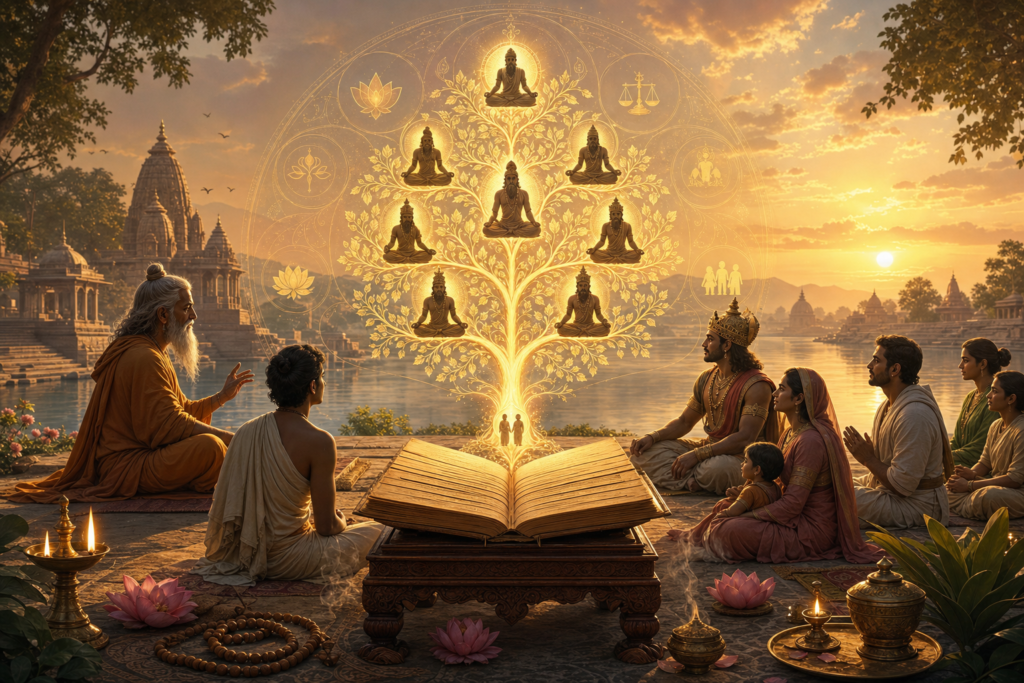
The very title Nyāyakusumāñjali, a handful of flowers of logic, signals this dual intent. The offering is poetic, yet each “flower” is a carefully constructed proof. Tradition often describes the work as organized into five thematic clusters (stabakas), each engaging objections from contemporary schools and crafting inferences that converge on the existence, knowledge, and governance of Īśvara.
Methodologically, the text exemplifies the Nyāya ideal that sound knowledge arises from reliable meanspratyakṣa, anumāna, upamāna, and śabda. Its inferential core deploys the five-member syllogism (pratijñā, hetu, udāharaṇa, upanaya, nigamana) underwritten by vyāpti ascertainment and tarka, ensuring that every step from sign to signified is publicly testable and philosophically transparent.
The central thesis is theistic but precise: atoms and universals supply a stable ontology, while Īśvara functions as the omniscient, compassionate efficient cause (nimitta-kāraṇa) who initiates, sustains, and regulates cosmic processessṛṣṭi, sthiti, and pralayawithout being the material substrate. In this framework, moral causality (adṛṣṭa or karma) requires intelligent coordination, not blind automatism.
Commentarial summaries often group Udayana’s reasoning into multiple, mutually supporting lines of proof. These include arguments from effect and design in nature, from the directed combination of inert atoms, from the world’s order and sustained regularities, from language and meaning, from the authority of trustworthy testimony and Veda, and from the coherence of moral causation across lifetimes.
The argument from effect proceeds from a familiar Nyāya maxim: every effect has an efficient cause. The world shows marks of effecthoodcomposite structure, novelty, and purposive arrangementtherefore, by parity with ordinary cases, an intelligent cause is posited. Īśvara is inferred not as an ad hoc postulate but as the best-explanatory hypothesis consistent with pramāṇa.
From the non-sentience of atoms, Udayana argues that initial combination and orderly assembly would be unintelligible without a directing agency. Appeals to a purely mechanical adṛṣṭa are judged insufficient because an unintelligent potency cannot fine-tune sequences of combination, dissolution, and re-combination across cosmological cycles with the precision the world exhibits.
Linguistic and semantic considerations add further weight. Stable correlations between words and meanings presuppose the institution of convention (saṅketa); the reliability of śabda as a pramāṇa, especially for supersensible matters, is anchored in an intentional, truthful source. Against the Mīmāṃsā claim of apauruṣeyatva, the Nyāya position attributes the Veda’s trustworthiness to Īśvara’s authorship without diminishing its sanctity or practical authority.
Ethical experience and the doctrine of karma provide another strand. Across lives, the proportional fruition of action suggests more than impersonal drift; it points to omniscient moral oversight that aligns consequences with deserts in a manner accessible neither to ordinary agents nor to unaided natural processes. Īśvara is thus posited as the guarantor of moral intelligibility and the stability of dharma.
In engaging Buddhist thought, especially kṣaṇikavāda and the critique of self, Udayana draws upon insights elaborated in Ātmatattvaviveka. Durable causal relations, memory, and deliberation indicate continuities not easily reducible to momentary streams; correlatively, the coordination required for karma to ripen is better explained given an enduring subject and a supervising Īśvara. The dialogue is exacting yet respectful, reflecting the dharmic ethos of shared pursuit of truth.
With Mīmāṃsā, the conversation turns on hermeneutics. Nyāya maintains that positing an omniscient Īśvara as author secures the Veda’s unity, purposiveness, and immunity from human defect, whereas impersonal eternity alone does not explain the Veda’s pedagogical precision. Even so, the exchange preserves a common commitment to dharma, ritual authority, and the primacy of śāstra in guiding life.
Beyond polemics, the devotional tenor is unmistakable. The very act of arranging arguments as a floral offering enacts the harmonization of head and heart: reasoning becomes worship, and worship disciplines reasoning. This integration resonates across Hindu bhakti, Buddhist compassion, Jain ahiṃsā, and Sikh devotion to the One, highlighting a dharmic convergence on ethical transformation.
Philosophically, Nyāyakusumāñjali models how pramāṇa-engineered humility operates. Perception, inference, and testimony are not rivals but collaborators; tarka serves as a therapeutic, clearing fallacies while guarding against overreach. The result is a theism that invites examination rather than demanding assent, suitable for intercultural and interfaith dialogue.
The text also consolidates insights from Vaiśeṣika ontology: categories such as dravya, guṇa, karma, sāmānya, viśeṣa, samavāya, and abhāva ground talk about objects, properties, motion, universals, particularity, inherence, and absence. Within this lattice, Īśvara’s governance is not a metaphysical add-on but the explanatory link that renders the system dynamically coherent.
In its afterlife, Nyāyakusumāñjali influenced the emergence of Navya-Nyāya, where thinkers such as Gaṅgeśa refined tools for analysis that would shape scholastic discourse well into the early modern era. Its theistic naturalismrooted in observation and inference yet open to transcendencebecame a touchstone for debates on mind, language, causality, ethics, and liberation.
Contemporary readers often find in the work a template for reconciling scientific curiosity with spiritual aspiration. In a plural society that values Unity in Diversity, its method demonstrates how traditions can reason together without erasing difference: Hindu, Buddhist, Jain, and Sikh voices can meet on the common ground of disciplined inquiry, shared ethics, and reverence for ultimate reality.
For students of Indian philosophy, Nyāyakusumāñjali offers both a rigorous course in logic and a compelling vision of devotional intelligence. For seekers, it shows how reasoned trust can deepen practice without compromising critical thought. And for a global academy, it presents a sophisticated philosophy of religion that broadens the conversation beyond familiar Western categories.
Taken as a whole, Udayana’s handful of flowers invites renewed confidence that the search for truth is most fruitful when analytical clarity and spiritual commitment support one another. That invitation, grounded in pramāṇa and open to dialogue, remains a vital resource for dharmic harmony today.
Inspired by this post on Hindu Blog.