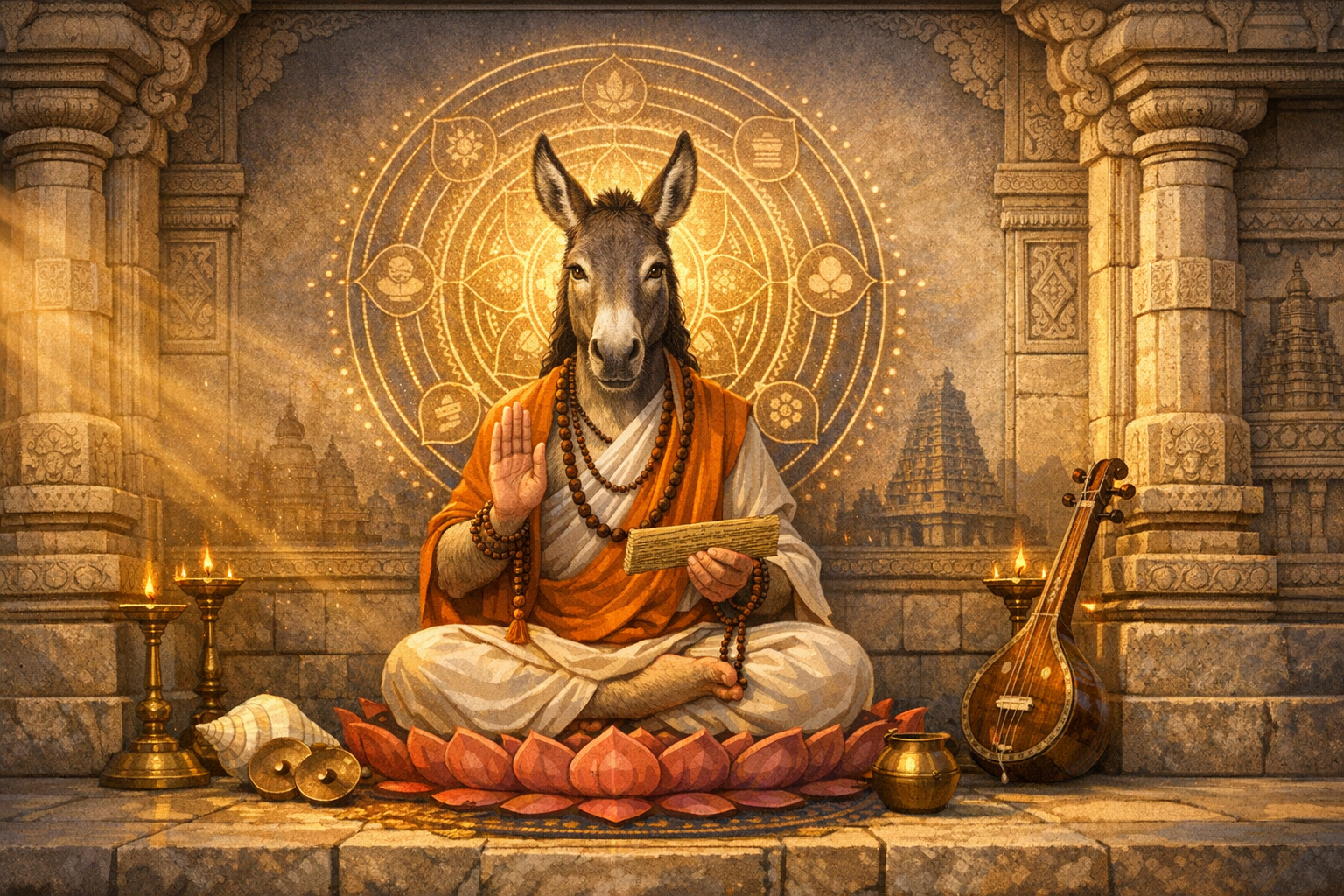
In Hindu sacred thought, the Vedas are not merely literature; they are śruti, the living vibration of apauruṣeya, timeless knowledge that emanates from Brahman. This understanding explains why ritual and visual traditions across India frequently treat the Vedas as animate presences, addressable, venerable, and capable of being installed, invoked, and even sculpted. Within this broader continuum of personification, Agamic and Tantric systems develop a striking iconographic vocabulary in which the Vedas sometimes appear as sages, teachers, or guardians of the sacred precinct. Among these forms, a rare but theologically resonant motif presents the Rig Veda as a gardabha-mukha, a donkey-faced sage, prompting careful reflection on how sacred knowledge is seen, heard, and embodied.
Personification of scripture has deep textual roots. The Brāhmaṇas and Purāṇas often speak of the Vedas as agents who praise, approach, and petition the deities, while the Upaniṣads interiorize those voices into the seeker’s own breath and awareness. Liturgically, the Vedas are invoked as Veda-puruṣa, the person of Veda, whose limbs are the six Vedāṅgas and whose heart is Vāc, the power of sacred speech. When sculpted within temple architecture, these personifications render visible a metaphysical truth: scripture is not a mute object but a living teacher whose form, attributes, and gestures convey the discipline, humility, and vision necessary to receive sacred knowledge.
Agamic iconography situates these figures within rigorous mūrti-lakṣaṇa, the canons that specify posture, mudrā, implements, and spatial placement. Śaiva Siddhānta Āgamas, Pāñcarātra traditions, and allied Śilpaśāstra manuals describe arrays of sages, knowledge-deities, and personified śāstras arrayed on gopura tiers, prākāras, mandapas, and shrine niches. In such sculptural programs, the four Vedas may appear as venerable teachers, each with distinctive attributes that allude to their sonic, ritual, and philosophical profiles. The donkey-faced Rig Veda is an uncommon subtheme within this field; it does not claim universality but emerges in specific regional or sectarian contexts to mark a particular hermeneutic emphasis.
Why a donkey-face for the Rig Veda? A first layer of meaning points to sound. The donkey’s harsh, unmistakable bray evokes primordial, unadorned phonationthe raw, truth-telling edge of voice. Rig Veda, a collection of ṛc, is bound to chandas, meter, and śikṣā, phonetics; its authority lies in correctly sounded syllables that cut through ambiguity. By rendering the Rig Veda with an emphatic muzzle and elongated jaw, sculptors foreground the mouth as the instrument of revelation, reminding practitioners that right sound, not mere sentiment, inaugurates right understanding.
A second layer is ascetic endurance. In agrarian life the donkey bears heavy loads with uncomplaining persistence. That image maps cleanly onto the sādhanā that sustains Vedic learningbrahmacarya, sustained svādhyāya, and ritual exactitude across years of daily practice. As a visual shorthand, the donkey-face commends the practitioner’s will to carry the weight of discipline, to walk the dusty road of repetition until recitation ripens into realization.
A third layer is hermeneutic humility. Donkeys are liminal animalsuseful, often overlooked, even deemed inauspicious in popular lore. Placing so unglamorous a visage on the embodiment of the Rig Veda confronts the viewer with a paradox: sacred knowledge is not about aesthetic polish or social prestige; it abides wherever sincerity, service, and steadfastness prevail. The motif thus invites a reading of the Veda that emphasizes compassion, ethical restraint, and accessible wisdom over elite display.
Within the Agamic framework, such personifications are not decorative flourishes but performative theology. Āgamas and Tantras understand temple space as a mandala of powers where forms instruct and empower. When a Veda appears as a sage, the image becomes an icon of pedagogyhands in abhaya or varada to bless, a pustaka to indicate living teaching, an akṣamālā to embody rhythmic study, or a kamaṇḍalu to suggest purity and restraint. Installed near gateways, on gopura bands, or along mandapa pilasters, these figures socialize devotees into a culture of listening, reciting, and ethical living.
Field surveys across South India show that medieval sculptural programs frequently include theriomorphic sages alongside r̥ṣis, siddhas, and śāstra-devatās. In some Tamil Nadu and Karnataka temples, arrays of personified knowledge figures present animal-faced teachers whose local sthala-purāṇas identify them with specific texts or disciplines. While documentation of a donkey-faced Rig Veda remains specialized and region-bound, informed guides and priests in certain shrines interpret such images explicitly as Veda mūrtis, reinforcing the performative link between sculpture, recitation, and ritual memory.
Ritually, personified Vedas are activated through Veda-pārāyaṇa, homa, and festival recitations that align bodily breath with sacred metrics. The presence of Veda icons near venues of chanting reinforces the acoustic ecology of the temple: resonance from cymbals and conches, drone from tanpura-like instruments, and the human voice moving through svara and syllable. In that soundscape, the donkey-faced sage ceases to be peculiar; it becomes a lucid sign that what matters first and last is śrutiwhat is heardand that the hearer must become worthy of the hearing.
There is value in placing this motif within a wider dharmic horizon. Across Buddhism, Jainism, and Sikhism, communities similarly personify or enthrone sacred knowledge. Mahāyāna traditions revere Prajñāpāramitā as the mother of wisdom; Tibetan monasteries ceremonially enthrone scriptures. Jain communities venerate Śruta-devī (often identified with Sarasvatī) as the embodiment of learning and the Jain Āgamas. Sikh tradition honors the Guru Granth Sahib as the living Guru, with prakāś and sukhasan rituals that mirror the care given a revered teacher. Seen together, these practices affirm a civilizational intuition shared across dharmic paths: wisdom is alive and relational, and images or enthronements are pedagogical bridges to that living presence.
Iconographically, the donkey-faced sage can be read alongside other animal-linked knowledge forms. Hayagrīva, the horse-headed embodiment of salvific knowledge in Vaiṣṇava traditions, emphasizes refined, swiftly delivered insight; Sarasvatī’s swan and peacock present discrimination and artistic flourishing; Kālī’s aspects and Śītalā’s donkey ride point to liminality, healing, and the fierce compassion that destabilizes complacency. The gardabha-mukha Veda thus fills an important niche: it affirms the austere, earthy labor by which subtle truth becomes anchored in a devotee’s life.
From a Śilpaśāstra perspective, theriomorphic features work as semiotic amplifiers. Muzzle and jaw accent the locus of śabda; ears may be sculpted large to encode attentive listening; the spine’s curve can hint at yogic steadiness; and the alignment with prākāra thresholds signals guardianship over the acoustic sanctity of the precinct. These are not arbitrary artistic liberties; they are exegetical strokes in stone, translating doctrinal and ritual insights into durable form.
Modern viewers sometimes stumble over this imagery, misreading it as eccentric or even demeaning. A more accurate reading recognizes its intellectual subtlety. By inverting expectations of beauty and prestige, the sculpture mentors a virtue-ethic: study that is patient, vocal discipline that is exact, humility that is steadfast, and compassion that is practical. For students of Vedic philosophy, such an icon proposes a daily disciplinerecite, listen, reflect, and liveuntil the coarse bray of the untrained voice matures into the measured cadence of mantra.
Historically, personifying texts aids cultural memory. Sculpted Vedas function as mnemonic anchors that help transmit liturgy, pedagogy, and ethics from one generation to the next. Where manuscripts decay and oral lineages waver, an image continues to teach silently, pointing devotees back to svādhyāya, the self-study that the tradition prizes. From this angle, the donkey-faced Rig Veda is an ethics of remembrance carved in stonean assurance that sacred learning remains available to all who are willing to work, listen, and serve.
Interpretive care is essential. Not every animal-faced sage on a temple wall is a Veda mūrti; local textual traditions, priestly explanations, inscriptions, and stylistic context must be weighed together. Likewise, not all regions deploy this motif; absence does not signal absence of respect for the Vedas, only a different iconographic grammar. The responsible approach balances philology, fieldwork, and living practice, allowing temples, texts, and communities to speak in their own voices.
Seen through the unifying lens of India’s dharmic family, the gardabha-mukha Rig Veda offers a constructive message: sacred knowledge is not a possession but a relationship. Whether venerated as Veda-puruṣa, Prajñāpāramitā, Śruta-devī, or the Guru Granth Sahib, the core conviction is sharedwisdom lives in sound, practice, and community. In that shared space, the donkey-faced sage is not an outlier but a teacher, reminding all seekers that humility, endurance, and careful listening are the bedrock of liberation-oriented learning.
In sum, the personification of the Rig Veda as a donkey-faced sage in Agamic iconography is a sophisticated visual theology of śabda, sādhanā, and service. It re-centers sound as the gateway to truth, dignifies the labor by which knowledge takes root, and calls communities to guard the sanctity of learning with compassion and care. Approached with that frame, the image enriches temple iconography, deepens ritual practice, and strengthens civilizational bonds across Hinduism, Buddhism, Jainism, and Sikhism.
Inspired by this post on Hindu Blog.