Within the ritual and textual universe of Hinduism, the terms Navagvas and Dāśagvas occupy a precise yet evocative niche tied to the lineage of Angiras, one of the celebrated Saptarishis (Seven Sages). These designations appear in early Vedic discourse around the Angirasasthe descendants and ritual communities associated with Angiraswhose disciplined sacrificial practice and hymnology helped define core features of Vedic religion. In this frame, Navagvas are linked with a nine‑month accomplishment in an extended sacrificial cycle, while Dāśagvas correspond to the analogous ten‑month attainment, both set against the ideal of a twelve‑month Sattrayāga (dvādaśa‑māsa‑sattra).
Philologically, the expressions Navagvāḥ and Dāśagvāḥ occur in the Rigveda, where they are associated with Angirasa groups and the mythic‑ritual complex that binds Indra, the Angirasas, and the release of the “cows” (go) from the cavern of Vala. Traditional exegesis, including that of Sāyaṇa, connects these names to the temporal architecture of long Soma rites, reading “nine” (nava) and “ten” (daśa) as markers of sustained ritual duration and achievement. This time‑conscious reading complements the broader Rigvedic narrative where well‑timed praise, precise liturgy, and collective ascetic focus catalyze success.
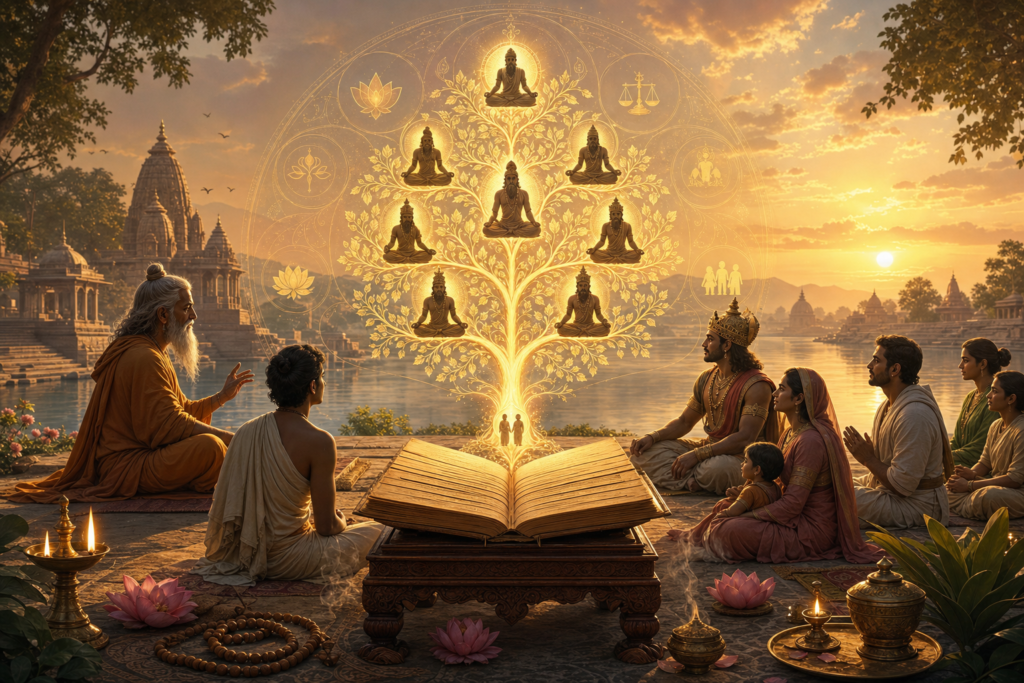
In the Vedic imagination, Angiras is simultaneously an archetypal sage, priestly prototype, and luminous discoverer of ritual forms. His descendants, the Angirasas, are credited with composing and transmitting hymns, serving as ritual specialists (notably in Hotṛ roles), and cooperating with Indra in liberating the cowsan image richly interpreted as the unveiling of light, wealth, or dawns. Against this mythic‑ritual backdrop, Navagvas and Dāśagvas signal differentiated cohorts or stages within Angirasa practice, especially where time‑regulation of sacrifice becomes a vehicle for efficacy.
Understanding the technical setting requires a brief sketch of Soma ritual typology. Vedic sacrifices are commonly classified as ekāha (single‑day), ahīna (2 to 12 days), and sattra (longer than 12 days, often months or a full year). A dvādaśa‑māsa‑sattratwelve months in scopeexemplifies the most exacting standard of communal ritual continuity. Within this frame, the Angirasas attached particular importance to steady sequence, daily savanas (morning, midday, evening Soma pressings), and the measured recitation cycles that ensured ritual coherence over seasons.
It is in relation to this ideal year‑long Sattrayāga that the names Navagvas and Dāśagvas are commonly explicated. When a ritual collective obtained the intended fruit (isṭa‑phala)whether conceived as prosperity, cosmic order (ṛta) alignment, or mythically the “release of the cows”in the ninth month of a sattra, the practitioners were acclaimed as Navagvas. When analogous fruition arose in the tenth month, the title shifted to Dāśagvas. The nomenclature thus encodes an index of temporal attainment within an otherwise twelve‑month sacrificial horizon.
Scholarly discussion, however, maps additional interpretive possibilities. One line of reading treats Navagvas and Dāśagvas not merely as timing labels but as numerical designations of Angirasa priestly cohortsnine‑member and ten‑member colleges that carried distinctive chant corpora or functions through the sattra. Another philological strand explores the -gva element in relation to go (cow), proposing archaic senses like “nine‑cowed” or “ten‑cowed” groups, though the duration‑based explanation rooted in ritual calendars remains influential in traditional commentary.
These terms also invite reflections on Vedic timekeeping. In early ritual astronomy, months (māsa) and their alignments with solar seasons and lunar phases shaped when rites were begun, intensified, or concluded. A nine‑month or ten‑month milestone might mark the ripening of a ritual sequence that tracks agricultural cycles, monsoon rhythms, or observational thresholds in the sacrificial year. While the canonical Vedic year is typically twelve months, a nine‑to‑ten‑month window readily functions as a symbolic culmination phasewhere communal resolve has matured and divine favor is thought to crystallize.
From a ritual‑technical perspective, the integrity of a sattra depends upon the sustained coordination of the four principal priestly roles (Hotṛ, Adhvaryu, Udgātṛ, Brahman), flawlessly timed chants, and correctly executed offerings. The Angirasas’ association with Navagvas and Dāśagvas can therefore be appreciated as a marker of ritual mastery under long‑duration constraintsa difficult achievement in any epoch. The precise mesh of speech (vāc), meter (chandas), melody (sāman), and action (kriyā) that such cycles demand amplifies the meaning of early attainment.
Symbolically, the numbers nine and ten also resonate with thresholds in Vedic hermeneutics: nine as a penultimate intensification before a cycle completes, and ten as a stabilization into fullness before the twelfth‑month consummation. These resonances do not collapse distinct observances into each other but draw attention to how number, time, and ritual agency interweave in Vedic thought. In a wider Hindu canvas, the disciplined arc from intention (saṅkalpa) to fruition (phala) remains a living spiritual grammar.
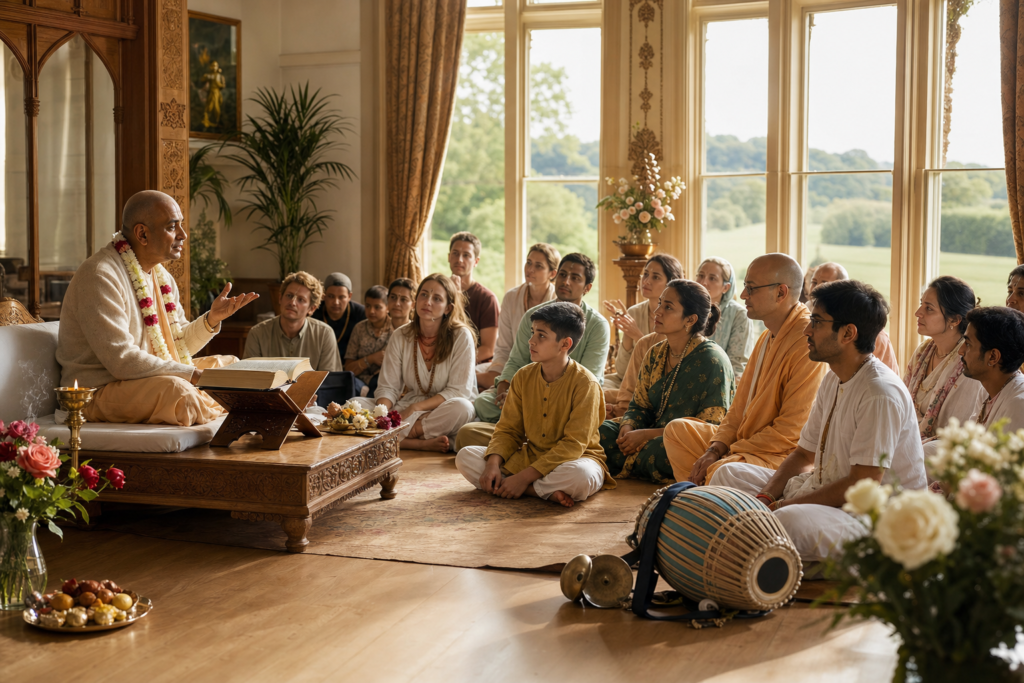
Socially, long sattras bind participants into compact ritual communities. Shared obligations, rotating functions, and the endurance of daily observances cultivate trust and coherence. The Navagva and Dāśagva identifiers consequently speak to more than calendrical bookkeeping; they memorialize how collective austerity and precision forge communal identity and transmit sacred expertise.
Viewed within the family of dharmic traditions, this disciplined, time‑bound striving for completion finds resonances beyond the Vedic altar. Hindu vrata cycles and Cāturmāsya observances, Buddhist Vassa (rains retreat), Jain Paryuṣaṇa, and extended Sikh recitational practices such as Akhand Pāṭh all elevate sustained, communal focus as a pathway to moral clarity and spiritual gain. These parallels highlight a unifying ethos across Hinduism, Buddhism, Jainism, and Sikhism: careful timekeeping, shared practice, and ethical restraint catalyze inner transformation and social harmony.
Modern Indology approaches the Navagva–Dāśagva complex through philology, ritual studies, and the history of religions. Some scholars lean toward the duration‑based decoding suggested by Sāyaṇa; others emphasize group designations, while a few explore astronomical and agrarian correlates. The evidence supports a layered reading: these terms are simultaneously ritual‑temporal markers, community identifiers, and mythic‑symbolic cues within the Rigvedic narrative of light’s release and order’s renewal.
For contemporary readers of Hindu scriptures seeking clarity amid interpretive plurality, the Navagvas and Dāśagvas offer a concrete lesson: when communal discipline aligns with well‑kept time and right intention, fruition may arrive even before a formal cycle completes. That insight, cherished in ancient India and meaningful today, animates the lived continuity of Hinduism’s Vedic heritage and strengthens kinship with cognate dharmic paths that honor measured practice and collective uplift.
In sum, Navagvas and Dāśagvas crystallize how Angirasa lineages integrated meticulous ritual design, symbolic number, and social cohesion to transform time into a medium of sacred efficacy. Their memory preserves a rigorous Vedic model of practice in which months are not merely counted but cultivatedwhere the steady blaze of shared effort illuminates the goal long before the calendar runs its course.
Inspired by this post on Hindu Blog.