Hanumath Kalyanamliterally, the sacred marriage of Hanumanraises a profound question for many: why would a nitya-brahmachari consent to wed? A careful reading of living Hindu traditions, temple narratives, and yogic exegesis suggests an answer that is at once historical, symbolic, and devotional.
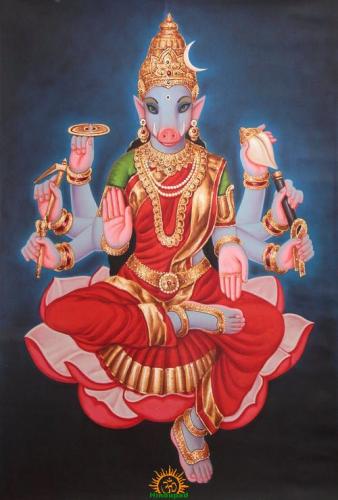
Borne of Surya Bhagavan’s radiance, Suvarchala is described as a personification of Varchas, the Sun’s unbearable luminosity that the world could not contain. In these narratives, Surya, seeking a guardian and an equal for this intense solar tejas, presents Suvarchala as a daughter whose very being is composed of light.
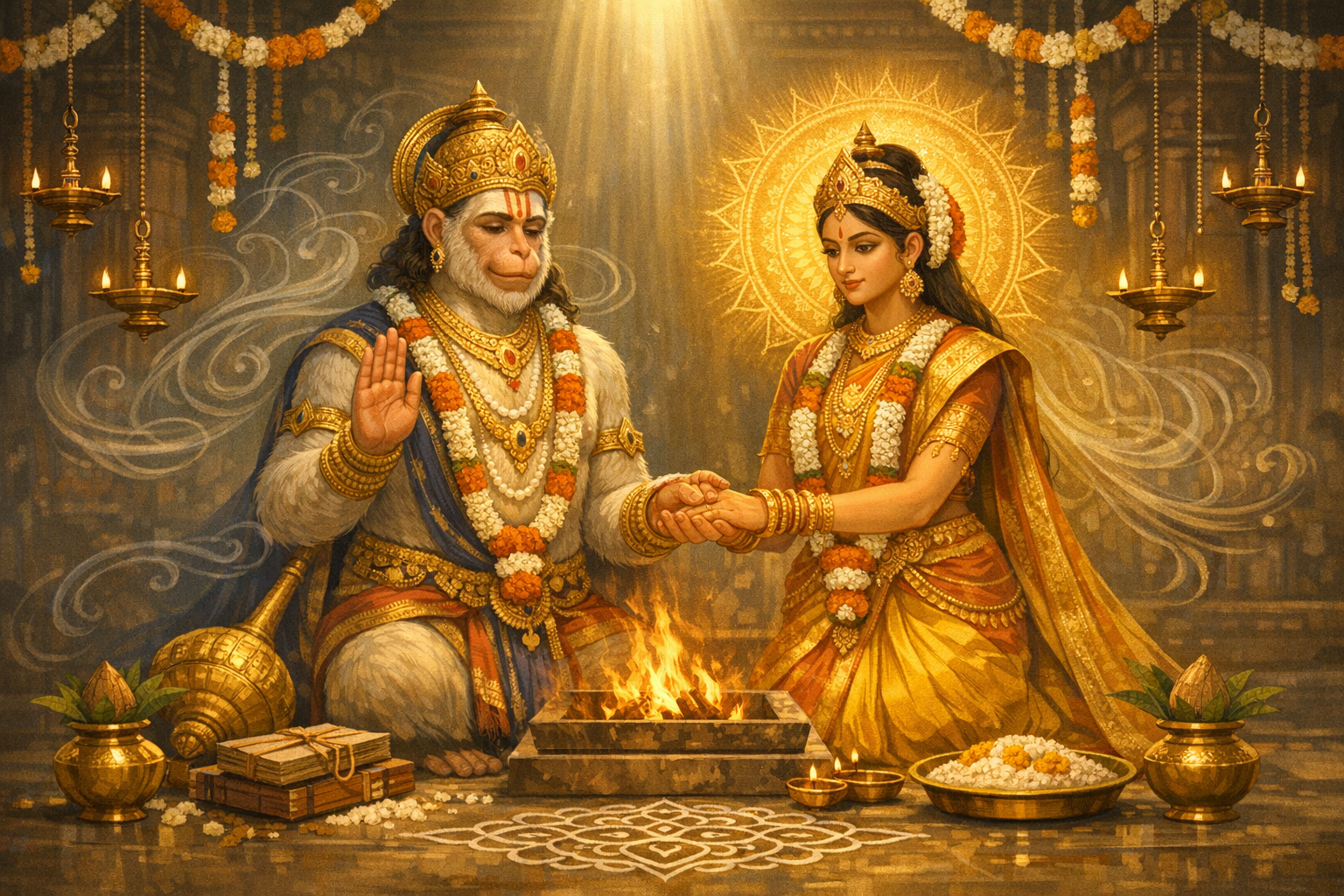
In parallel strands of lore, Hanuman completes Vedic studies under Surya Bhagavan, demonstrating extraordinary humility by facing the moving Sun throughout his lessons. Upon completion, when Guru Dakshina is sought, the request is framed not as a worldly demand but as a higher dharmic arrangement: the hand of Suvarchala, so that solar radiance and vāyu-borne prāṇa find resolute harmony in service of dharma.
Crucially, the tradition maintains Hanuman’s lifelong brahmacharya. The marriage is portrayed as a sacred commitment without conjugal pursuit, honoring his vow while sanctifying Suvarchala’s role as a protective, luminous shakti. In some tellings, the rite consists principally of pāṇigrahaṇa and mangalya-dhāraṇa performed for a cosmic purpose rather than for householdership, thereby reconciling brahmacharya with ritual obligation.
From a textual perspective, the pan-Indian canonical Valmiki Ramayana is silent about such a marriage, and many early Sanskrit narratives do not mention Suvarchala. The motif comes to the fore in later regional retellings, sthala-puranas, and temple katha traditions in South India, particularly in Telugu and Tamil devotional milieus, where Hanumath Kalyanam features in Harikatha repertoires and festival dramaturgy. This layered reception history exemplifies how Hindu narrative worlds accumulate meanings across time without displacing earlier strata.
Yogic hermeneutics gives the legend technical depth. Hanuman, identified with vāyu-tattva and the mastery of prāṇa, represents disciplined breath, steadiness, and service. Suvarchala, as the living embodiment of Surya’s tejas, aligns with the surya or pingala nadi, the energizing current of vitality and clarity. Their ritually affirmed union is thus read as an inner alchemy: radiance (tejas) stabilised by prāṇa within sushumna, a state associated with luminous awareness, courage, and unwavering devotion to Sri Rama.
Under this lens, Hanumath Kalyanam signifies integration rather than contradiction. The vow of brahmacharya is not diminished; it is contextualised as the containment and right-direction of power. Devotees often understand the narrative as a map for ethical energy management: knowledge from the guru (Surya), disciplined vitality (Hanuman), and protective luminosity (Suvarchala) converging to support seva, fearlessness, and clarity in action.
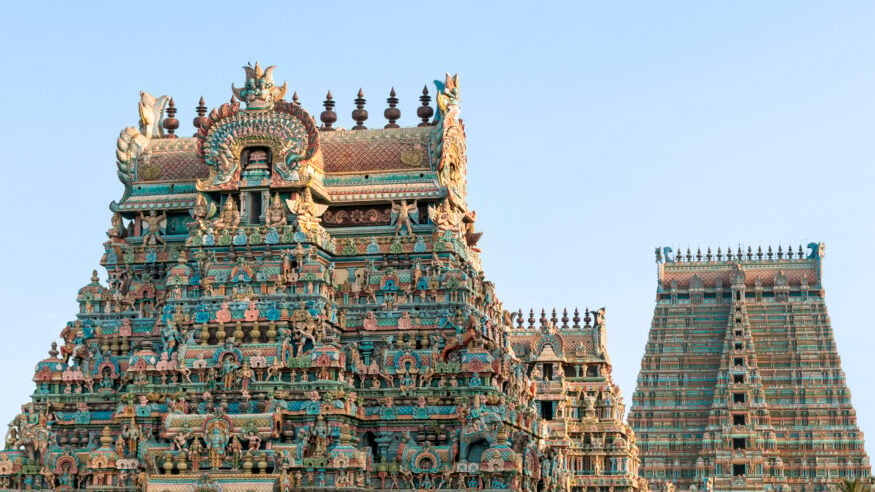
In living practice, Hanumath Kalyanam is observed in numerous Anjaneya temples across Andhra Pradesh and Telangana, and in select shrines elsewhere. The kalyanam is especially prominent at the conclusion of Hanuman Deeksha, when devotees complete their vrata and symbolically witness the marriage to internalize its blessings of strength, restraint, and radiance. While liturgical sequences vary, they commonly include ankurarpana, edurukolu, kanyadanam, pāṇigrahaṇa, mangalya-dhāraṇa, talambralu, and blessings drawn from Suryopasana and Hanuman stotras.
Iconographically, some temples venerate Suvarchala-sameta Anjaneya, in which Hanuman’s fearless posture (abhaya) is complemented by a quiet, solar luminosity attributed to Suvarchala. Though not universal, such icons reinforce the interpretive balance between austerity and grace, valor and wisdom, prāṇa and tejas.
For historical clarity, it is important to distinguish textual silence from theological impossibility. Hindu traditions routinely accommodate multiple horizons of truth: the śruti-smriti-itihasa-purana continuum, regional sthala-purana evolutions, and pastoral narratives sustained by festivals and kirtana. That Valmiki omits a detail does not foreclose its later sacred reception; rather, it marks a baseline from which communities elaborate meanings suited to evolving spiritual needs.
Seen in a comparative dharmic frame, the legend’s resolution of vows and roles resonates beyond Hinduism. Buddhism upholds both renunciate and householder paths, Jainism treats brahmacharya as a supreme vrata often balanced by responsibilities before formal renunciation, and Sikh tradition elevates the grihastha ideal while insisting on spiritual discipline and seva. Hanumath Kalyanam symbolically honors this shared dharmic insight: different life stations can realize the same ethical and spiritual ends when vows are upheld with integrity.
Devotees frequently seek the kalyanam’s blessings for resilience, mental clarity, and right use of power. In personal terms, many testify that contemplating Hanuman’s unwavering celibacy alongside his sacred marriage reframes difficult modern tensions between ambition and restraint, work and worship, responsibility and renunciation. The narrative becomes a mirror for equanimity, urging disciplined service without burnout and vigor without aggression.
Common questions arise in this connection. Did Hanuman have offspring? Tradition answers in the negative; the brahmacharya vow remains intact in these tellings. Is the marriage historical or symbolic? Communities answer both ways, often treating the event as ritually real and theologically emblematic. Does it conflict with Rama-bhakti? On the contrary, the union is said to amplify Hanuman’s capacity to serve Sri Rama with even greater radiance and steadiness.
Ultimately, Hanumath Kalyanam is a living synthesis: a South Indian devotional flowering rooted in the pan-Indian figure of Hanuman, enriched by Vedic and yogic ideas about prāṇa and tejas, and animated by ritual life in temples and households. It invites a unifying attitude across dharmic traditions and within one’s own inner practice, integrating courage with compassion, light with breath, and scholarship with devotion.
By engaging this legend with academic care and devotional sensitivity, readers encounter not a contradiction but a pedagogy. The marriage to Suvarchala articulates an ethics of containment: immense capability concentrically bound by vows, luminous power put to work for the wellbeing of all, and knowledge oriented to service. In that light, the question of why Lord Hanuman married Suvarchala yields a distinctly dharmic answer: to yoke radiance and strength under the sovereignty of dharma.
Inspired by this post on Hindu Pad.